

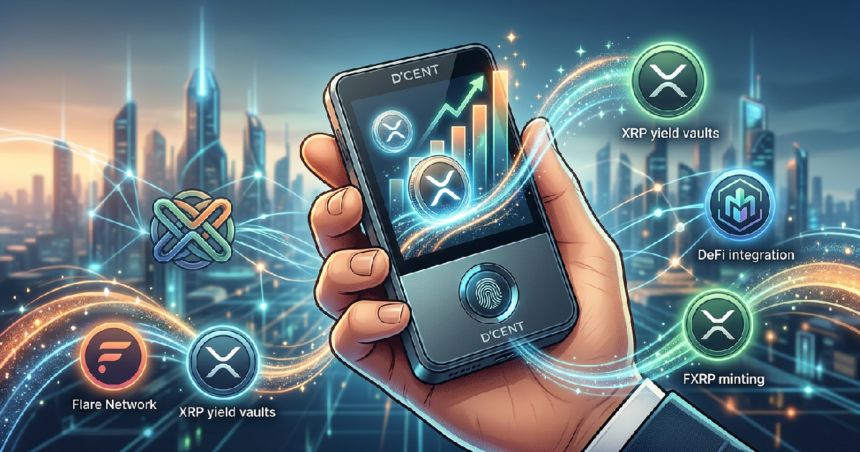
The XRP Alliance launched on May 19, 2026, creating a direct link between D’CENT Wallet’s estimated 720,000 users and decentralized finance (DeFi) yield vaults. This coalition, convened by D’CENT alongside Flare, Doppler, Banxa, and Squid, aims to expand the role of XRP in the DeFi sector. Through the use of Flare Smart Accounts, holders can now access yield-bearing opportunities without the need for a new blockchain, a separate wallet, or a traditional gas token.
The integration represents a significant technical milestone for the XRP ecosystem. D’CENT, a biometric hardware wallet provider trusted by the community since 2018, serves a global user base across the U.S., UK, Canada, Japan, and South Korea. According to alliance data, D’CENT users protect billions of XRP on their hardware devices. This new partnership allows these participants to put their assets to work while maintaining the security of their cold storage hardware.
Hugo Philion, co-founder of Flare, noted that the system allows users to “earn on their XRP without moving it off the device they already trust.” This development arrives as XRP momentum restarts following a period of increased institutional activity. In April 2026, XRP ETF products recorded $81.63 million in net inflows, marking the most successful month of the year for those products.
Non-custodial architecture powers XRP yield access
The alliance utilizes a “two-signature” process on the XRP Ledger (XRPL) to ensure the system remains fully non-custodial. The first signature reserves collateral on the Flare Network and identifies the user’s chosen vault. The second signature sends the XRP to a Core Vault on the XRPL. This triggers the automatic minting of FXRP—Flare’s representation of XRP—and completes the deposit into the yield vault in a single process.
This streamlined workflow removes the traditional friction of managing multiple tokens for transaction fees. The XRP Alliance is designed to increase distribution and interoperability, allowing users to interact with smart contracts while their private keys remain secured by D’CENT’s biometric layer. This focus on simplifying the entry into decentralized finance follows successful pilots with the Xaman wallet, which saw over 5,400 participants, many of whom were first-time DeFi users.
Broader market changes are forcing many developers to reconsider how they offer returns, especially given that the New Clarity Act blocks interest payments on stablecoins in some jurisdictions. By focusing on asset-backed yield through FXRP, the alliance provides an alternative for holders seeking productive use of their digital assets.
Vault availability and promotional fee incentives
At launch, two primary vaults are available to D’CENT users. The Monarq XRP Yield Vault (MXRPY), developed with vault infrastructure provider Upshift, targets an annual return of 3% to 4%. This vault utilizes institutional-grade strategies such as basis arbitrage and options trading. Monarq has established an initial deposit cap of 500,000 FXRP for this specific product.
A second option, the Clearstar earnXRP vault, focuses on providing on-chain yield. Additionally, Doppler provides institutional-grade custody and vaults for staking rewards on both XRP and RLUSD. To encourage early adoption, D’CENT is offering a 0% platform fee for a limited promotional window. Between May 19 and June 8, 2026, users will only be responsible for the standard base fees required by the Flare Network.
The appetite for these types of products has been demonstrated by recent performance in the Flare ecosystem. A separate Flare XRPFi vault recently hit its deposit cap of 25 million XRP, valued at approximately $33.9 million, within only one week of its launch. That vault offered a 3.4% APY, illustrating the speed at which the community is moving toward yield-focused products.
Institutional infrastructure and global on-ramps
The XRP Alliance is supported by a network of providers designed to facilitate cross-chain movement and liquidity. Banxa acts as a fiat on-ramp, allowing users in over 180 countries to purchase XRP using bank transfers or cash. Once assets are in the ecosystem, Squid provides the necessary cross-chain swaps to move XRP or RLUSD effectively across different blockchain environments.
Flare serves as the programmable layer that makes these complex interactions possible. Earlier in 2026, Flare expanded its modular lending capabilities through partnerships with Morpho and Mystic, which helped establish the underlying vault infrastructure used today. These developments are part of a broader shift that analysts suggest signals a shift toward functional utility as the primary driver of value for major digital assets.
As the alliance moves forward, the focus remains on maintaining the security and non-custodial nature of the platform. Unlike many custodial yield services of the past, this integration requires no intermediary to take possession of the user’s funds. The success of the May 19 launch will likely set the stage for further vault expansions and increased deposit limits across the coalition’s suite of DeFi products.