

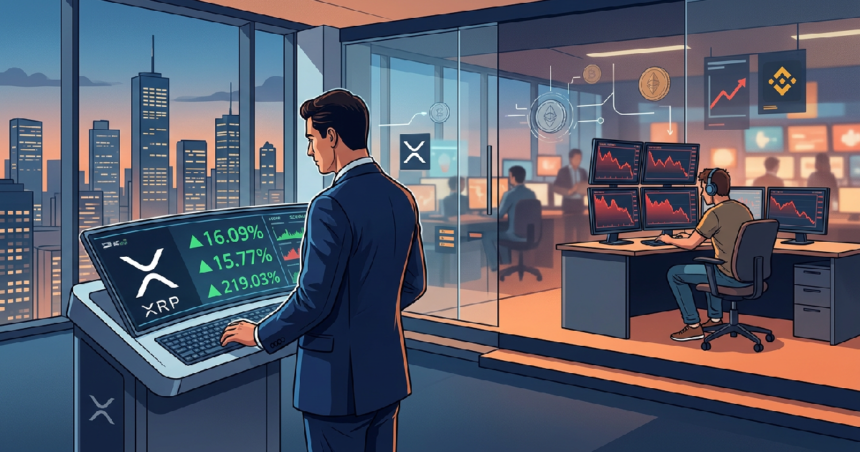
Institutional interest in digital assets has created a sharp divide in the market as professional firms reportedly increase their XRP holdings while retail traders on the Binance exchange continue to build short positions against the token. Market observations indicate a widening gap between professional accumulation and speculative retail sentiment, suggesting that large-scale investors are betting on long-term regulatory clarity while smaller traders anticipate near-term price fatigue. This divergence comes during a period of broader market uncertainty, where traditional financial players are looking for assets with established payment utility.
The trend highlights a shift in how different classes of investors perceive the risk-reward profile of the cross-border payment token. While Binance remains a hub for high-leverage retail speculation, the influx of capital from institutional desks indicates that the professional sector is no longer deterred by previous legal hurdles. This institutional “bid” appears to be providing a floor for the asset even as bearish sentiment persists among high-volume day traders on global platforms.
Institutional Accumulation vs Retail Shorting Patterns
Large-scale buyers, often referred to as “whales” or institutional custodians, have been quietly absorbing supply over recent months. Financial institutions are reportedly viewing the token as a core component of future liquidity corridors, specifically for institutional settlement. This professional interest stands in stark contrast to the activity on the Binance exchange, where funding rates and long-short ratios have recently indicated a bias toward betting on a price decline.
Retail traders often focus on technical indicators that suggest overbought conditions, leading them to open short positions. But when Wall Street enters the fray with deep pockets, these technical signals can often be overridden by sustained buying pressure. This setup frequently leads to a “short squeeze,” where those betting against the asset are forced to buy back their positions at higher prices, further fueling an upward move. This is particularly relevant as XRP momentum restarts amid a new liquidity surge, catching many speculative traders off guard.
The Role of Regulatory Clarity in Professional Direct Investment
Wall Street’s appetite is largely driven by the perceived end of legal ambiguity in the United States. Unlike many other digital assets that still face scrutiny regarding their classification, the legal framework surrounding payment tokens has become clearer for compliance-heavy firms. This has allowed traditional hedge funds and family offices to include the asset in their portfolios without the fear of sudden enforcement actions.
And then there is the move by major banks to integrate blockchain technology into their existing infrastructure, which has validated the use case for fast settlement. While retail traders on Binance remain focused on the “altcoin” volatility of the week, institutional desks are increasingly focused on much longer time horizons. Long-term projections for XRP value by 2030 suggest that professional investors are willing to endure short-term fluctuations for a stake in what they believe will be a global standard for value transfer.
Market Sentiment Divergence and Liquidity Dynamics
The disparity in sentiment is also a reflection of where the capital is coming from. Wall Street capital is typically “sticky,” meaning it is held for longer periods and is less sensitive to daily price swings. In contrast, the liquidity on Binance is often driven by leverage, where even a slight move against a position can trigger liquidations. This creates a volatile environment where retail bears are fighting against an institutional wall of money.
The broader cryptocurrency market has been experiencing mixed signals lately. While some assets struggle with overhead resistance, the focused accumulation by established financial entities provides a unique dynamic for this specific token. This decoupling from standard retail-driven trends is a hallmark of a maturing market, where institutional utility begins to outweigh speculative fervor. Even as the digital asset utility window shifts in 2026, the focus remains on which protocols can survive the transition from hype to actual usage.
Future Implications for Global Payment Infrastructure
As Wall Street continues to scoop up available supply, the amount of liquid tokens available for retail trading on exchanges could potentially shrink. This “supply shock” is a scenario that many institutional analysts are monitoring closely. If the betting on Binance continues to remain bearish while supply is moved into cold storage by American firms, the eventual resolution of this tension could be significant.
The coming months will likely determine whether the retail “wisdom of the crowd” or the Wall Street “smart money” was correct in its assessment. For now, the data shows a clear preference: retail is looking for a way out, while the institutional world is looking for a way in. For more information on the legal standards governing these assets, investors often look to the official statements from the Commodity Futures Trading Commission regarding market oversight.