

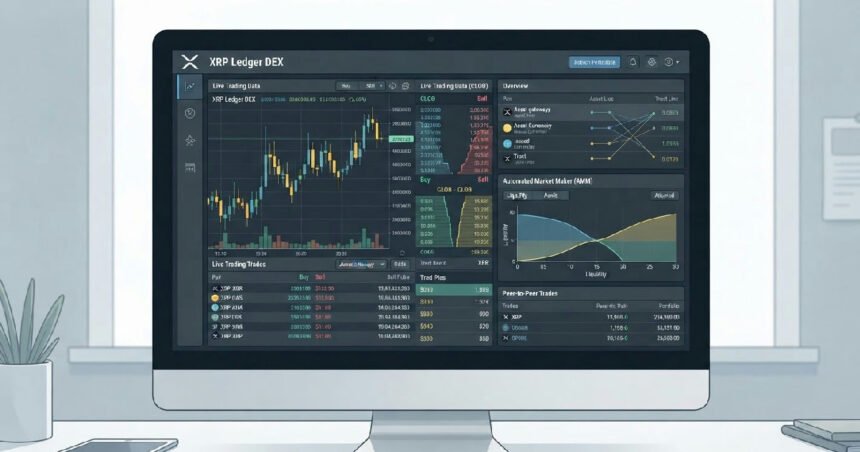
The XRP Ledger (XRPL) hosts a native Decentralized Exchange (DEX), a robust platform enabling direct, peer-to-peer asset trading without reliance on central intermediaries. Launched in 2012, this built-in exchange stands as one of the crypto market’s longest-running decentralized trading venues.
Its architecture ensures users maintain full control over their assets, fostering a non-custodial environment. This approach removes the need for traditional financial institutions in transactions, streamlining the trading process significantly.
Understanding the XRP Ledger DEX
At its core, the XRPL is an open-source, public, and decentralized Layer 1 blockchain. It’s engineered for rapid, low-cost payments and the tokenization of assets, leveraging a Federated Consensus mechanism for efficiency.
A Decentralized Exchange (DEX) on a blockchain facilitates direct asset swaps between users. This P2P trading model is distinct because it bypasses centralized entities. Users conduct transactions directly with each other, enhancing security and autonomy.
Key Components of XRPL DEX
Beyond XRP itself, the Ledger supports “Issued Currencies” (IOUs), which are tokens representing assets like fiat currencies or real-world assets. These IOUs are issued by specific accounts, requiring users to establish “trust lines” to hold and trade them.
Trust lines create a connection between accounts, defining the maximum amount of an IOU an account is willing to accept from an issuer. This mechanism prevents unwanted tokens and requires a small 0.2 XRP owner reserve, which locks until the trust line is removed.
XRP, the native digital asset, serves multiple functions; it covers transaction fees, funds account reserves, and acts as a vital bridge currency for cross-currency payments and trades on the DEX.
How Trading Works on the XRPL DEX
The XRPL DEX combines a Central Limit Order Book (CLOB) model with more recent innovations. Like traditional stock exchanges, the CLOB ranks buy and sell orders by price and time, forming the backbone of its trading functionality.
In March 2024, Automated Market Makers (AMMs) were integrated to complement the CLOB. This dual-system approach is designed to enhance liquidity and offer traders more efficient execution paths. It represents a significant evolution in the DEX’s capabilities.
Order Matching and Liquidity
Users initiate trades by placing “Offers,” which are essentially limit orders to exchange one asset for another at a specified rate. These offers can involve XRP or any issued tokenized asset.
The ledger’s powerful matching engine automatically processes these orders, consuming matching offers at the best available rates. If an offer isn’t fully filled instantly, its remainder becomes a passive object, awaiting future matches. The XRPL employs a shuffle algorithm, deterministically pseudo-randomly ordering transactions, which helps to mitigate front-running.
Liquidity on the DEX originates from assets held by willing traders, contributing to the CLOB via limit orders. For decentralized exchange liquidity, AMMs allow users to deposit equivalent values of two tokens into a pool. These liquidity providers (LPs) then earn a share of trading fees, with the XRPL’s AMM design incorporating a Continuous Auction Mechanism to reduce impermanent loss.
Seamless Interoperability and Pathfinding
The XRPL protocol intelligently routes trades across both the AMM and the CLOB simultaneously. It consistently selects the combination that provides the optimal rate for the user, ensuring efficient trade execution.
One of the DEX’s standout features is its unique ability to automatically find the most efficient trading path between any two assets. This “pathfinding” capability functions even if a direct market pair does not exist. Altcoin strategies often leverage this.
Often, XRP acts as an intermediary “bridge currency” to connect disparate order books. This “auto-bridging” optimizes costs and provides implicit liquidity for virtually every trading pair. This mechanism enables complex cross-currency payments that settle atomically within seconds.
Technical Specifications and Network Mechanics
Operating the XRPL involves several key technical parameters that underscore its efficiency and security. Transaction fees are minimal, typically 0.00001 XRP, which is burned with each transaction. This deflationary mechanism scales with network load, deterring spam attacks.
Each XRPL account requires a base reserve of 1 XRP to remain active. Furthermore, every trust line established incurs an owner reserve of 0.2 XRP, which is locked for the duration the trust line exists. These reserves ensure network stability and prevent malicious activity.
The ledger closes every 3 to 5 seconds, resulting in rapid transaction finality. This swift settlement time is crucial for high-frequency trading and cross-border payments. The XRPL also boasts a significant transaction throughput, capable of processing over 1,500 transactions per second (TPS), far exceeding many legacy financial systems.
The total supply of XRP is fixed at 100 billion, with no additional coins ever created. This finite supply, combined with the burning of transaction fees, contributes to XRP’s deflationary economic model. Such characteristics are fundamental to the XRPL’s design as a fast, reliable, and secure payment network.
Dispelling Common Misconceptions
A frequent misunderstanding in the crypto community is the belief that XRP, the native asset of the XRPL, can be “frozen.” However, XRP itself, as the foundational currency of the Ledger, is immutable and cannot be frozen by any entity.
It’s crucial to differentiate this from Issued Currencies (IOUs), which are tokens issued by specific gateways on the XRPL. These IOUs *can* be frozen by their respective issuers if those issuers choose to implement such a feature. This distinction is vital for understanding asset control on the Ledger.
Similarly, the XRPL’s trust line mechanism effectively prevents accounts from receiving unsolicited tokens, commonly referred to as “spam” tokens. Explicit consent via a trust line is required to hold any asset other than XRP, providing users with control over their digital holdings.
Institutional Adoption with Permissioned DEXes
A recent and significant development on the XRPL is the introduction of Permissioned DEXes. These are controlled trading environments within the broader decentralized exchange, designed specifically for institutional participants. They utilize “Credentials” and “Permissioned Domains” to manage access.
The primary purpose of Permissioned DEXes is to address regulatory compliance barriers, such as Know Your Customer (KYC) and Anti-Money Laundering (AML) requirements. This feature allows regulated institutions to engage in institutional trading while adhering to necessary legal frameworks. It represents a strategic move to broaden institutional involvement in the XRPL ecosystem by addressing compliance barriers.