

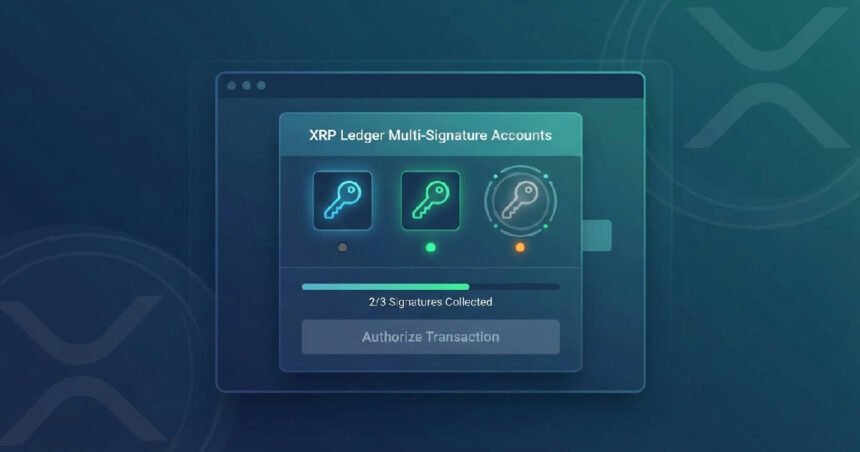
XRP Ledger Multi-Signature accounts provide a robust security framework that demands multiple cryptographic signatures to authorize transactions, fundamentally shifting control away from a single point of failure. This native protocol integration offers a distinct advantage in safeguarding digital assets on the XRP Ledger (XRPL).
Unlike many blockchain implementations that rely on smart contracts for multi-signature functionality, the XRPL’s approach is built directly into its core protocol. This design significantly mitigates smart contract risks, offering a more secure and reliable method for managing funds.
Understanding XRP Ledger Multi-Signature Accounts
Multi-signature (MultiSig) on the XRP Ledger is a security mechanism requiring more than one private key to approve a cryptocurrency transaction. It operates as a digital vault, where multiple keys are necessary to access and move funds, ensuring enhanced security.
The XRP Ledger itself is a decentralized, public blockchain specifically engineered for swift and cost-effective transactions, primarily for its native digital asset, XRP. It leverages a unique consensus algorithm, distinguishing it from traditional proof-of-work or proof-of-stake systems.
An account on the XRPL represents an address capable of holding XRP and other assets, from which all transactions originate. Each transaction must be cryptographically signed by the account owner to validate its authenticity.
At the heart of XRPL’s MultiSig is the Signer List, which defines a set of authorized addresses permitted to sign transactions for a specific account. This list meticulously details each individual signer and assigns them a “weight,” indicating their influence in the approval process.
A signer’s weight reflects their authority, with higher values denoting greater control. While individual weight values are capped at 2^16 – 1, the collective impact dictates transaction approval. The quorum, then, is the minimum total weight from the signers required to authorize a transaction.
This quorum must be greater than zero but cannot exceed the combined weight of all signers, ensuring transactions remain achievable while maintaining distributed control. Every transaction, whether a payment or an account setting modification, alters the state of the XRP Ledger and requires this stringent authorization.
Enhancing Digital Asset Security and Control
Multi-signature accounts on the XRPL offer several critical advantages for securing and controlling digital assets. They eliminate the single point of failure inherent in single-key accounts, meaning a compromise of one signer’s private key won’t automatically lead to unauthorized transactions; the required quorum still needs to be met by other signers.
This distributed control is particularly valuable for businesses, joint ventures, and organizational treasuries, as it prevents any single individual from independently initiating transactions. It effectively guards against internal threats, ensuring a single malicious actor cannot move assets without the approval of other team members.
Ripple engineer Mayukha Vadari underscored the security benefits of this native implementation. Vadari highlighted that because multi-signing is “baked directly into the protocol and not patched together through 3rd-party smart contracts,” the attack vector associated with smart contract vulnerabilities simply doesn’t exist for XRPL accounts. This contrasts sharply with some other blockchain implementations, providing a significant edge in network defense strategies.
Furthermore, MultiSig accounts provide enhanced backup options. Should a key be lost, funds remain recoverable as long as the remaining keys can still collectively meet the defined quorum threshold. This built-in resilience is vital for long-term digital asset management.
How Multi-Signing Works on the XRP Ledger
Implementing multi-signature on the XRP Ledger begins with configuring a standard XRPL account for multi-signing. This process involves creating a SignerList object directly on the ledger, associating it with the designated account.
The SignerList is crucial for defining the operational parameters. It includes up to 32 authorized addresses that can sign transactions for the account, a limit increased from 8 by the ExpandedSignerList amendment. Each signer in this list is assigned a specific weight, reflecting their individual authority, while also preventing duplicate entries or the account’s own address from being listed.
Crucially, the SignerQuorum value is set, establishing the minimum cumulative weight from these signers required to authorize any transaction. As XRP price movements often hinge on such underlying infrastructure, this security feature provides stability.
When a transaction needs to be executed from the multi-signature account, it is meticulously prepared, incorporating an empty SigningPubKey field and an array of signatures within a Signers field. The next step involves collecting signatures.
The required number of authorized signers, whose combined weights meet or exceed the set quorum, must cryptographically sign the prepared transaction using their respective private keys. Once these necessary signatures are collected, they are combined and submitted to the XRP Ledger.
The ledger then validates that the combined weights of the signatures meet the account’s configured quorum. If the quorum is met and the signatures are verified as valid, the transaction is executed on the XRP Ledger, finalizing the asset movement or account modification.
Addressing Common Misconceptions
A frequent misconception is that multi-signature on the XRPL operates like other blockchains, relying on complex smart contracts for its functionality. The reality is quite different: XRPL’s multi-signing is a native feature, directly integrated into the protocol itself. This foundational difference eliminates the smart contract risks prevalent in other implementations, which often use third-party smart contracts for multisig, creating potential vulnerabilities.
This native implementation of multi-signing was launched in June 2016, establishing it as a core component of the ledger’s architecture from an early stage. Another common misunderstanding relates to the coordination of multi-signature transactions.
While the XRPL supports multi-signature transactions, the actual coordination and collection of individual signatures often occur off-chain. This means external communication channels and centralized coordinators are currently involved. A proposed upgrade, “On-Chain Cosigner,” aims to address this by allowing signers to coordinate and collect approvals directly on the XRPL.
This “On-Chain Cosigner” proposal seeks to resolve the “last mile” problem, where the signing process could falter if an off-chain coordinator loses collected signatures or goes offline. Such advancements continue to shape how digital currencies reshape industries and financial operations.
The Future of XRPL Security
The ongoing development and native integration of multi-signature features underscore Ripple’s and the XRPL Foundation’s commitment to robust security. By continuously refining these core protocols, the XRP Ledger aims to remain a resilient platform for digital asset transactions.
The evolution from off-chain coordination to potential on-chain solutions reflects a broader trend towards greater decentralization and self-custody in the cryptocurrency ecosystem. This focus on protocol-level security provides a strong foundation for future applications and broader adoption.
Ultimately, XRPL Multi-Signature accounts are poised to play an increasingly vital role in institutional and individual asset management, providing a dependable and secure infrastructure for the evolving digital economy.