

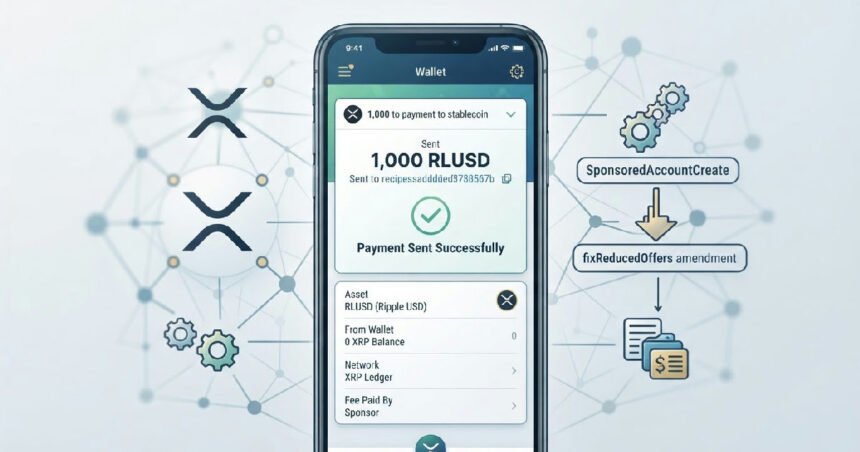
A key proposal from XRP Ledger (XRPL) developers could soon remove a long-standing barrier to entry for new users, specifically targeting the burgeoning world of stablecoin payments. The plan, first formally proposed on October 24, 2024, introduces a method for creating new wallets on the ledger without first needing to fund them with XRP, the network’s native digital asset.
This change, if approved, would allow payment companies and other businesses to onboard users directly with stablecoins, such as Ripple’s own RLUSD. It addresses a critical friction point in the user experience and could significantly enhance the XRPL’s competitiveness as a hub for reliable, low-cost digital payments.
Eliminating the initial xrp reserve requirement for XRP Ledger stablecoin payments
At the heart of the proposal is the removal of the mandatory minimum reserve. Currently, every new wallet on the XRP Ledger must be activated with a small deposit of 1 XRP. While this reserve is modest for a single user, it serves a crucial function: preventing network spam and the creation of millions of abandoned “dust accounts” that would bloat the ledger.
However, this requirement creates a logistical hurdle for businesses aiming to onboard thousands or even millions of users for a stablecoin-based application. A company deploying 100,000 user wallets, for example, would need to acquire and set aside 100,000 XRP just to get started.
This upfront cost and operational step can deter developers and slow down adoption, especially for users who have no intention of ever holding or trading XRP itself.
The new proposal, detailed in a code submission for a transaction called SponsoredAccountCreate, would allow a third party—such as a payment application provider—to sponsor a new account.
This sponsor would cover the reserve requirement on behalf of the user, enabling the new wallet to hold a zero XRP balance while still being fully functional for sending and receiving other tokens. The integrity of the network’s anti-spam mechanism is preserved, but the financial burden is shifted from the end-user to the sponsoring institution.
How sponsored accounts and limited functionality would work
The technical foundation for this change is an amendment dubbed “fixReducedOffers,” which would establish a new type of account with specific limitations. These “Limited Accounts” are designed explicitly for holding tokenized assets like stablecoins and other fungible tokens, but not XRP.
While they could freely send and receive these assets, they would be barred from interacting with the XRP Ledger’s integrated DEX for trading the native currency.
This specialized design ensures that the accounts serve their intended purpose—facilitating stablecoin payments—without gaining full access to features they don’t need. It’s a tailored solution that acknowledges the diverse use cases emerging on the ledger. For users, it means a simpler onboarding process where they can receive a stablecoin payment without first having to navigate an exchange to buy XRP.
This proposal is part of a broader push for a “Sponsored Fees and Reserves” standard on the XRPL. This wider feature would also allow a sponsor to cover a user’s network transaction fees.
Combined, these changes would empower companies to offer a completely seamless experience where customers can use stablecoins on the ledger without ever needing to worry about the underlying network mechanics or its native asset.
The strategic push for mainstream stablecoin use
This development effort doesn’t exist in a vacuum. It directly supports Ripple’s strategic initiatives, including a recent partnership with the Stripe-owned wallet platform Privy. That collaboration aims to bring embedded wallets to XRPL applications, simplifying the integration process for developers and making blockchain-based payments invisible to the end-user. The ability to create zero-XRP wallets is a critical component for making such integrations truly effortless.
Furthermore, the proposal aligns with the increasing global focus on digital assets for payments. As financial regulators worldwide begin to establish frameworks for digital currencies, the demand for efficient and compliant payment networks is growing. A recent Canadian stablecoin rule consultation highlights the move by governments to create clear guidelines, paving the way for wider mainstream adoption.
By removing a key technical barrier, the XRP Ledger positions itself to capture a larger share of this expanding market. It enters a competitive field where networks are judged on their speed, cost, and ease of use. Removing the need for users to acquire a specific native asset just to receive a dollar-pegged stablecoin is a significant competitive advantage.
Hurdles on the path to activation
Despite the clear benefits, the proposal is not yet a done deal. The XRPL operates on a consensus mechanism where trusted validators must vote to approve any changes to the network’s code. The SponsoredAccountCreate feature is dependent on the broader sponsorship amendment activating on the mainnet, which requires a sustained supermajority of support from these validators.
As of late October 2026, progress has been slow. The sponsorship amendment had secured only 11 of the 35 total validator votes, falling well short of the 29 needed for approval. This illustrates the deliberate and cautious nature of decentralized network governance.
While developers can propose and build new features, their activation ultimately rests in the hands of the community of operators who secure the network.
The pull request for the code remains under review, with some automated checks still unresolved. The journey from a proposal on GitHub to a live feature on the mainnet is often a marathon, not a sprint, involving extensive testing, peer review, and a robust political process among validators. This ensures that any changes are secure and beneficial for the entire ecosystem.
Outlook for the xrp ecosystem
Should the amendment pass, it would mark a significant evolution for the XRP Ledger, shifting it further toward a multi-asset platform where XRP serves as a core utility for security and transaction settlement, but isn’t a mandatory buy-in for all users. This could have complex effects on the ecosystem, potentially driving a new wave of development and transaction volume from stablecoin-focused applications.
The move is a clear signal that the XRPL community is looking to compete directly with other blockchains like Ethereum and Solana for dominance in payments and tokenization. The ongoing investor comparison of Solana and XRP often centers on their distinct approaches to network design and developer ecosystems.
This proposal sharpens the XRPL’s focus on enterprise- and consumer-grade payments, a domain where it has historically held an edge in speed and cost.
For developers and businesses, the change would unlock new models for user acquisition and retention. For the average user, it promises a future where using blockchain-based digital dollars is as simple as using any other payment app, with the complexities of the underlying technology hidden from view.
The final decision now rests with the network’s validators, whose votes will determine the next chapter in the ledger’s development.