

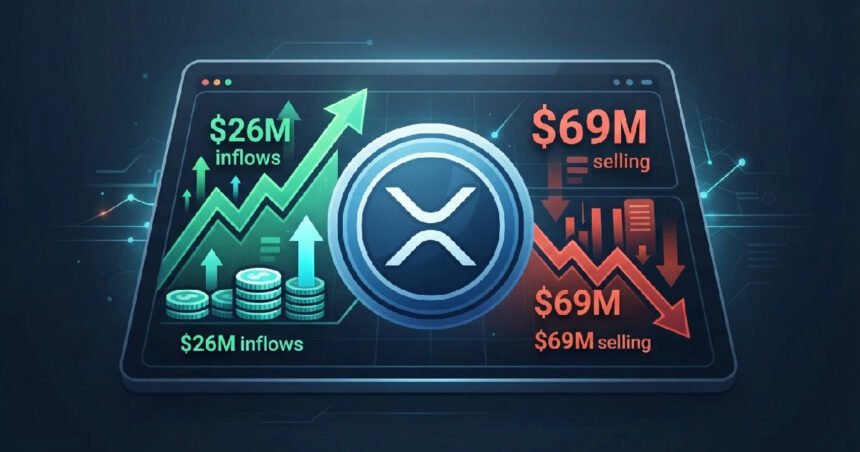
XRP’s digital asset market has revealed a significant divergence in investor sentiment, with its spot market recording approximately $26 million in net buying while its futures market experienced a substantial $69.2 million net selling imbalance. These XRP market flows indicate a complex picture for the cryptocurrency.
This contrast, based on data primarily reported as of November 24, 2026, though rooted in underlying trends observed since November 18, 2024, points to cautious short-term views despite consistent interest in the underlying asset.
Understanding XRP market flows and trading activity
The figures, compiled from CoinGlass data for recent reports and supported by CoinShares analysis for historical context, illustrate a complex picture for XRP. Positive spot taker-buying activity suggests a segment of the market is accumulating XRP directly. Yet, the dominant negative futures taker flows indicate that many traders are hedging or betting against XRP’s immediate price direction, creating a push and pull within the ecosystem.
Over a 24-hour period leading up to recent reports, XRP saw its spot market absorb around $26 million in net inflows. This metric signifies that buyers exceeded sellers by that amount on spot exchanges. In stark contrast, the futures market registered net selling of approximately $69.2 million within the same timeframe, indicating a prevailing bearish sentiment among derivatives traders.
Shorter-term data amplified this split. Over a 12-hour window, spot net buying still held strong at $19.9 million. However, futures net selling reached $35.3 million. This consistent pattern across different timeframes underscores a fundamental difference in how participants are approaching XRP.
The total trading volume further highlights the dominance of derivatives. Futures trading volume for XRP reached an estimated $3.45 billion over 24 hours. Spot trading volume, while substantial, was considerably lower at about $895 million. This disparity confirms that derivatives continue to drive the bulk of XRP market activity, making futures sentiment particularly influential.
This divergence suggests that while some investors see value in acquiring XRP directly, a larger contingent using derivatives anticipates potential price declines or is actively hedging existing spot positions. It creates a dynamic where underlying demand battles against speculative short-term pressure, influencing XRP’s price movements.
Broader market context and recent XRP performance
At the time of the November 24, 2026, reports, XRP was trading around $0.93. This price point comes after a period of significant volatility and a notable dip around November 15, 2026, when XRP fell to approximately $0.89. That marked its lowest level since November 2024, reflecting broader pressures across the cryptocurrency market.
Several factors contributed to this price contraction. Widespread selling pressure affected the entire digital asset space. There were also significant withdrawals from U.S.-listed spot XRP exchange-traded funds (ETFs), alongside a general contraction in stablecoin supply, which often signals reduced liquidity in the crypto ecosystem.
U.S. spot XRP ETFs recorded approximately $19.13 million in net withdrawals during the week ending November 13, 2026. This represented their largest weekly outflow since March 2026. Such movements indicate that even institutional vehicles designed to simplify XRP investment are experiencing periods of decreased investor confidence or profit-taking.
Despite these recent outflows, the long-term view for U.S. spot XRP ETFs remains positive. They have collectively attracted approximately $1.5 billion in cumulative net inflows since their launch in November 2025. This shows that while short-term sentiment can be volatile, a foundational base of institutional interest continues to support the asset class.
The overall market environment, characterized by fluctuating investor appetite and macroeconomic uncertainties, undeniably impacts XRP’s price. These broader trends often overshadow individual asset performance, creating a complex backdrop for understanding its specific market flows.
Understanding the spot-futures imbalance implications
The distinct patterns in XRP’s spot and futures markets provide valuable insights into market participants’ varying strategies and expectations. Spot net inflows typically signal accumulation, where investors are buying XRP with the intention of holding it. This often reflects a belief in the asset’s long-term value or an immediate utility for the token.
Conversely, net selling in the futures market points towards speculative bets on a price decline, or sophisticated hedging strategies employed by larger players. These participants might be protecting existing spot holdings from potential downside risks, or they could simply be taking a bearish stance on XRP’s short-term trajectory.
The sheer volume of futures trading, significantly outweighing spot volume, amplifies the impact of futures market sentiment on XRP’s immediate price action. When such a large segment of the market is leaning bearish, it can create downward pressure that even strong spot buying may struggle to counteract.
Historical data from CoinShares reports further illustrates fluctuations in XRP flows. In a report from November 25, 2024, XRP saw measurable inflows of US$15 million. More recently, a May 11, 2026, CoinShares report indicated significant inflows of US$39.6 million. These past periods of positive inflows suggest that while the current futures selling is notable, XRP has historically attracted substantial capital.
This dynamic interplay between spot buying and futures selling means that any sustained price recovery for XRP would likely require a shift in futures market sentiment. Without it, bullish spot activity could be continuously capped by derivative-driven selling pressure, leading to choppy price action.
Regulatory landscape and XRP’s trajectory
XRP’s journey has been significantly shaped by its protracted legal battle with the U.S. Securities and Exchange Commission (SEC). The lawsuit, initiated in December 2020, centered on whether XRP constituted an unregistered security. A pivotal moment arrived on July 13, 2023, when Judge Analisa Torres ruled that XRP itself is not a security, though institutional sales by Ripple Labs were deemed securities offerings.
The final resolution came in March 2025, when the SEC officially dropped its appeal against Ripple, and Ripple subsequently withdrew its cross-appeal. This concluded a four-year legal saga, bringing a degree of regulatory clarity to XRP. The ruling that retail XRP transactions are not securities became final, setting a precedent for the broader cryptocurrency industry.
This increased clarity paved the way for more mainstream adoption, particularly in the form of spot XRP Exchange-Traded Funds (ETFs). Following the settlement, multiple U.S. asset managers applied for these products, with some receiving approval. ProShares Ultra XRP ETF notably launched in July 2025, marking the first SEC-approved XRP investment product. This development signaled growing institutional acceptance of the asset.
Beyond specific asset classifications, the broader U.S. regulatory environment for cryptocurrencies continues to evolve. On November 23, 2026, the Commodity Futures Trading Commission (CFTC) issued new guidance. This advisory allows certain crypto assets, including Bitcoin, Ethereum, and payment stablecoins, to count toward operating cost reserves for regulated derivatives exchanges and clearinghouses, albeit with valuation discounts.
This regulatory evolution, even if not directly about XRP, suggests a growing comfort level among regulators with integrating digital assets into traditional financial frameworks.
Such developments are critical for XRP’s long-term prospects. Greater regulatory certainty often correlates with increased institutional investment and broader market participation. The resolution of the SEC case has arguably been one of the most significant catalysts for XRP’s recent market dynamics, influencing everything from investor sentiment to product development like ETFs. XRP institutional adoption has been a key theme.
What’s next for XRP investors?
The current market landscape for XRP presents a mixed bag for investors. The continued strength in spot buying suggests underlying confidence from a segment of the market, potentially long-term holders or those using XRP for its intended utility in payments. This consistent demand provides a floor of support for the asset’s price.
However, the significant net selling in the futures market indicates that short-term volatility and downward pressure remain real concerns. Traders leveraging derivatives are clearly taking a more cautious, if not bearish, view. This dynamic could cap any immediate upward price movements, making sustained rallies challenging without a shift in futures sentiment.
Expert analysis often points to the $1 area as a crucial psychological and technical level for XRP. Cryptocurrency trader VirtualBacon suggested that this zone might represent a rough bottom for the current cycle, though XRP has struggled to hold above it.
Another analyst, Dark Defender, has observed that while XRP’s weekly corrective structure has become more complex, it could be on the cusp of “one of the biggest XRP reversals ever.”
Forecasts for XRP remain varied. While some project the asset could reach $10 in the long term, short-term predictions are more modest. For December 2026, price forecasts indicate a minimum near $0.9188984, a projected maximum of $1.28, and an average price around $1.1.
These predictions reflect the ongoing uncertainty and potential for both upside and downside movements. Binance XRP supply metrics also play a role in short-term price discovery.
Looking further ahead, projections for 2027 estimate XRP to reach around $0.99715. Longer-term predictions suggest a gradual increase, with XRP potentially reaching $2 by 2036 and possibly $3 by 2051. These long-range forecasts are highly speculative but underscore a belief in XRP’s enduring utility and adoption over decades, particularly as global payment systems evolve.
Investors will need to monitor not only technical indicators and trading volumes but also broader cryptocurrency market trends and regulatory developments. The outcome of ongoing regulatory discussions globally, along with the performance of spot XRP ETFs, will continue to significantly influence XRP’s trajectory in the coming months and years. The underlying technology of the XRP Ledger also continues to evolve.