

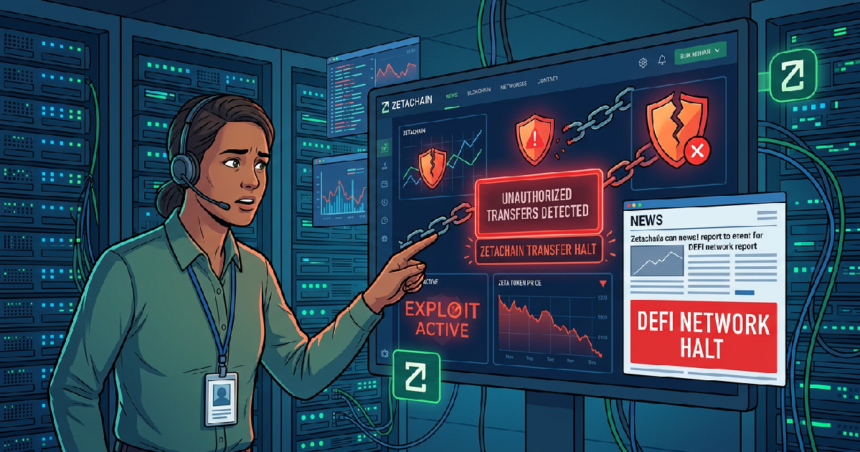
ZetaChain developers reportedly suspended network activity following reports from decentralized finance monitors indicating a security exploit. The project, which focuses on cross-chain interoperability, moved to freeze transfers after unusual activity was detected within its ecosystem. This development marks a significant challenge for the protocol as it attempts to secure its infrastructure against unauthorized outflows.
The incident came to light when security alerts flagged a series of transactions that appeared to circumvent standard safety protocols. ZetaChain confirmed the suspension through its communication channels, indicating the move was a necessary precaution to protect user funds and maintain network integrity while a forensic investigation is conducted. The freeze has effectively paused activity across the layer-1 blockchain, which is built to provide connectivity between disparate networks.
While the total volume of the loss is still being assessed, initial reports from trackers like DefiLlama suggest the breach involved a six-figure sum. Such incidents often force a reckoning for interoperability protocols, as any vulnerability in core smart contracts or bridge mechanisms raises questions about the long-term safety of cross-chain liquidity. The protocol now faces the task of identifying the entry point used by the attacker.
Security Outage Challenges Cross-Chain Connectivity
The decision to halt transfers has locked users out of their assets, a common defensive maneuver used by decentralized finance (DeFi) platforms to stop the “bleeding” during an active exploit. Early indicators suggest a vulnerability within the network’s liquidity pools may have been targeted. The ZetaChain team has not yet released a full technical post-mortem, leaving the community to speculate on the exact nature of the flaw.
This disruption occurs during a period of mixed performance for the broader digital asset market. For instance, Bitcoin holds steady as mid-cap tokens face selling wave, often leaving smaller altcoin projects more vulnerable to targeted technical attacks. The pause in operations is intended to give developers breathing room to patch the code without risking further capital flight.
Security analysts noted that reported loss figures are often subject to revision as investigators uncover the full scope of an attack. In many DeFi breaches, initial estimates only cover direct theft from a primary source, while the secondary impact on integrated decentralized exchanges takes longer to quantify. The protocol’s ability to contain the damage will likely depend on how quickly the validators reached a consensus to stop the chain.
Market Impact and Recovery Efforts
The market reaction to the network halt was swift, with the native ZETA token experiencing immediate pressure on secondary markets. Investors generally treat a total transfer freeze as a signal of high technical risk, which often triggers volatility on centralized exchanges where the asset remains tradable. This incident adds to the pressure on the project to prove its resilience.
The DeFi sector has been navigating an increasingly complex security environment. While some major assets are showing signs of stabilization, others, such as Cardano as it seeks to regain key price milestones, show how difficult it is to maintain momentum when technical issues arise. For ZetaChain, the timing is difficult as the project had been actively working to expand its footprint in the cross-chain space.
Technical Response and the Path Forward
Developers are reportedly working with security firms to trace the movement of the unauthorized funds. On-chain data suggests the assets are being moved through various privacy tools in an attempt to obscure their origin. This process is a common hurdle for investigators, though the speed of the network shutdown might have prevented a more extensive drain of the protocol’s total value locked.
Feedback from the community has been divided. Some users have expressed support for the rapid response, while others are frustrated by the lack of access to their funds and a perceived lack of transparency. The “halt” mechanism remains a controversial tool among decentralization advocates, but it is frequently the only way to stop a total loss of assets during a crisis.
This incident arrives at a time when analysts suggest the window for projects to prove their utility is narrowing, forcing developers to prioritize security over rapid expansion. ZetaChain will need to demonstrate not only that it can remediate this specific flaw, but that its fundamental architecture can withstand the demands of a more mature financial ecosystem.
The road to resuming normal operations will likely involve a multi-step verification process. The team must identify the technical exploit, deploy a patch to all network validators, and successfully pass a security audit before reopening transfers. Restoring user trust may also require a discussion regarding potential reimbursements, a move other protocols have utilized to maintain their community following similar setbacks.