

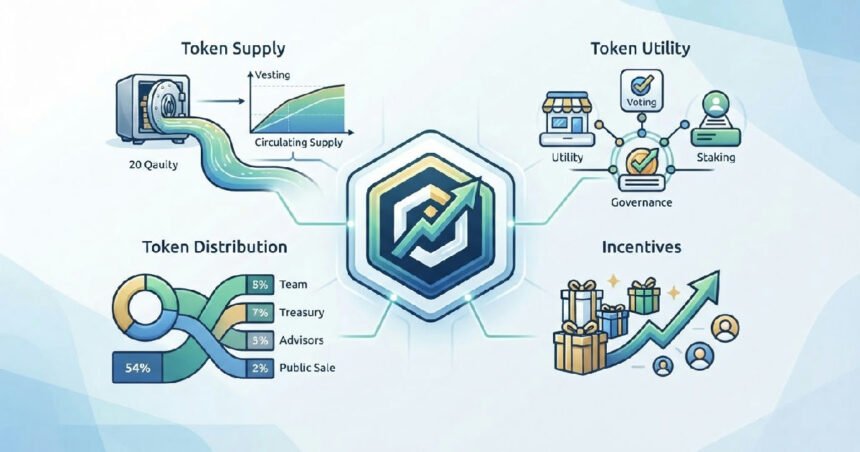
Tokenomics, a blend of “token” and “economics,” defines the economic blueprint of a cryptocurrency token within a blockchain project. It outlines the token’s supply, distribution, utility, and the incentives driving network interaction, which is crucial for **tokenomics for sustainable altcoin growth**. This intricate design directly impacts an altcoin’s long-term value and its potential for sustainable success.
Unlike traditional financial systems, tokenomics operates through immutable code and smart contracts. This foundational structure offers transparency and predictability, which is crucial for building investor confidence. Ultimately, a well-engineered tokenomics model is essential for an altcoin’s viability and its ability to accrue value over time.
Core elements of robust tokenomics for sustainable altcoin growth
Sustainable growth for emerging altcoins relies heavily on a robust tokenomics model. This model meticulously balances various economic factors, which are often detailed within a project’s whitepaper. These core components dictate how a token behaves and contributes to the overall ecosystem’s health.
Token supply and distribution metrics
Understanding token supply metrics is fundamental to assessing an altcoin’s economic health and future potential. Supply metrics define the total number of tokens that will ever exist and how they enter circulation across the network.
The **Total Supply** refers specifically to the overall number of tokens that have been created for the project to date. In contrast, the **Maximum Supply** represents the hard cap on the total number of tokens that will ever be minted. Bitcoin’s limit of 21 million coins is a clear example of a maximum supply ceiling.
The **Circulating Supply** refers to tokens currently available to the public for trading and use on exchanges and platforms. Some tokens, like stablecoins such as USDT or USDC, may not have a fixed maximum supply, adapting instead to market demands. Similarly, Ethereum, post-Merge issuance, doesn’t operate with a fixed maximum supply ceiling.
Distribution strategies are equally critical, determining how tokens are initially allocated and released into the ecosystem. This can include Initial Coin Offerings (ICOs) for capital raising or fair launches designed for broader, more equitable distribution among early adopters. Airdrops provide free tokens to existing wallet holders, helping to foster early network participation and community building.
Furthermore, staking and mining rewards incentivize participation in vital network operations and consensus mechanisms. Allocations for core development teams, advisors, and project treasuries also shape the initial token landscape. These varied methods influence both price stability and long-term community engagement.
Crucially, vesting schedules and lock-up periods control the release of tokens to insiders and early investors. These mechanisms prevent sudden, large-scale sell-offs by team members, which could otherwise destabilize the market price. They also help align long-term incentives with the project’s overarching success, reducing speculative pressure.
Token utility and value accrual mechanisms
A token’s utility is a primary driver of its intrinsic value within the specific ecosystem it powers. Utility Tokens grant access to specific services, features, or applications on a blockchain platform. They might be used for transaction fees, earning network rewards, or unlocking exclusive platform functionalities.
Governance tokens, by contrast, empower holders to participate directly in a decentralized organization’s decision-making process. Holders can vote on key proposals, influencing protocol upgrades, token issuance policies, and treasury fund allocation. The weight of their vote typically scales proportionally with the amount of tokens they hold.
Staking is another vital mechanism where users lock up tokens to support the network’s operations, such as validating transactions in Proof-of-Stake systems. In return, stakers earn rewards, which both reduces the immediate circulating supply and encourages long-term holding. This mechanism strengthens network security and decentralization simultaneously.
Burning mechanisms permanently remove tokens from circulation, typically by sending them to an unspendable address on the blockchain. This planned reduction in total supply aims to increase scarcity and potentially boost the value of the remaining tokens. It functions as a built-in deflationary measure designed to benefit existing holders over time.
A prime example is Ethereum’s EIP-1559, implemented in August 2021, which burns a base fee from each transaction. This innovation shifts transaction fee revenue away from miners and toward the network itself. During periods of high network usage, the burn rate can even exceed new issuance, potentially making Ethereum deflationary. Some protocols also employ buyback programs, using generated revenue to purchase and often burn their own tokens, creating consistent buying pressure.
Shaping altcoin market dynamics
The specific design of an altcoin’s tokenomics fundamentally shapes its market dynamics and investor perception. Carefully crafted supply limits and balanced distribution models directly influence demand and overall price stability. Transparent economic principles are essential for instilling greater confidence among investors and users alike.
Conversely, poorly conceived tokenomics can quickly lead to significant market volatility and deep investor uncertainty. Projects with substantial unvested insider holdings, for instance, face predictable risks of future price dilution when those tokens unlock. These factors become critical when assessing an altcoin’s potential for sustained, long-term growth versus a pump-and-dump scheme.
Evaluating altcoin sustainability indicators
Investors must rigorously scrutinize a project’s whitepaper to understand its underlying tokenomics model thoroughly. This document should clearly articulate the token’s purpose, its precise supply schedule, and how value truly accrues to holders. A lack of transparency in this documentation often signals potential red flags that serious investors shouldn’t ignore.
Assessing the gap between circulating and total supply is also crucial before committing capital. A large disparity, especially one coupled with over 30–50% insider holdings, strongly indicates future price dilution risks when vesting schedules expire. Therefore, a comprehensive evaluation of these metrics is vital for making informed altcoin investing decisions and avoiding costly pitfalls.
The path forward for digital assets
As the broader blockchain landscape continues to evolve and mature, tokenomics models must also progress beyond simple fixed issuance schedules. Successful altcoins will likely feature adaptive and dynamic tokenomics that can respond fluidly to market changes and community needs as they arise. Projects demonstrating flexibility and foresight in their economic design are better positioned for enduring success.
Ultimately, a deep understanding of tokenomics empowers market participants to make far more informed decisions than relying purely on hype. It illuminates precisely how digital assets are engineered to function and whether they possess the structural integrity required for long-term viability in the intensely competitive crypto market.