

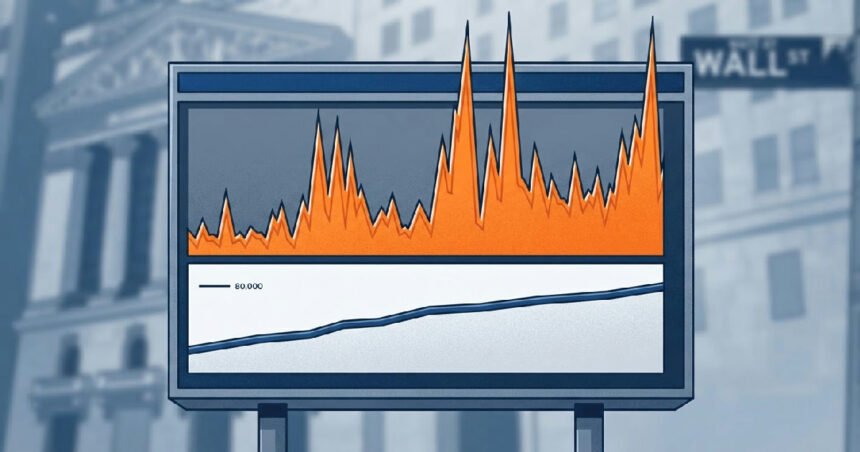
The Wall Street Fear Gauge, or VIX index, surged dramatically on Friday, October 16, 2026, as US stocks tumbled due to inflation, AI sector pressure, and geopolitical tensions.
Yet, in contrast to the equities rout, Bitcoin demonstrated remarkable stability throughout the weekend, consistently holding above the $80,000 mark. This divergence indicates that the widespread market panic experienced by traditional finance might prove to be short-lived, potentially easing as the new trading week commences on Monday.
Wall Street’s Fear Gauge Spikes on Friday
The Cboe Volatility Index, or VIX, acts as a real-time barometer for investor sentiment, measuring the market’s expectation of 30-day volatility for the S&P 500 index. A higher VIX reading signals greater anticipated price swings, often reflecting investor anxiety.
Bitcoin, unique among major macro assets, trades continuously through the weekend, making its price action a closely watched indicator for how traditional markets might behave when they reopen.
Friday saw the VIX index leap by a substantial 21.45%, closing at 19.99. Another report noted the index climbed 4.97 points to 21.41, marking a four-month high and representing a roughly 30% jump from its previous close of 16.44. This was the most significant one-day rise for the VIX since June 5, a day when the S&P 500 recorded its worst performance in months.
The broad S&P 500 index itself declined by 1.09% to 7659.44 on the same day, reflecting widespread investor unease. Technology and communication-services shares bore the brunt of the sell-off. But typically defensive sectors such as healthcare, consumer staples, and energy managed to finish the session in positive territory, highlighting a flight to safety.
Underlying Factors Fueling Market Anxiety
The market’s sudden downturn wasn’t a singular event but rather a confluence of several potent factors. Renewed concerns over inflation played a significant role, with September U.S. consumer prices rising 3.7% year over year. This figure notably exceeded forecasts of 3.6%, immediately raising red flags for investors.
Core prices, which exclude volatile food and energy components, also increased more than expected, posting a 0.3% month-over-month rise against a 0.2% consensus. This hotter-than-anticipated inflation data immediately rekindled expectations of another Federal Reserve interest rate hike. Market-implied odds for an October hike jumped to approximately 33% from about 20% prior to the data release, per Reuters.
Adding to the unease was mounting pressure on highly indebted AI-focused companies, where the cost of default insurance has hit record highs. Firms like CoreWeave, a “neocloud” company, saw its five-year credit default swap (CDS) spread surge past 1,100 basis points on October 15, 2026.
This implied a staggering 63-64% five-year default risk, up from about 30% a year prior. Oracle also saw its five-year CDS reach 288 basis points.
Geopolitical tensions further exacerbated market jitters. Reports emerged on Saturday, October 17, that Iran’s Revolutionary Guards claimed two oil tankers caught fire after hitting naval mines in the Strait of Hormuz. These incidents, though unconfirmed by independent sources, coincided with an escalating situation on the Russia-Ukraine front, pushing global oil prices higher.
Earlier in the week, the UK Maritime Trade Operations (UKMTO) announced an oil tanker was struck by an unidentified projectile while exiting the Strait of Hormuz on October 12, adding to the regional volatility.
VIX History: A Guide to Potential Market Reversals
The Cboe Volatility Index, or VIX, is more than just a real-time indicator. It’s a sophisticated measure derived from the prices of S&P 500 options, reflecting the market’s collective expectation of volatility over the next 30 days. When traders become nervous, they typically buy more options to hedge against potential price swings, which consequently drives the VIX higher.
History offers a valuable perspective on these sudden spikes. Major VIX surges often accompany significant market downturns, such as the 2008 financial crisis or the initial shock of the COVID-19 pandemic in March 2020. Understanding long-term market cycles is crucial here.
Historically, big Friday jumps in the VIX — defined as a 20% or more increase — often prove short-lived. CoinDesk’s analysis of data since January 1990 found that in 25 out of 32 such instances, the VIX actually fell the following Monday. The typical Monday move was a drop of 4.5%, suggesting investors often “sleep off” the initial panic over the weekend.
Seasonality trends also lean towards a cooling period for volatility. The VIX has declined in November in 25 of the last 36 years, with a median drop of 7.2%.
This pattern extends from October end through the close of the year, where the VIX has fallen in 22 of 36 years, showing a median decline of 9.4%. Such historical precedence suggests that the current spike may indeed be transient.
Bitcoin’s Resilience: A Weekend Bellwether
While traditional exchanges shutter for the weekend, Bitcoin’s 24/7 trading cycle positions it as a unique macro asset. Its continuous price action often provides an early indication of how global risk appetite might shift before equity markets reopen. This weekend, Bitcoin’s performance has been particularly noteworthy.
The world’s largest cryptocurrency has shown remarkable resilience, holding comfortably above $80,000 and trading at $81,100 on Sunday. This steady performance within its recent choppy range suggests that Friday’s pronounced risk aversion, which heavily impacted Wall Street, may not spill over into Monday’s trading. It appears to act as a stabilizing force in the broader digital asset ecosystem.
Further reinforcing this narrative is the behavior of the Bitcoin Volmex Implied Volatility Index (BVIV), often dubbed Bitcoin’s own “fear gauge.” BVIV slipped 1% on Friday to just under 40% and has remained largely stable since. This metric measures the market’s expected 30-day volatility for Bitcoin, similar to how the VIX gauges S&P 500 expectations.
The calm in BVIV indicates that even within the crypto sphere, widespread panic about future Bitcoin derivatives market price swings isn’t taking hold.
Interestingly, bettors on the decentralized platform Polymarket aren’t panicking either. They currently see only a 9% chance that the much-discussed “AI bubble” bursts this year. This sentiment further contrasts with the pronounced fear observed in traditional markets and underscores Bitcoin’s distinctive position as a digital asset that operates on different cycles and influences.
What Could Still Derail a Calm Monday?
Despite historical patterns and Bitcoin’s recent stability, a return to calm on Monday isn’t a guaranteed outcome. There remain distinct possibilities for continued market turbulence. In 7 of the 32 historical instances where the VIX jumped 20% or more on a Friday, the index continued to climb sharply on Monday. Notable examples include August 2015, February 2018, and August 2024.
Traders, for their part, are actively betting on sustained volatility. CNBC reported significant call option purchases indicating expectations for the VIX to remain elevated through November. Specifically, traders bought 9,200 November 18, 20-strike calls for $1.7 million, alongside 12,500 November 18, 23-strike calls for $1.1 million. This implies a collective wager that the VIX will close above 23 by the third week of November.
From a technical standpoint, the VIX index, even after Friday’s 21.45% surge, remains below 20. Historically, the VIX has topped this 20-point mark on more than a third of all trading days since 1990.
It has closed above 30 on just 8% of days, suggesting there’s still significant room for the “fear gauge” to climb if market concerns intensify. This could impact Bitcoin price tests as well.
Therefore, while historical data and Bitcoin’s steady performance offer a degree of optimism, the confluence of persistent inflation worries, escalating geopolitical risks, and structural pressures on the AI sector means market participants should remain cautious. The resilience of Bitcoin, however, offers a compelling counter-narrative, suggesting a potential decoupling of sentiment between traditional finance and the digital asset space.