

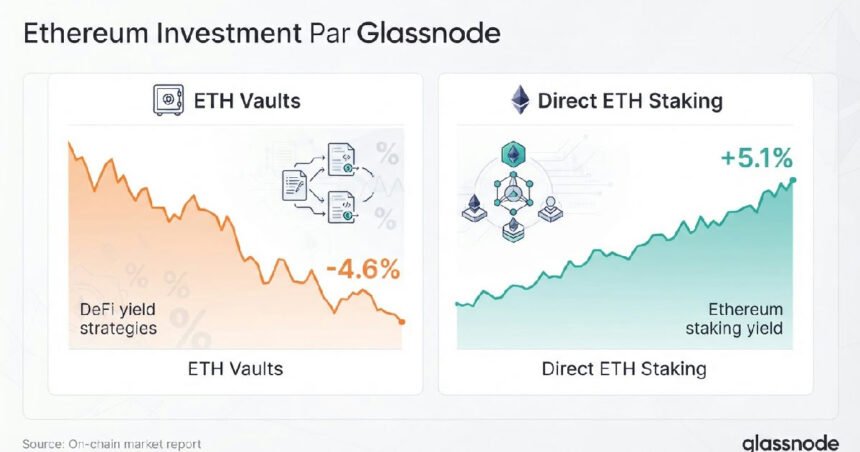
Complex Ethereum-based investment strategies known as vaults generated negative returns for investors over a 20-month period, significantly underperforming the simpler approach of direct ETH staking. That’s according to a detailed analysis by blockchain analytics firm Glassnode, which found that from January 2022 to August 2023, ETH vaults produced an average annual loss of -4.6%.
In stark contrast, direct Ethereum staking yielded a positive annual return of 5.1% during the same timeframe. The report, published on August 28, 2023, also highlighted a separate, more successful trend: dollar-denominated DeFi strategies, primarily involving stablecoin lending, returned an impressive 7.7%, easily outpacing the 3.6% yield from traditional U.S. Treasury bills.
Why ETH Vaults Post Negative Returns
The Glassnode findings paint a clear picture of two divergent outcomes in the world of decentralized finance. For investors holding Ethereum, the allure of automated, high-yield vaults proved to be a losing proposition. The data reveals a staggering 9.7 percentage point performance gap between the complex vault strategies and the foundational yield-bearing instrument of the Ethereum network: staking.
This suggests that for a holder whose goal is to accumulate more ETH, the additional layers of complexity, risk, and fees associated with many vaults actively destroyed value compared to a straightforward staking approach. The report underscores a critical question for any investor: what is the primary goal of the investment?
Is it to grow a holding of a specific digital asset, or is it to generate cash-flow returns in dollar terms?
On the other side of the spectrum, the outperformance of stablecoin strategies was just as noteworthy. These strategies delivered a 4.1 percentage point premium over one of the safest assets in traditional finance.
This has attracted investors seeking higher yields on their cash positions, though it comes with a different set of risks than government debt. This dynamic highlights a growing debate about where to park cash-equivalent assets, a conversation that even prominent dollar investors are now engaging with.
Why did ETH vaults fail to deliver?
The dramatic underperformance of ETH vaults can be traced back to several key factors identified by Glassnode. These automated strategies, which aim to optimize yield by interacting with various DeFi protocols, often fall victim to their own complexity. The primary culprits eroding returns were high transaction costs, impermanent loss, and management fees.
The persistent drain of fees and costs
Every action a vault takes on the Ethereum blockchain incurs a gas fee. Strategies that frequently rebalance assets, harvest rewards, or move funds between different lending pools can accumulate substantial transaction costs. Over time, these fees act as a constant drag on performance, eating away at any potential gains.
Furthermore, most vaults charge management or performance fees. These are typically a percentage of the total assets under management and a cut of the profits generated. While fees are standard for managed products, the Glassnode data suggests that in this case, investors were paying for strategies that ultimately failed to even match the baseline return of staking.
The misunderstood risk of impermanent loss
A more complex and often misunderstood risk is impermanent loss. This phenomenon affects users who provide liquidity to automated market makers (AMMs), a common activity for many yield-farming vaults.
When an investor deposits a pair of assets (like ETH and a stablecoin) into a liquidity pool, the value of their deposited assets can fall relative to simply holding them if the price ratio between the two changes significantly.
While the fees earned from providing liquidity are meant to offset this risk, a volatile market can cause impermanent loss to outpace the fee income. For many ETH vaults deploying capital into these pools between early 2022 and mid-2023, this appears to have been a significant contributor to their negative returns.
Stablecoins shine in a rising rate environment
While ETH strategies struggled, the success of dollar-denominated strategies was a bright spot in the report. The average annual return of 7.7% from stablecoin lending demonstrates DeFi’s ability to offer competitive yields on cash-like assets. This success is directly tied to the macroeconomic backdrop of the period.
As central banks around the world, led by the U.S. Federal Reserve, hiked interest rates to combat inflation, borrowing costs rose across all financial markets. This trend extended into DeFi, where demand for stablecoin loans pushed lending rates higher.
Investors who supplied stablecoins like USDC and USDT to lending protocols were able to capture these elevated yields, which comfortably exceeded the returns on U.S. Treasury bills.
This has made DeFi a compelling alternative for corporate treasuries and individuals seeking to earn a return on their cash holdings. The development of more sophisticated financial products on-chain, including the rise of tokenized stock trading and other real-world assets, shows how deeply these two worlds are beginning to intertwine.
The key question for investors remains whether the extra 4.1 percentage points of yield is adequate compensation for the added risks of DeFi, including smart contract vulnerabilities and protocol stability.
Lessons for DeFi investors and the road ahead
The Glassnode report serves as a crucial lesson for anyone navigating the DeFi landscape. It highlights that a higher advertised APY (Annual Percentage Yield) does not always translate to better real-world returns. The complexity and hidden costs of a strategy can easily negate its theoretical advantages.
This has led some to reconsider their strategies, with the recent Bitcoin price recovery prompting a fresh look at direct holdings versus complex yield farming.
For Ethereum holders, the data strongly suggests that direct staking, particularly via liquid staking derivatives that maintain token liquidity, offers a more reliable and profitable path to growing their holdings. The simplicity of earning rewards for securing the network has proven more effective than the intricate, and costly, maneuvers of many automated vaults.
Looking forward, the pressure is now on vault curators to prove their value. To justify their fees, these protocols must demonstrate a consistent ability to generate returns that meaningfully exceed the staking benchmark after all costs are accounted for. This may lead to the development of more efficient, lower-cost strategies or greater transparency around the specific risks being taken.
Ultimately, the report champions a back-to-basics approach. It emphasizes the need for investors to understand the benchmark they are trying to beat and to critically assess whether a strategy’s complexity and fees are justified by its performance. In the period analyzed, the simplest path for ETH holders was the most profitable one.