

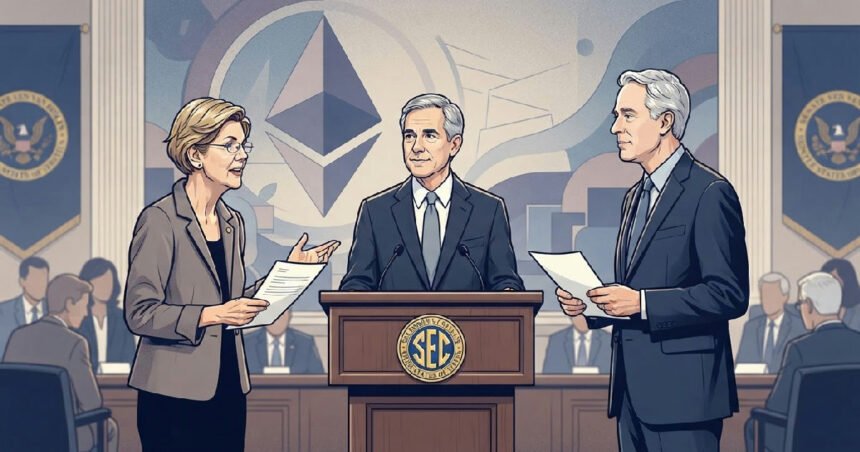
Senators Elizabeth Warren and Chris Van Hollen urged SEC Chair Paul Atkins to reverse two key crypto-related policies. S. Securities and Exchange Commission’s (SEC) stance on digital assets, Senators Elizabeth Warren (D-Mass.) and Chris Van Hollen (D-Md.) have formally urged SEC Chair Paul Atkins to reverse two key crypto-related policies.
Their letters, dated November 24, specifically target the proposed “Regulation Crypto Assets” rule and a September order that allows tokenized stock trading venues to operate without full exchange registration. These actions, say the senators, threaten investor protection and market integrity.
Chair Paul Atkins and tokenized stock policy
The Democratic senators, whose concerns were released by the Senate Banking Committee on November 25, contend that the SEC’s current approach risks creating a less regulated environment for digital securities. They argue that these policies could inadvertently foster a shadow market outside the established financial oversight framework. This pushback highlights an ongoing tension between fostering financial innovation and maintaining robust regulatory safeguards.
Central to the senators’ criticism is the SEC’s “Innovation Exemption” order, issued on September 17. This order temporarily exempts Tokenized Securities Venues (TSVs) from the standard definition of an exchange and provides relief for certain liquidity providers from being classified as dealers.
Senator Chris Van Hollen led the letter specifically addressing this exemption, joined by Senator Warren, Senator Tina Smith (D-Minn.), and Senator Jack Reed (D-R.I.).
The Democratic senators expressed deep concern that this exemption “would allow TSV platforms to operate a shadow stock market outside longstanding regulatory protections.” They argue that this regulatory bypass places an undue burden on public companies, which would struggle to navigate a bifurcated market.
The letter highlights a lack of adherence to Regulation NMS (National Market System), the foundational SEC rules for U.S. stock trading, as a critical oversight.
Scrutiny over the “Innovation Exemption”
The “Innovation Exemption” order also drew fire for its limited issuer objection period. Public companies are given only 30 calendar days to object if an unaffiliated party tokenizes their shares, a timeline the senators deem insufficient. They also pointed to potential gaps in anti-money laundering (AML) protocols within these exempted venues, raising flags about illicit financial activity.
Jamie Selway, Director of the SEC’s Division of Trading and Markets, offered a counterpoint to criticisms regarding the regulation of these venues. Speaking on Unchained just a week before the letters were sent, he asserted that the notion of TSVs being “totally unregulated is wrong.”
Selway clarified that these are “exempt entities” subject to specific conditions, including public notice, activity limits, and a duty to “submit yourself to the SEC examination regime.”
Pushback on broader crypto asset regulation
Beyond tokenized stocks, Senator Warren, as the Banking Committee’s ranking member, led a separate letter—also signed by Senator Van Hollen and Senator Smith—targeting the SEC’s proposed “Regulation Crypto Assets.” This comprehensive offering framework, unveiled on August 18, aims to create a tailored regime for certain crypto assets. It includes a one-time $5 million startup exemption and a fundraising exemption allowing up to $75 million annually.
The senators sharply criticized the framework, arguing that it “only serves to help crypto assets escape from the SEC’s regulatory regime.” They expressed alarm over the startup exemption, suggesting it implies the SEC is “willing for investors to be defrauded in $5 million increments.” Their letter also contends that the proposal oversteps the SEC’s statutory authority and preempts legislative efforts in Congress.
Examining the proposed offering framework
This “Regulation Crypto Assets” proposal also introduces a safe harbor provision, which the senators fear could enable issuers to self-certify their way out of SEC jurisdiction. Critics from the North American Securities Administrators Association (NASAA) echoed these sentiments. NASAA, representing state securities administrators, urged the SEC to withdraw the proposal, citing a lack of robust investor protections and a potential for “pump and dump schemes.”
The proposal’s aim to preempt state securities registration and qualification requirements for certain offerings further compounds the senators’ concerns. They believe this approach undermines the ability of states to enforce their own investor protection laws, creating a fragmented and potentially hazardous regulatory environment for retail investors. The battle over jurisdiction and oversight remains a contentious point in the evolving crypto landscape.
Historical context of crypto oversight
The current pushback by Senate Democrats is not an isolated incident. There’s a history of legislative concern regarding the SEC’s approach to nascent digital asset markets. For instance, on March 17, 2021, a group of Senate Democrats sent a letter to then-Acting SEC Chair Allison Herren Lee.
That letter urged the agency to reverse a “no-action” letter issued to the firm “Atkins,” now known as Prometheum Inc., which operates Prometheum ATS.
Those senators, including Elizabeth Warren, Sherrod Brown (D-OH), Tina Smith (D-MN), and Brian Schatz (D-HI), raised concerns that the no-action letter could “undermine the integrity of capital markets and expose investors to undue risk.” They argued against a “piecemeal” approach to crypto regulation, advocating instead for a comprehensive framework.
This earlier intervention underscores a persistent theme: the desire for clear, unified regulatory oversight for digital asset securities.
Evolution of SEC’s digital asset approach
Paul Atkins himself has a background that informs his current position. Appointed SEC Chair in April 2025 by President Donald J. Trump, he previously served as an SEC Commissioner from 2002 to 2008. Atkins is known for advocating reduced regulatory burdens and has a history as an advocate for the cryptocurrency industry.
Before his current appointment, he led Patomak Global Partners, an advisory firm for financial entities, including crypto companies.
The SEC has also engaged with crypto regulation through other channels. Early in 2025, following the appointment of then-Acting Chairman Mark Uyeda, the agency established a Crypto Task Force.
In March 2026, the SEC and the Commodity Futures Trading Commission (CFTC) issued a joint interpretive release, setting forth a “token taxonomy” and addressing when an investment contract for digital assets ceases to exist. This broader regulatory activity highlights the increasing complexity of defining and overseeing crypto assets.
Industry perspectives and future implications
The debate surrounding tokenized securities and crypto regulation has drawn varied reactions from the industry. For example, the Common Sense Leadership Fund, a conservative nonprofit, recently placed an advertisement in The Wall Street Journal warning public company CEOs about the risks of stock tokenization. Their concerns ranged from market manipulation to cybersecurity vulnerabilities and anti-money laundering loopholes.
However, industry leaders like Carlos Domingo, CEO of tokenization platform Securitize, have countered these warnings. Domingo dismissed the advertisement as “misleading,” asserting that its concerns primarily applied to offshore derivatives, not legitimate and regulated tokenization operating under SEC oversight in the U.S.
Securitize itself published an advertisement emphasizing the benefits of properly tokenized shares, highlighting features like 1:1 backing by real shares and trading on SEC-regulated venues. This shows that a nuanced view on tokenized fund growth is crucial for market development.
Navigating the evolving regulatory landscape
SEC Chair Paul Atkins has framed the “Innovation Exemption” as a “significant step forward” in modernizing capital markets, facilitating on-chain trading of tokenized National Market System (NMS) stocks. He describes it as a temporary, five-year measure, expiring on September 17, 2031, intended to allow the SEC to observe emerging venues and participants.
This temporary nature suggests an iterative approach to regulation, acknowledging the rapid evolution of digital finance.
Despite these intentions, the senators’ letters underscore the deep divisions within Washington regarding crypto asset oversight. The outcome of this congressional pressure could significantly reshape how digital securities are traded and how crypto offerings are regulated. The ongoing dialogue between policymakers, regulators, and industry participants will be critical in defining the future of blockchain and tokenized assets in the U.S. financial system.
The broader implications extend beyond just investor protection and market stability. Clarity and consistency in regulation are vital for fostering innovation and attracting investment in the digital asset space.
The push for a comprehensive regulatory framework, rather than piecemeal exemptions, remains a key demand from a segment of lawmakers who believe it is essential for a mature and secure crypto market.
The continued scrutiny from lawmakers, coupled with internal debates at the SEC, points to a dynamic and uncertain path ahead for crypto regulation.