

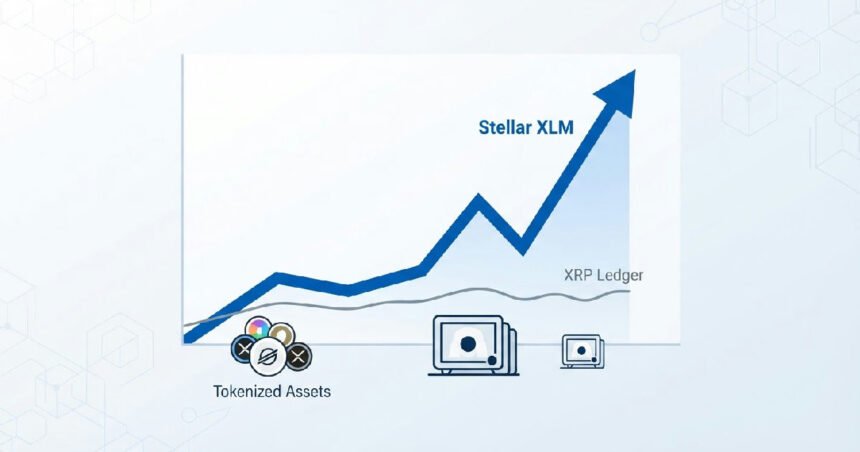
Stellar (XLM) dramatically outpaced XRP in daily tokenized fund growth on November 25, 2026, marking a significant shift in the competitive landscape for blockchain-based real-world assets. On-chain data from Token Terminal revealed that tokenized funds on the Stellar network surged by an impressive $80.4 million within a 24-hour period.
In stark contrast, XRP Ledger recorded a more modest $36.3 million increase during the same timeframe, placing Stellar’s daily gain at more than double its rival’s.
Analyzing Stellar XLM Tokenized Fund Growth
This single-day performance underscores a broader trend of Stellar’s increasing traction in the tokenized asset market, drawing substantial capital and solidifying its position as a frontrunner among various blockchain networks. The growth reflects not just a momentary spike, but sustained interest from financial institutions and DeFi users seeking efficient platforms for digital asset management.
The latest figures from November 25 paint a clear picture of Stellar’s burgeoning influence. While the XRP Ledger certainly saw substantial tokenized activity, its $36.3 million growth was less than half of what Stellar achieved. This indicates Stellar’s stronger performance in attracting new capital into tokenized funds across the blockchain ecosystem during this specific period.
Other networks, often cited in the tokenized asset conversation, lagged considerably behind. Robinhood Chain, for example, registered approximately $3.6 million in daily growth, followed by Base with $1.9 million and Plume Network with $1.2 million. This disparity highlights how concentrated institutional and investor interest currently is within the top-tier blockchain platforms like Stellar and XRP for tokenized real-world assets.
Broader Momentum and Institutional Backing
Stellar’s robust daily performance isn’t an isolated incident. The network has consistently led its peers in both daily and weekly tokenized fund inflows throughout November 2026, indicating sustained momentum. For instance, between November 15 and November 22, Stellar recorded a massive $207.2 million in weekly tokenized fund inflows, significantly driven by major financial players.
Key institutional asset managers are increasingly leveraging Stellar for their tokenization initiatives. Franklin Templeton, a global investment firm, contributed $108.0 million to Stellar’s weekly inflows, primarily through its BENJI fund. Additionally, Spiko, in collaboration with Amundi, added $68.2 million through its tokenized money-market products on the network. This demonstrates a clear preference among established finance for Stellar’s infrastructure.
The increasing engagement from these large entities underscores a strategic move towards blockchain technology for traditional financial products. As institutions seek more efficient and transparent ways to manage assets, the underlying blockchain infrastructure becomes a critical differentiator. Stellar gains tokenized funds from these partnerships, illustrating its growing utility.
Key Players Driving Stellar’s Tokenization Ecosystem
A constellation of established financial firms is propelling Stellar’s tokenized fund growth. Franklin Templeton’s BENJI fund, which has operated on Stellar since 2021, remains a pivotal component of this ecosystem. Its utility was further validated in August 2026, when the SEC’s Division of Investment Management issued a no-action letter, confirming that Franklin Templeton’s registered mutual funds and ETFs could utilize BENJI for cash management purposes.
Beyond BENJI, Franklin Templeton has also expanded its reach by registering ‘grBenji’ as a Luxembourg UCITS share class for third-party distribution in Europe, which is live on 21X. This move opens up the Stellar-powered tokenization model to a wider European investor base.
Spiko, another significant player, has partnered with Amundi to issue tokenized money-market products on the Stellar network, further diversifying the types of assets being tokenized. Ondo’s USDY, a yield-bearing dollar product, is also a main issuer on Stellar, providing another avenue for institutional participation.
Expanding Institutional Partnerships
The network’s appeal to traditional finance extends beyond these core offerings. In August 2026, Marketnode announced plans to offer funds from BNY Investments on Stellar, with Marketnode serving as the primary tokenization and distribution platform across Asia. This strategic partnership broadens Stellar’s geographical footprint and its integration into established investment frameworks.
September 2026 saw State Street Investment Management and Galaxy introduce their Onchain Liquidity Sweep Fund to Stellar. These collaborations highlight Stellar’s increasing credibility and adoption within the mainstream financial sector. The focus on institutional-grade products and partnerships has been instrumental in attracting the significant capital inflows observed.
Stellar’s Ascending Market Position in Tokenized Assets
The recent growth figures are a snapshot of Stellar’s rapidly expanding market share in tokenized real-world assets (RWAs). By the end of Q3 2026, the total tokenized real-world assets on Stellar reached an impressive $4.1 billion. This represents a substantial 36% increase from Q2 2026 and an astonishing 548% expansion compared to Q3 2025.
Mid-November 2026 estimates placed Stellar’s tokenized fund market capitalization at approximately $4.5 billion. This figure firmly positions Stellar as the second-largest chain for tokenized funds, trailing only Ethereum. The network also leads all other blockchain networks in tokenized non-US government debt, holding approximately $490 million in this sector as of late August 2026.
This specialized leadership showcases Stellar’s targeted success in specific RWA categories, particularly those attracting significant institutional capital.
XRP Ledger’s Tokenization Efforts and Market Rivalry
While Stellar captured the headlines for daily growth, the XRP Ledger (XRPL) also remains a formidable player in the tokenization space. Both Stellar and the XRP Ledger were originally designed to facilitate efficient payments and cross-border settlement, creating an inherent rivalry in their pursuit of financial institution adoption.
The XRPL has also seen considerable growth in tokenized assets, reflecting the broader market trend towards digitizing real-world value. In Q3 2026, the average value of tokenized assets on the XRP Ledger, excluding stablecoins, reached roughly $5 billion. This marked a solid 34% increase from the previous quarter.
The platform demonstrated remarkable expansion earlier, with tokenized assets growing from approximately $150 million to nearly $4 billion in just one year by July 2026. This rapid ascent underscores the XRPL’s capacity to attract significant tokenization activity. However, some analysts question if XRP institutional adoption truly translates to token demand.
Despite this broader growth, Stellar’s ability to attract more than double the daily tokenized fund inflows compared to XRP on November 25, 2026, indicates a current advantage in securing new capital.
The competition between these two networks, both vying for dominance in cross-border payments and RWA tokenization, will likely intensify as the tokenized asset market continues its rapid expansion. XRP market flows often fluctuate, highlighting the dynamic nature of this competition.
The Accelerating Tokenized Asset Market
The significant growth seen on both Stellar and the XRP Ledger reflects an accelerating global trend towards the tokenization of real-world assets. Analysts project this market to reach staggering figures in the coming years.
Various estimates suggest the market could be worth anywhere from $5.5 trillion to $8 trillion by 2030, according to Citi Institute, or even as high as $24.5 trillion by 2033, as per Grand View Research.
This burgeoning market is driven by the perceived benefits of tokenization, including unlocking liquidity in traditionally illiquid assets, reducing transaction costs, and enabling fractional ownership. Major financial institutions like BlackRock, JPMorgan, and Goldman Sachs have already committed substantial capital to developing tokenization infrastructure, signaling a broad industry shift.
Larry Fink, CEO of BlackRock, has even suggested that “every stock” and “every bond” could eventually be tokenized, indicating the long-term potential for this financial innovation. As this market matures, the competitive advantages of platforms like Stellar, with its strong institutional adoption and robust infrastructure, will become increasingly vital.
The ongoing innovation within the tokenized asset market will ultimately shape which platforms capture the largest share of this burgeoning trillion-dollar opportunity.