

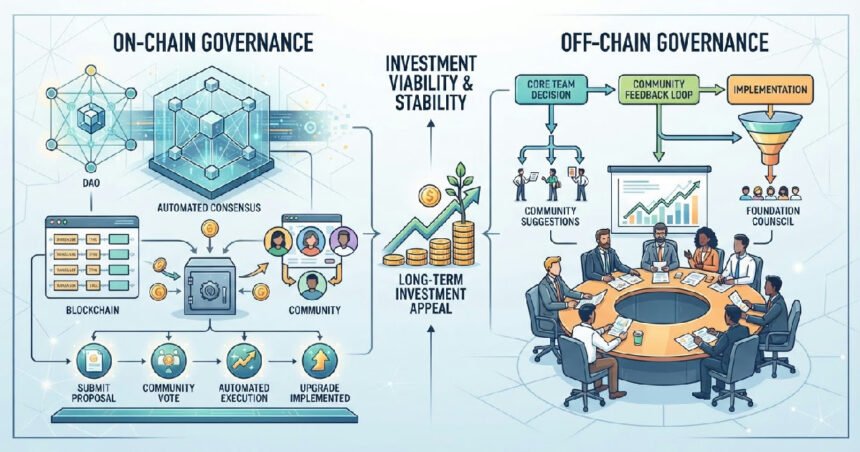
Altcoin governance models play a critical role in assessing a project’s long-term stability and overall investment appeal by defining how decisions are made, disputes are resolved, and the network can adapt. Effective governance ensures a blockchain project can evolve and improve over time without relying on a single central authority, fostering trust among its distributed community of users and developers.
Understanding these underlying structures helps investors evaluate the resilience and future growth potential of various altcoin projects.
Exploring altcoin governance models
In the context of cryptocurrency, governance refers to the fundamental mechanisms and structures through which decisions are made within a blockchain network or project. It encompasses responsibility, rules, stability, widespread participation, and inclusion. This framework dictates who makes decisions, how they are enforced, and how disagreements are ultimately resolved.
An altcoin is any cryptocurrency other than Bitcoin. Its investment viability is its attractiveness for long-term investment, influenced by stability, security, adaptability, and the ability to sustain and grow its ecosystem. Governance tokens are cryptocurrencies that grant holders voting rights on crucial proposals, similar to shareholders in a traditional company.
These tokens are key to decentralizing the voting process, allowing individuals to acquire and stake them to participate in project decisions.
Decentralized Autonomous Organizations (DAOs) are community-governed entities operating on blockchain technology, with their rules encoded in smart contracts rather than controlled by a central authority. Members holding governance tokens typically participate in voting on decisions like treasury allocation or protocol updates. Once approved, smart contracts automatically execute these decisions.
How Governance Shapes Investment Viability
A project’s governance structure directly impacts its investment viability through several critical aspects. A robust model allows a project to adapt effectively to changing technological landscapes, market demands, and potential security threats.
Without clear mechanisms for upgrades and changes, a project faces the risk of becoming obsolete or vulnerable. The degree of decentralization in governance is particularly important, as it affects trust and a network’s resistance to censorship.
Highly centralized projects, while efficient in decision-making, are susceptible to single points of failure, regulatory pressure, or manipulation. Conversely, decentralized governance, though potentially slower, distributes decision-making power, reducing these risks and enhancing long-term stability for investors.
Active community participation in governance also fosters a sense of ownership, ensuring that decisions reflect the collective interests of stakeholders. Projects with engaged communities are often more resilient and possess a stronger foundation for sustained growth. This level of engagement can be a key indicator for those building a personalized altcoin investment thesis.
Governance design is also an integral part of a project’s security model. It determines who can influence network changes and how resistant the protocol is to attacks such as vote manipulation or governance bribery. Strong governance can effectively protect against malicious proposals or unintended consequences, safeguarding investor capital.
Transparent governance processes, especially those recorded directly on-chain, allow all stakeholders to scrutinize decisions and their execution. This transparency builds confidence and significantly reduces the potential for corruption or hidden agendas. Furthermore, many projects include a treasury managed through governance, allowing the community to fund development and ecosystem growth initiatives. A well-managed treasury, guided by community consensus, ensures the project’s long-term sustainability.
Mechanical Approaches to Blockchain Governance
Blockchain governance models broadly fall into three categories: on-chain, off-chain, and hybrid approaches. Each has distinct characteristics that influence a project’s operational efficiency and resistance to external pressures.
On-chain Governance
On-chain governance is a system where rules for protocol changes are encoded directly into smart contracts. This allows token holders to vote on and automatically execute updates on the blockchain itself. The binding nature and automation of this process adhere to the principle of “code is law.”
Typically, anyone can submit a governance proposal, often requiring a small deposit to prevent spam. Token holders then use their governance tokens to vote, with voting power usually proportional to the number of tokens held. Some systems, like Polkadot, use “conviction voting,” which boosts voting weight if tokens are locked for longer periods.
Proposals require a certain percentage of votes (quorum) and an approval threshold to pass; these parameters can be adaptive. If a proposal meets the criteria, smart contracts automatically execute the change, eliminating reliance on a core development team for implementation. This provides transparent, immutable voting records and can help avoid hard forks.
However, on-chain governance faces challenges such as the potential for plutocracy, where large token holders dominate decisions. Voter apathy is another concern, as is the risk of encoding inherent weaknesses into the protocol if the initial governance mechanism is flawed. These factors are crucial for investors evaluating altcoin development teams.
Off-chain Governance
Off-chain governance refers to decision-making processes that occur outside the blockchain, relying on informal discussions and community consensus. This includes forums, social media, and broader community engagement. Once consensus is reached, developers manually implement the agreed-upon changes.
Stakeholders, including developers, miners, and users, engage in discussions across various platforms to debate proposals and build consensus through social coordination and persuasion. If a consensus emerges, core developers implement the necessary code changes, and node operators voluntarily adopt the new software. Bitcoin and Ethereum largely employ off-chain governance. Ethereum’s process involves Ethereum Improvement Proposals (EIPs), where community discussion prioritizes and leads to implementation.
Off-chain governance offers flexibility and adaptability, allowing diverse perspectives without the constraints of on-chain protocols. It can also be more resistant to plutocratic capture, as influence is distributed beyond just token holdings, incorporating technical merit and economic weight.
The main drawbacks include slower decision-making, reduced transparency, and reliance on the good faith of developers to implement community decisions. Disagreements can sometimes lead to contentious hard forks.
Hybrid Governance Models
Hybrid models combine elements from both on-chain and off-chain governance. Proposals may undergo extensive discussion off-chain to refine their details, but the final decisions or their execution are conducted on-chain via smart contracts. This approach seeks to leverage the benefits of both systems while mitigating their respective weaknesses.
This model typically involves open deliberation off-chain to shape proposals, followed by programmed on-chain rules to execute approved decisions. Cardano’s governance, evolving with CIP-1694, exemplifies a hybrid system. It introduces a tricameral structure involving Delegated Representatives (DReps), Stake Pool Operators (SPOs), and a Constitutional Committee (CC).
Discussions occur off-chain, but key governance actions like protocol parameter changes require on-chain approval from at least two of these three roles. Cardano’s constitution establishes the rules and principles for collective decisions, with the Constitutional Committee ensuring compliance.
Real-World Governance: Cardano and Polkadot
Cardano (ADA) uses a decentralized, community-driven on-chain governance model, significantly evolving with its Voltaire phase and CIP-1694. This system involves Ada owners delegating voting power to DReps, while SPOs also vote on specific actions. The Constitutional Committee ensures all governance actions comply with the established Cardano Constitution. Requiring approval from multiple groups enhances checks and balances.
Polkadot (DOT) also employs a sophisticated on-chain governance system, which recently transitioned to OpenGov. DOT holders directly participate in decision-making, proposing and voting on network upgrades and treasury expenditures.
Polkadot uses “conviction voting,” allowing voters to increase their voting power by locking their DOT tokens for longer periods, signaling a stronger commitment to the project’s future. OpenGov is designed to make the governance process more agile and inclusive.
Ultimately, a deep understanding of these intricate governance structures is paramount for any investor looking to evaluate the long-term potential and stability of an altcoin project in a dynamic market environment. The evolution of these models reflects the industry’s ongoing effort to balance decentralization, efficiency, and security.