

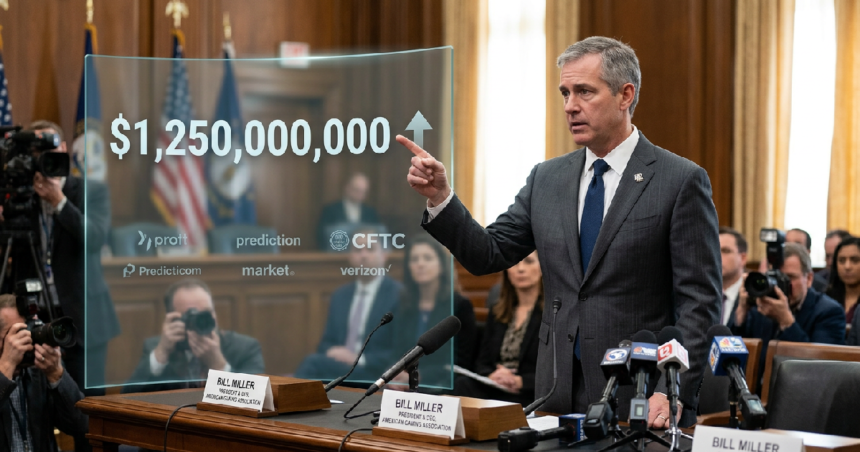
American Gaming Association (AGA) President & CEO Bill Miller announced on Thursday, May 28, 2026, that estimated lost tax revenue from prediction markets has surpassed $1 billion. This fiscal milestone is being used by the AGA to lobby for stricter state-level oversight of platforms like Kalshi, Polymarket, and Robinhood. During an appearance on CNBC’s Squawk Box, Miller argued that these platforms are essentially operating as “backdoor sportsbooks” without paying the licensing fees or taxes required of traditional gambling entities.
The $1 billion figure, tracked live by the American Gaming Association, represents a doubling of the group’s $500 million estimate from February. By framing this as a massive drain on state and tribal coffers, the AGA has successfully recruited a coalition of 41 attorneys general to challenge the current regulatory status quo. These officials argue that the Commodity Futures Trading Commission (CFTC) should not be the sole regulator for what they believe are clearly gambling products.
This debate intensifies as the CFTC asserts its readiness to oversee digital asset markets, including event contracts. While prediction market platforms maintain they offer hedging tools and economic forecasting, the AGA contends that when they offer sports-related contracts, they must fall under the same rigorous state gambling laws that govern licensed sportsbooks and casinos.
Regulatory pressure mounts against prediction market platforms
The AGA is leveraging the billion-dollar claim to highlight what it calls an unlevel playing field. Traditional state-licensed sportsbooks generated $78.7 billion in revenue last year, contributing a massive portion of that to public funds. Prediction markets, however, operate under federal commodities law, which allows them to bypass the state-specific tax rates and community funding mandates that the gaming industry faces.
Bill Miller’s rhetoric on CNBC was particularly sharp, labeling the CFTC a “rogue agency” regarding its handling of event contracts. He emphasized that the dispute isn’t just a corporate rivalry, but a matter of state and tribal sovereignty. According to Miller, if these platforms are allowed to facilitate sports betting under the guise of financial derivatives, they are effectively starving community projects of necessary tax dollars.
State officials are increasingly siding with the gaming lobby. The New York Attorney General recently reported that Kalshi monthly betting volume exceeded $1 billion in 2025, with an estimated 90% of that activity spent on sports-related outcomes. This high volume, combined with relatively lower oversight compared to casinos, has made prediction markets a prime target for state regulators seeking new revenue streams.
The technical divide between derivatives and gambling
The legal friction hinges on a fundamental question: Is a contract on a game’s outcome a financial instrument or a bet? Platforms like Polymarket and Kalshi argue their products provide unique transparency and lower risk than traditional betting. They view themselves as technological evolutions of the financial market, whereas the AGA sees them as a regulatory bypass for sports gambling.
Polymarket, which saw its valuation reach $15 billion in April 2026, has faced scrutiny over its internal resolution mechanisms. In April alone, 230 contracts involving over $1 billion in trading volume were settled through third-party adjudication. This complexity has led some critics to question the long-term utility and stability of these digital asset platforms if they cannot achieve clear legal standing in the United States.
Furthermore, concerns regarding market integrity have surfaced. Reports indicate that nine anonymous cryptocurrency wallets control nearly half of the UMA tokens used to resolve Polymarket disputes. Allegations of insider trading have also emerged, with individuals like Gannon Ken Van Dyke and Michele Spagnuolo reportedly making $400,000 and $1.2 million respectively on well-timed trades.
Future of decentralized betting and state tax implications
The escalation of this conflict suggests a looming federal court battle or a definitive legislative intervention. The AGA’s “State Gaming Tax Dollars Lost” tracker remains a potent psychological tool for lawmakers, providing a concrete number to what was previously a conceptual debate. Every dollar labeled as “lost” is a dollar that state representatives feel belongs in their local budgets.
Prediction markets currently sit in a precarious position. On one hand, they have raised significant capital, with Kalshi securing $1 billion in funding and Polymarket raising $400 million. On the other, the intense focus on tax revenue makes them vulnerable to state-level bans or heavy taxation that could erode their competitive edge over traditional books.
As the market continues to evolve, the distinction between a financial derivative and a gambling product will likely be decided by the outcome of these tax-focused arguments. If the AGA succeeds in convincing more states that prediction markets represent a fiscal threat, the era of light-touch federal regulation for these platforms may be coming to an end. Readers watching the broader market might notice that even as the crypto sector shows resilience in other areas, the regulatory walls are closing in on pure event-based trading.
The outcome will ultimately set the precedent for how all decentralized or digital-first forecasting tools are taxed and governed in the United States. For now, the $1 billion claim serves as a reminder that in the world of regulation, the most effective weapon is often a large, disputed sum of money.