

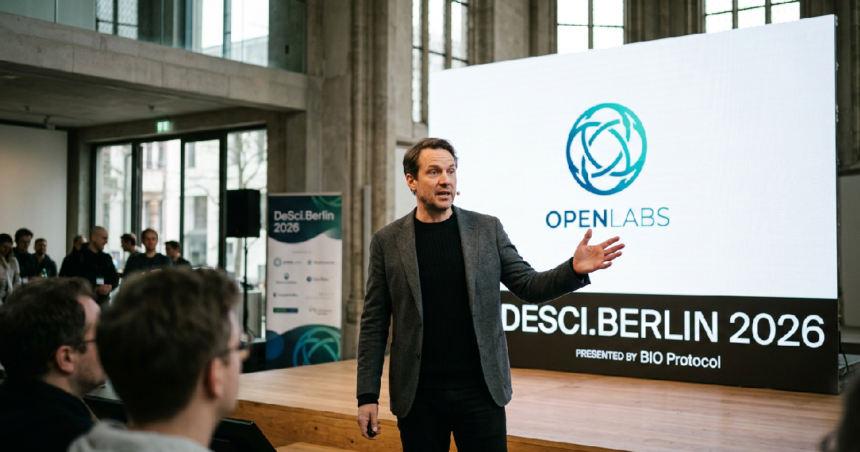
Bio Protocol officially launched OpenLabs, a decentralised AI research hub, on June 19, 2026, during the DeSci.Berlin 2026 event at KÖNIG GALERIE. Founder and CEO Paul Kohlhaas introduced the platform as a direct challenge to traditional scientific grant gatekeepers during Berlin Blockchain Week. The move aims to replace institutional bottlenecks with on-chain governance and artificial intelligence to accelerate biotech discovery.
The OpenLabs platform integrates AI-assisted research development with community-led funding mechanisms, allowing scientists to develop ideas and seek capital through a single interface. By leveraging the BIO token for governance, the protocol enables a collaborative environment where AI-powered workflows help refine scientific hypotheses in real-time.
This focus on long-term technological utility mirrors current shifts in the Cardano price outlook as investors prioritise functional blockchain ecosystems over speculative assets.
Bio Protocol targets institutional bottlenecks with OpenLabs
This initiative follows a period of growth for the Bio Protocol ecosystem, which has already surpassed $33 million in capital raised through its BIO Genesis program. Since 2024, the network has successfully directed more than $50 million in research funding to scientists across the globe.
The protocol seeks to democratise biotech commercialisation by converting research outputs into tradable intellectual property (IP) tokens, providing fractional ownership to those who back early-stage projects.
The core mission of OpenLabs is to dismantle what CEO Paul Kohlhaas describes as the “institutional black boxes” that currently house scientific discovery. Under the traditional model, researchers often wait months or years for grant approvals from centralised bodies. OpenLabs replaces these fragmented tools with a unified environment where researchers and contributors can coordinate experiments without traditional pharmaceutical oversight.
During the launch, CEO Paul Kohlhaas noted that by unifying AI, biotech, and crypto, the platform can potentially compress drug development timelines from decades to months. This decentralisation allows citizen scientists to participate alongside professionals. The move aligns with broader market trends where utility shifts dictate 2026 market performance for major protocols.
The role of BioAgents and autonomous science
A critical component of this new ecosystem is the use of BioAgents, which are autonomous AI co-scientists designed to generate hypotheses and fund experiments on-chain. Scientific results from the first of these agents, Aubrai, have already demonstrated the model’s viability. Within its first weeks after a late August 2025 pilot, Aubrai generated over $900,000 in research funding and minted more than 1,000 scientific hypotheses.
These agents act as economic actors within the protocol. They can identify promising research niches and facilitate the monetisation of resulting discoveries through tokenized IP. This automation reduces the administrative burden on human researchers, allowing them to focus on laboratory execution rather than paperwork. This level of on-chain activity highlights the final proof for digital assets regarding real-world application.
Capital raised and the BIO token performance
Despite the high-profile nature of the launch at KÖNIG GALERIE, the BIO token saw immediate market volatility. In the 24 hours following the OpenLabs announcement, the token’s value declined by more than 8%. This performance came despite the platform’s strong financial backing and the successful deployment of its technical infrastructure during the Berlin event.
The protocol’s financial foundation is supported by a previous $6.9 million funding round anchored by the Maelstrom Fund. Other participants included Mechanism Capital, Animoca Brands, Presto Labs, and a syndicate of biotech-focused investors. Arthur Hayes, the CIO of Maelstrom Fund, stated that Bio Protocol is positioned to be a category-defining launchpad for research the community actually finds appealing, rather than just academics.
Structural advantages of the BioDAO model
The protocol operates through Biotech Decentralised Autonomous Organisations, or BioDAOs, which focus on specific scientific fields such as longevity or rare diseases. These organisations allow community members to vote on which projects receive funding and how the resulting intellectual property is managed. This decentralised oversight ensures that research priorities are aligned with patient and contributor needs.
The Bio Protocol team includes several specialists tasked with scaling this model across different regions and functions. Key figures involved in the protocol’s development include Co-Founder and CPO Clemens Ortlepp and Science Lead James Sinka. Additionally, Strategy Lead William Fang and Head of AI Agency Sean Brennan are working on the next generation of BioAgents to broaden the scope of scientific inquiries.
The success of OpenLabs will ultimately depend on the quality of research it produces and the willingness of the global scientific community to adopt on-chain tools. If successful, the platform could serve as a blueprint for other highly regulated industries seeking to leverage decentralised technology. For now, the protocol remains an experiment in merging raw computing power with human scientific ambition.