

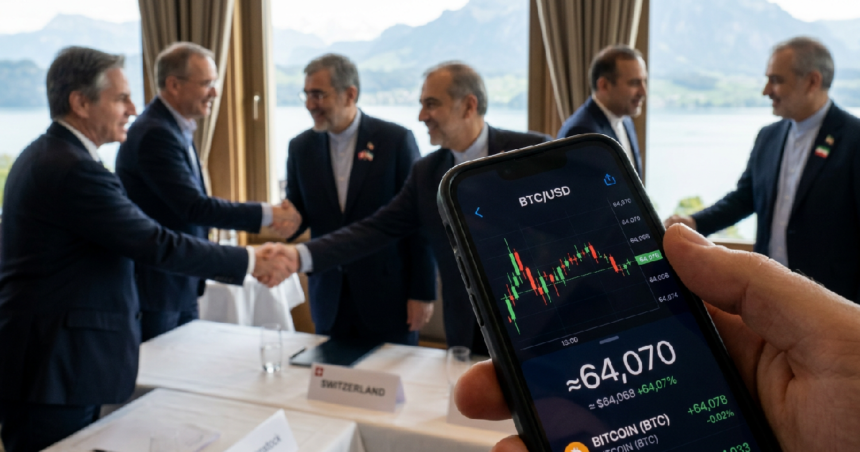
Bitcoin stayed resilient near the $64,000 mark on Sunday, June 21, 2026, as high-stakes permanent ceasefire talks between the United States and Iran commenced in Switzerland.
The market stability follows a period of extreme volatility where Bitcoin surged past $65,500 and briefly touched nearly $66,000 on June 16, 2026, following the initial announcement of a framework peace deal. However, the asset retreated below $63,000 during a broad sell-off on Friday before stabilizing as diplomats gathered at a mountainside resort.
The negotiations at the Qatari-owned Bürgenstock resort involve a U.S. delegation led by Vice President JD Vance and an Iranian contingent headed by Speaker of the Parliament Mohammad Bagher Ghalibaf.
Market performance and the geopolitical risk premium
While the presence of senior officials has offered some optimism, the process is being complicated by Tehran\’s renewed threat to close the Strait of Hormuz. Iran\’s joint military command announced the closure to vessel traffic on Saturday, June 20, 2026, citing Israeli attacks in Lebanon and a perceived breach of commitments by the U.S.
to end the regional fighting.
This geopolitical tension has kept Bitcoin in a consolidation phase, which some market participants believe could lead to an imminent volatility spike as the situation in Switzerland develops. As of Sunday morning, Bitcoin was trading up 1.05% at $64,070.6, reflecting a market that is waiting for a definitive signal from the diplomatic front.
The relationship between global energy security and digital assets has been starkly revealed over the past week. Previously, oil prices fell approximately 5% to settle around $80 per barrel after the mid-June framework peace deal was announced, a significant decline from the $120 highs seen in March 2026.
However, with the Strait of Hormuz effectively closed again, traders are wary that rising oil prices could drag down risk-on assets like Bitcoin. The current price action suggests geopolitics continues to impact the broader crypto market.
While the top cryptocurrency remains roughly flat on the week, other major digital assets showed mixed results on Sunday. Ethereum (ETH) rose 0.5% to $1,734, managing a 3.3% gain over the last seven days. Solana (SOL) added 1.5% to reach $73, while Tron (TRX) gained 1.2%.
The standout performer for the week was Hyperliquid\’s HYPE, which despite slipping 2% on Sunday, remained up 14.8% over the seven-day period. Conversely, Dogecoin (DOGE) was the week\’s laggard, dropping 4.9%.
Diplomatic hurdles at the Bürgenstock summit
The agenda in Switzerland is extensive, covering the unfreezing of billions of dollars in Iranian assets, the lifting of U.S. sanctions on oil exports, and the sensitive nuclear enrichment issue. Vice President JD Vance arrived early Sunday and indicated he could join the talks for a day or two. Parallel to these discussions, U.
S. envoys Steve Witkoff and Jared Kushner also arrived in Switzerland on Saturday to support the diplomatic effort. The talks aim to build upon a memorandum of understanding (MOU) signed last week by President Donald Trump and Iranian President Masoud Pezeshkian.
This MOU established a 60-day window for negotiations, following an initial agreement reached on June 15, 2026, to extend the ceasefire. However, the path to a formal signing is rocky; a ceremony originally expected on Friday in Geneva was postponed after the Iranian delegation raised concerns regarding escalating conflict in Lebanon.
Consequently, an emergency session to address the Israel-Hezbollah conflict has been added to the first day of the Swiss talks, despite the fact that neither Israel nor Hezbollah are formal parties to these specific negotiations.
Current Crypto Market Snapshot (June 21, 2026)
- Bitcoin (BTC): $64,070.6 (+1.05% 24h)
- Ethereum (ETH): $1,734 (+0.5% 24h)
- Solana (SOL): $73 (+1.5% 24h)
- Hyperliquid (HYPE): -2% 24h (+14.8% weekly)
- Dogecoin (DOGE): -4.9% (7-day change)
The uranium enrichment friction point
On Sunday, President Masoud Pezeshkian reiterated that while Iran is willing to provide assurances that it is not seeking nuclear weapons, it will not give up its right to enrich uranium. This remains a significant sticking point for U.S. negotiators and contributes to the “wait-and-see” atmosphere in the markets.
Past trends have shown that Bitcoin often holds steady while other tokens face selling waves during periods of extreme global uncertainty.
If the talks in Switzerland can deliver a durable extension or a move toward a permanent ceasefire, Bitcoin may retest the resistance levels observed earlier in the month. However, if the Strait of Hormuz remains blocked, the resulting energy market shock could force a retest of the $63,000 support level.
For now, the crypto market is acting as a real-time barometer for the success or failure of the Bürgenstock summit.