

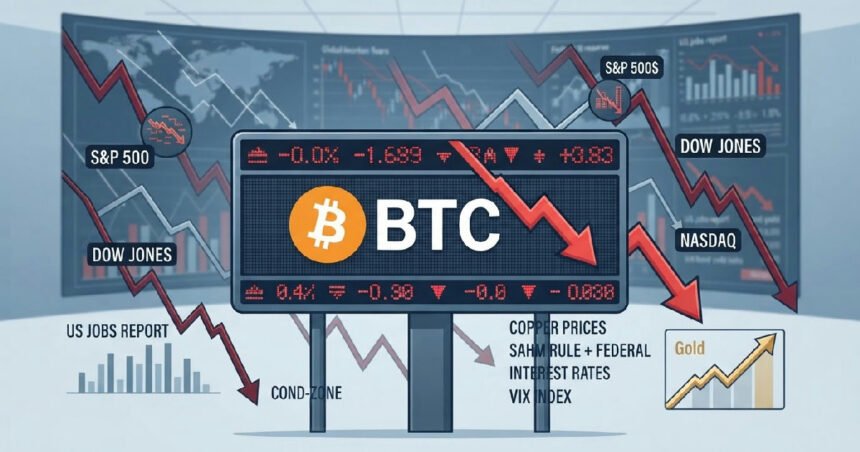
A severe Bitcoin market crash on August 5, 2024, saw the cryptocurrency’s price plummet below $53,000 as fears of a U.S. recession sent shockwaves across global financial markets. The sell-off was widespread, hitting major stock indices and industrial commodities, while investors fled to the traditional safe-haven asset, gold.
This market shift was primarily catalyzed by a weaker-than-expected U.S. jobs report released the preceding Friday, which in turn triggered a key recession indicator.
Understanding the Bitcoin market crash
The day was marked by a dramatic flight from risk, impacting a broad spectrum of assets. Wall Street suffered its worst session in nearly two years, with the S&P 500 plunging 3% and the Dow Jones Industrial Average shedding over 1,000 points.
Bitcoin, often touted by some as a potential hedge, instead traded like a high-risk tech stock, magnifying the downturn and leading to massive liquidations in the crypto derivatives market.
The financial turmoil of August 5, 2024, was not confined to the United States. It began in Asia and swept across Europe, creating a cascade of losses. Japan’s Nikkei 225 index experienced a staggering 12.4% plunge, marking its most severe single-day drop since the 1987 market crash.
Global market events like these often reveal deeper trends about market perception and growth. In Europe, Britain’s FTSE 100 recorded its steepest one-day decline in over a year.
Back in the U.S., the damage was deep and broad. The S&P 500 fell 160.23 points to close at 5,186.33, its largest daily percentage drop since September 2022. The Dow Jones Industrial Average fell 1,033.99 points, or 2.6%, to 38,703.27. Technology stocks, which had led the market for months, were hit particularly hard.
The tech-heavy Nasdaq Composite slid 3.4%, or 576.08 points, to 16,200.08, with giants like Apple and Nvidia caught in the downdraft.
The pain was also felt in the small-cap sector, indicating that investors were shedding risk across the board. The Russell 2000 index, a barometer for smaller American companies, fell 3.3%, or 70.15 points. The market’s ‘fear gauge,’ the CBOE Volatility Index (VIX), surged to an intraday high of 60, signaling extreme panic among traders.
Analysts pointed to a cocktail of negative factors. “Couple economic concerns with the cacophony of earnings disappointments and weak corporate outlooks, global unrest, and currency gyrations, and you have the recipe for sudden volatility,” stated Greg McBride, Bankrate’s chief financial analyst at the time.
Bitcoin crash triggers over $740 million in liquidations
The cryptocurrency market felt the full force of the risk-off sentiment. Bitcoin’s price experienced a breathtaking drop, falling 10% from $58,350 to a low of $52,500 in less than two hours. Such rapid shifts highlight how challenging Bitcoin trading performance can be.
The move pushed the leading digital asset below the $53,000 level for the first time since February 26, 2024, with its price briefly touching $51,224 before finding some support. The average closing price for the day settled at $53,991.46, a 7.1% loss.
This sudden price collapse had a devastating effect on leveraged traders. Within 24 hours, over $740 million in leveraged positions were liquidated across the crypto market. The vast majority of these, more than $644 million, were long positions, meaning traders had bet on the price going up. The rapid decline triggered a chain reaction in the market, particularly affecting Bitcoin derivatives and liquidity.
While the macroeconomic environment was the primary driver, other factors contributed to the crypto-specific upheaval. Concerns were circulating at the time regarding potential mass selling by the prominent crypto trading firm Jump Crypto, adding another layer of uncertainty. The event underscored Bitcoin’s high correlation with risk assets during times of market stress, challenging narratives of it being a disconnected safe haven.
The economic indicator that tipped the scales
The market panic was ignited by a clear economic signal. The July 2024 jobs report triggered the “Sahm Rule,” a recession indicator developed by former Federal Reserve economist Claudia Sahm. The rule posits that a recession has begun when the three-month moving average of the national unemployment rate rises by at least 0.5 percentage points above its 12-month low.
Data showed the three-month average jobless rate had climbed to 4.13%. This was 0.63 percentage points higher than its 12-month low, crossing the threshold and flashing a historically reliable recession warning. “The July jobs report is being viewed as a recession warning, and the markets are responding accordingly,” said Bill Adams, chief economist at Comerica Bank, in his analysis of the situation.
The Federal Reserve was also a focus of criticism. The central bank had held interest rates steady, with many analysts arguing it was waiting too long to begin cutting rates to support the slowing economy. The dismal jobs data and weak forecasts from major technology firms compounded the view that a significant economic downturn was imminent.
Flight to safety buoys gold as bond yields tumble
As investors dumped stocks and crypto, they poured money into traditional havens. Gold was a primary beneficiary of this flight to safety. The price of an ounce of gold rose to $2,408.64, peaking at $2,453.23 during the day’s trading. By 03:35 GMT, spot gold was holding its ground at $2,443.44 per ounce, while U.S. gold futures climbed 0.7% to $2,485.80.
The bond market also reflected the intense demand for safety. Investors rushed to buy U.S. Treasury bonds, pushing their prices up and their yields down. The yield on the benchmark 10-year U.S. Treasury Note, which moves inversely to its price, fell to an intra-month low of 3.79%. This rapid drop in borrowing costs signaled a strong belief among investors that economic trouble was ahead.
The stark divergence was clear: assets sensitive to economic growth, like copper, stocks, and Bitcoin, were punished. Meanwhile, assets perceived as safe during turmoil, like gold and government bonds, rallied. It was a classic risk-off day, driven by the oldest of market motivators: fear.
Lessons from the widespread market downturn
The events of August 5, 2024, served as a powerful reminder of market fragility and the interconnectedness of modern finance. For the crypto industry, it highlighted the risks of high leverage and demonstrated Bitcoin’s vulnerability to broader macroeconomic shocks. This significant downturn underscored how quickly market sentiment can shift, affecting a wide array of asset classes.
The day’s trading patterns solidified Bitcoin’s perception as a high-beta asset for many investors. It behaved like a leveraged play on broader equity markets, amplifying both gains and losses. Rather than acting as a disconnected asset, Bitcoin’s movements reflected the wider economic concerns impacting traditional markets.
Looking back, the sell-off was a textbook response to a credible recession threat. It highlighted the importance of fundamental economic data and the limitations of narratives that decouple any asset class from the global economy entirely. For a single day, fear was the only thing that mattered, and almost every market fell in line.