

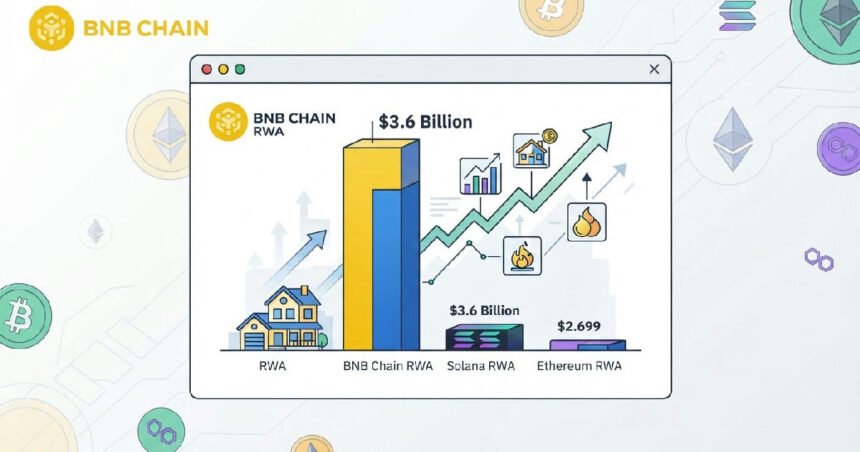
BNB Chain has decisively overtaken Solana as the fastest-growing blockchain for real-world asset (RWA) value, adding a staggering $3.6 billion so far in 2026. This surge positions the network as the new leader in RWA expansion, signaling a major shift in a sector many believe represents the next frontier for digital finance.
The milestone, highlighted in recent data from analytics firm CryptoRank, underscores the escalating competition among top-tier blockchains to dominate the tokenization of tangible, off-chain assets. While rivals also saw gains, BNB Chain’s growth significantly outpaced the field, reflecting increased adoption and a strengthening ecosystem for institutional-grade financial products on its network.
BNB Chain RWA growth leads tokenized assets
BNB Chain’s $3.6 billion year-to-date growth in RWA value puts a considerable gap between it and its primary competitors. The figure demonstrates a clear preference among new RWA projects for the chain’s infrastructure, which balances low transaction costs with high throughput, an attractive combination for developers and institutions looking to bring assets on-chain.
Solana, previously a frontrunner in this space, secured the second position with a respectable $2.6 billion increase in RWA value over the same period. While still a strong showing, it’s a full billion dollars behind BNB Chain’s pace. The data suggests that while real-world asset tokenization on Solana remains robust, BNB Chain has captured the lion’s share of new momentum this year.
Further down the rankings, the Stellar network came in third, adding $2.5 billion in RWA value. Its performance indicates that the competition for this burgeoning market extends beyond the top two players, with specialized chains finding significant traction. The RWA sector is not a monolith, and different networks are appealing to different use cases within the broader tokenization trend.
The broader market context
This individual chain-level competition is happening within a market that is experiencing explosive growth. The total value of tokenized real-world assets across all blockchains has surged by approximately $39 billion since the beginning of 2026. This represents an increase of over 50%, highlighting a clear and accelerating trend of bridging traditional financial assets with the efficiency and transparency of blockchain technology.
Ethereum’s surprisingly sluggish growth
In a surprising twist, Ethereum recorded comparatively slow growth in its RWA value despite maintaining the largest overall market share of tokenized assets. The network added just $1.6 billion during the same period, placing it in a distant fourth place behind BNB Chain, Solana, and Stellar in terms of year-to-date expansion.
This lag in growth momentum is significant. While Ethereum’s mature and secure ecosystem holds a vast amount of existing RWA value, its high transaction fees and lower speeds may be steering new and more experimental RWA projects toward more nimble competitors. The cost of minting and managing tokenized assets on Ethereum’s mainnet can be prohibitive for projects that require high transaction volumes.
The data suggests a critical divergence: Ethereum serves as a deep, stable reservoir of existing value, while chains like BNB Chain are acting as the primary growth engines attracting the next wave of assets. This dynamic could have long-term implications for market dominance if the trend continues.
Developers may increasingly opt for platforms that offer a lower barrier to entry and faster iteration cycles, even if it means sacrificing some of Ethereum’s deep-rooted decentralization. Exploring cross-chain solutions for altcoin interoperability will be key for projects navigating this fragmented landscape.
What’s behind the multichain RWA boom?
The $39 billion explosion in RWA value this year isn’t happening in a vacuum. It’s fueled by the tangible benefits that blockchain tokenization brings to traditionally illiquid and cumbersome asset classes. By representing assets like real estate, private credit, art, and commodities as digital tokens, owners unlock a host of advantages.
Chief among these benefits is liquidity. A token representing a fraction of a commercial building can be traded on secondary markets far more easily than a physical deed. This process allows asset owners to access capital without selling the entire asset, while investors gain exposure to markets that were previously inaccessible. This fractionalization democratizes investment opportunities across the board.
Furthermore, blockchain technology provides an immutable and transparent record of ownership, reducing the risk of fraud and streamlining administrative processes. Transactions that once took days or weeks and involved costly intermediaries can now be settled in minutes. For assets like private credit funds and U.S. Treasuries, this efficiency translates directly into lower costs and higher potential yields for investors, a powerful incentive driving institutional adoption.
A strategic victory for the BNB ecosystem
Securing the top spot in RWA growth is more than just a bragging right for BNB Chain; it’s a strategic victory that could create a powerful flywheel effect. Leadership in a high-growth narrative like RWA attracts developers, institutional partners, and, crucially, capital.
As more high-value assets are tokenized on BNB Chain, the network’s total value locked (TVL) increases, making its DeFi ecosystem more robust and attractive.
This success also helps BNB Chain solidify its identity as a versatile, institutional-grade platform, moving it beyond its initial perception as primarily the blockchain for the Binance exchange. For rival Solana, this development represents a direct challenge.
Solana has heavily marketed its high-speed, low-cost architecture as the ideal home for the future of finance, and losing its lead in RWA growth could prompt a strategic response, potentially through new grants and initiatives like the DeFi development offering seen previously.
The road ahead for real-world assets
The race to become the dominant platform for real-world assets is still in its early innings. While BNB Chain has claimed the lead in 2026’s growth sprint, the landscape remains intensely competitive. Ethereum’s massive network effect and security assurances cannot be discounted, especially as Layer 2 scaling solutions mature and begin to mitigate high transaction costs.
Ultimately, the long-term winner will be the ecosystem that can provide the optimal blend of security, scalability, low fees, and—perhaps most importantly—a clear framework for regulatory compliance. Institutions entering the space demand certainty and a stable environment for their assets. As regulators worldwide continue to formulate rules for tokenized securities, the chains that work proactively to meet these standards will be best positioned for success.
For now, BNB Chain is celebrating a significant milestone that validates its development strategy and positions it at the forefront of one of crypto’s most promising sectors. But in the fast-moving world of blockchain technology, maintaining that lead will require continuous innovation and adaptation as the multi-trillion-dollar opportunity of RWA tokenization unfolds.