

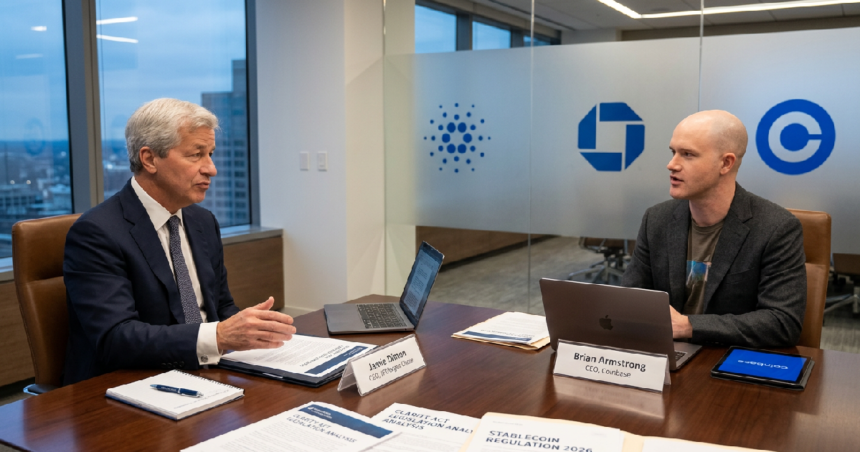
JPMorgan Chase CEO Jamie Dimon has reportedly issued a sharp critique of Coinbase Global CEO Brian Armstrong, signaling a major hardware-and-software clash over the direction of federal crypto policy. At a recent industry gathering, the JPMorgan Chase leader took aim at what he characterized as an aggressive and costly lobbying campaign led by the Coinbase executive to advance the Clarity Act through the United States Congress.
These developments suggest that JPMorgan Chase plans to actively oppose the current version of the bill, potentially stalling a major legislative push for digital asset regulation.
The intensifying dispute highlights a fundamental disagreement between the traditional banking establishment and the digital asset industry. While Brian Armstrong has positioned the Clarity Act as a vital framework for bringing legal certainty to stablecoins, Jamie Dimon has suggested the proposed law could compromise the safety of the American financial system. This rare individual call-out by the JPMorgan Chase CEO indicates that the bank views this specific legislative effort as a competitive threat to the established financial order.
A primary point of contention involves the regulatory standards for stablecoin issuers and how they overlap with traditional banking rules. Reports suggest the New Clarity Act blocks interest payments on stablecoins, a measure intended to prevent these assets from functioning as unregulated deposit accounts. However, JPMorgan Chase reportedly remains concerned that the legislation still allows non-bank entities to access the payments infrastructure without facing the same capital requirements as commercial banks.
Banking sector concerns over stablecoin legislation
JPMorgan Chase and its peers in the banking industry appear worried that the Clarity Act would create a parallel financial system with lighter oversight. Jamie Dimon has long argued for a level playing field, suggesting that any firm performing bank-like functions should be regulated exactly like a bank. This stance puts him in direct opposition to Brian Armstrong, who argues that digital asset firms require a bespoke regulatory path to avoid stifling technology that could modernize global payments.
And yet, the banking giant is not entirely against the underlying technology. JPMorgan Chase has developed its own internal blockchain solutions for settlement while simultaneously lobbying against broader crypto-asset legislation. The current friction suggests this battle is less about technology and more about which institutions will dictate the rules of the road. If the bank successfully lobbies to change the bill, it could significantly alter how digital assets are integrated into the mainstream economy.
The legislative environment is already complex, with several agencies vying for authority over the burgeoning sector. While some officials believe the CFTC is ready to oversee crypto markets, the banking sector continues to push for the Federal Reserve to maintain primary control over any asset that resembles a dollar-backed instrument. This tug-of-war between regulators further complicates the path forward for Coinbase and other digital asset exchanges.
Impact on market sentiment and institutional growth
The rift between Brian Armstrong and Jamie Dimon is likely to influence how institutional investors weigh the risks of entering the crypto space. Coinbase currently acts as a primary bridge for large-scale players, but continued legislative gridlock in Washington could cause some firms to hesitate. Without a clear federal mandate, the industry remains stuck in a cycle of litigation and shifting enforcement priorities that many had hoped the Clarity Act would resolve.
For decentralized projects like Cardano, a lack of regulatory progress impacts more than just stablecoins. The legal status of various tokens often hinges on broader definitions of digital assets, making federal clarity a high-priority issue. A recent Cardano price outlook as ADA seeks return to dollar mark suggests that regulatory sentiment remains a critical variable for long-term project viability and investor confidence during this period of transition.
The outcome of this lobbying duel may determine whether the American crypto industry move towards a structured federal framework or remains under fragmented state and agency oversight. If Jamie Dimon and other banking leaders manage to block or significantly dilute the Clarity Act, the move-fast approach favored by Brian Armstrong face a long period of stagnation. For now, the future of stablecoin regulation rests on whether the tech lobby can outmaneuver the deep political connections of the established financial elite.