

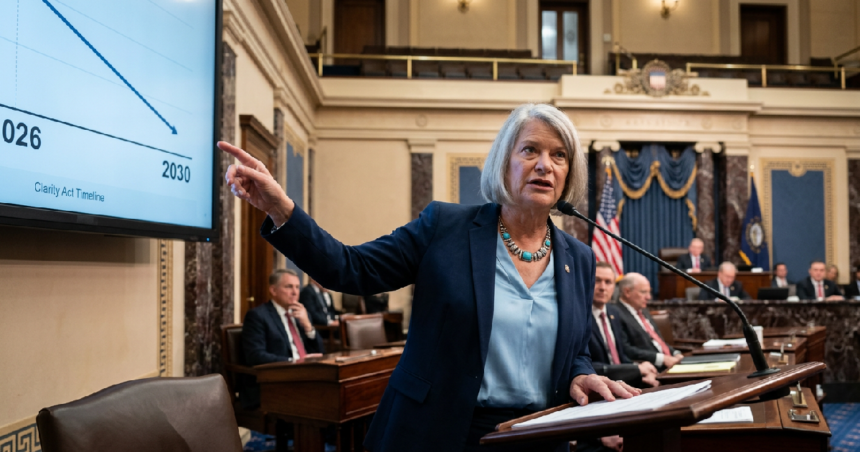
U.S. Senator Cynthia Lummis (R-WY) has warned that the window to pass the Digital Asset Market Clarity Act will effectively slam shut until 2030 if Congress fails to finalize the bill this session. In a statement posted to X on May 29, 2026, the Wyoming lawmaker emphasized that the fast-approaching November midterms have created a “now or never” scenario for cryptocurrency market structure. Her warning comes as the legislative calendar shrinks, leaving only a small number of weeks to navigate the final hurdles in the Senate.
The urgency stems from a fragile political alignment that Senator Cynthia Lummis believes may not survive the 2026 elections. S. House of Representatives, the Senate Banking Committee, and the White House have all shown support for the framework.
However, analysts suggest Republicans risk losing House seats in November, a move that could shift the legislative agenda away from digital assets for years. “If we miss this session, the next chance will be 2030,” Senator Cynthia Lummis told media outlets, citing the time required to seat a new Congress and rebuild bipartisan consensus.
The impact of this potential delay reaches beyond Capitol Hill into the broader digital economy. Supporters of the bill argue that the current regulatory ambiguity is driving innovation toward offshore jurisdictions like Abu Dhabi and Singapore. Without the narrowing window for crypto regulation being utilized now, firms may continue to seek legal certainty outside the United States. Senator Cynthia Lummis noted that American developers currently remain “exposed with no legal protections” simply for publishing open-source code.
Senate Banking Committee clears path for market structure reform
Progress on the Digital Asset Market Clarity Act reached a milestone on May 14, 2026, when the Senate Banking Committee approved an updated version of the bill. The committee passed the measure with a 15 to 9 bipartisan vote, following months of negotiations over stablecoin yield provisions and ethics language. This followed the bill’s successful passage in the House of Representatives on July 17, 2025, where it garnered a 294 to 134 bipartisan majority.
The legislation seeks to draw clear jurisdictional boundaries between the Securities and Exchange Commission (SEC) and the Commodity Futures Trading Commission (CFTC). It classifies digital assets into three specific categories: digital commodities, investment contract assets, and permitted payment stablecoins. Under the proposed “mature blockchain test,” certain tokens could eventually move from SEC oversight to the CFTC once their underlying networks reach a sufficient level of decentralization.
com/cardano-price-prediction-2026-2032-ada-recovery-analysis/”>Cardano price outlook depends heavily on regulatory status for broader institutional integration.
Despite the committee’s approval, the bill still faces a daunting climb to reach the president’s desk. A full Senate floor vote would require 60 votes to overcome a potential filibuster, a high bar in a polarized election year. While President Donald Trump has publicly backed the bill as a national priority, the competing priorities of a midterm campaign season threaten to push the CLARITY Act off the floor schedule entirely.
Protecting decentralized protocols and developer rights
A key provision within the bill, specifically Section 604, aims to address long-standing fears within the developer community. This “Blockchain Regulatory Certainty Act” provision would exempt non-custodial developers and decentralized protocols from being classified as money transmitters. Senator Cynthia Lummis has been a vocal advocate for these protections, arguing that developers should not be targeted by law enforcement for the mere act of writing and publishing code.
The bill also includes measures to restrict the development of central bank digital currencies (CBDCs) and provides specific tools for law enforcement to target actual criminal activity. Senator Cynthia Lummis argues that without these specialized tools, federal agencies are forced to rely on outdated statutes that do not account for the nuances of decentralized finance. The legislation would establish the CFTC as a primary regulator for digital commodities, moving away from the “regulation by enforcement” model currently employed by the SEC.
For Senator Cynthia Lummis, the clock is ticking on a personal level as well. Having announced in December 2025 that she will not seek a second Senate term, her tenure in Washington will conclude in January 2027. She has framed the passage of the Clarity Act as a final effort to ensure the United States does not “surrender its financial future” to global competitors. If the 2030 forecast holds true, the U.S. crypto sector may face four years of continued litigation and market uncertainty.
Forecasting the final weeks of the legislative session
Market participants are closely watching the odds of the bill becoming law before the end of the year. Currently, predictions on Polymarket price the chance of the Clarity Act passing in 2026 at approximately 58%. These odds reflect the bill’s significant progress in committee but also account for the historical difficulty of passing major financial reforms during an election cycle where committee compositions are likely to change.
If the bill fails to reach a floor vote, the industry must wait for a reconciliation between the House and Senate versions under a new Congress. Senator Cynthia Lummis warns that such a reset would be catastrophic, as it would dismantle the current bipartisan coalition. ” law enforcement remains without the tools to hold bad actors accountable,” she noted, suggesting that a failed bill leaves both the industry and the public at risk from the current regulatory vacuum.
The coming weeks will determine if the Senate leadership prioritizes a floor vote for the Clarity Act. While the Senate Agriculture Committee has cleared its version, the window for a final signature from President Donald Trump is narrowing by the day. As Senator Cynthia Lummis maintains, the choice for Congress is now between immediate clarity or a mandatory freeze on progress that could last until the next decade.