

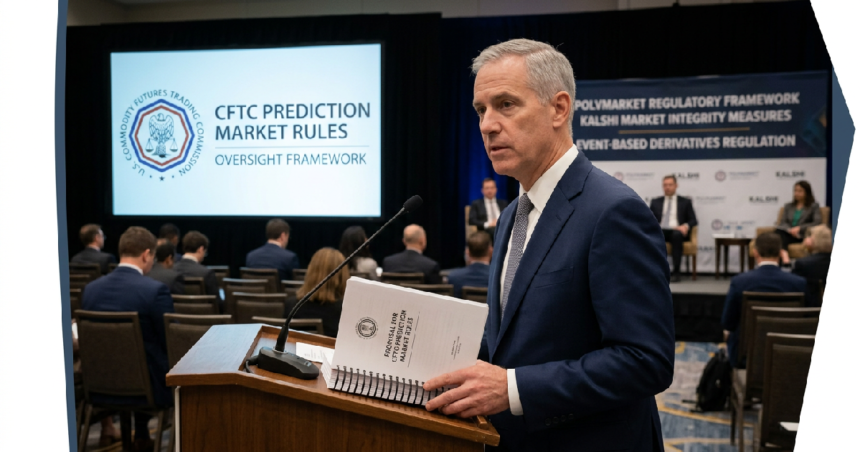
The U.S. Commodity Futures Trading Commission (CFTC) unveiled a 267-page regulatory proposal on Wednesday, June 10, 2026, targeting the rapidly expanding prediction market sector. CFTC Chairman Michael S.
Selig announced the framework, which aims to replace previous blanket bans on specific contract types with a case-by-case assessment model that will directly impact platforms such as Polymarket and Kalshi.
The proposal seeks to establish a durable, transparent system for identifying the crowd-sourced intelligence contracts that serve the public interest while filtering out those that do not.
The timing of the announcement marks a significant shift in federal sentiment toward event-based derivatives. Chairman Michael S. Selig noted that the agency intends to protect market integrity without blocking responsible innovation within the space.
This move follows a period of intense legal and legislative scrutiny, including a March 2026 introduction of the “DEATH BETS Act” and a federal judge’s 2024 ruling that the regulator had previously overstepped its authority by trying to block election contracts on the Kalshi platform.
Industry leaders have already begun positioning themselves for the new era of oversight. Shayne Coplan, CEO of Polymarket, claimed via social media that the announcement effectively gives his platform a “green light” to continue expansion. This follows Polymarket’s strategic $112 million acquisition of QCEX, a regulated exchange, which helped facilitate the crypto-based platform’s return to the United States market in late 2025.
Establishing a gold standard for prediction market oversight
For years, the U.S. Commodity Futures Trading Commission has grappled with how to classify contracts that act as a hybrid of gambling and financial hedging. Former CFTC Chairman Rostin Behnam previously described prediction markets as tools that deliver measurable value for information reliability.
He argued in April 2026 that crowd-sourced data could provide a “gold standard” for economic forecasting if properly regulated under a federal umbrella rather than a patchwork of state laws.
President Donald Trump has also voiced support for this centralized federal approach. By having the CFTC as the exclusive oversight body, the administration believes it can provide a single, consistent framework for firms. Supporters argue this prevents the confusion of state-by-state regulation while ensuring that the agency is ready to oversee the crypto market effectively as it matures into a mainstream financial asset class.
The proposed rules specifically target the loophole identified by former CFTC Commissioner Kristin Johnson. Before her departure in late 2025, she warned that firms were securing licenses for traditional financial products and then pivoting to prediction markets without sufficient guardrails.
The new 267-page document intends to close these gaps by requiring clear disclosures and rigorous public interest tests for every new contract type listed on an exchange.
Assessing the impact on Polymarket and Kalshi operations
The immediate practical effect of these rules will be felt at the operational level for major exchanges. Kalshi, a federally-regulated exchange, did not wait for the final rule to be published before acting. On Tuesday, June 9, 2026, the company announced three new “market integrity” measures.
These include risk scoring for participants, employment verification for certain high-stakes bettors, and expanded whistleblower tools to combat potential price manipulation.
Polymarket faces a different set of challenges as a crypto-native entity. While it used regulated brokerages to return to the U.S. in November 2025, its massive global volume continues to draw attention.
For instance, a single market regarding the future leadership of Iran generated $14 million in trading volume on Polymarket, while a similar contract on Kalshi saw approximately $1.6 million. The CFTC proposal asks whether such contracts provide genuine hedging value or merely facilitate speculative wagering.
The agency must also address concerns raised by a U.S. House panel regarding insider trading. Because prediction markets rely on the speed of information, they are susceptible to participants who have non-public knowledge of political or corporate outcomes.
The new framework will likely mandate stricter monitoring of “event-based” contracts to ensure they remain as reliable as traditional financial derivatives like the recovery path for Cardano or other major digital assets.
The 45-day window for public and industry feedback
Now that the proposal is public, a 45-day comment period will commence following its publication in the Federal Register. This window allows developers, traders, and legal experts to weigh in on specific criteria used to judge “public interest.” Commissioner Summer K. Mersinger previously stated that election event contracts are “here to stay,” but the technical specifics of price discovery and liquidity remain heavily debated topics.
If the rules are finalized as proposed, they could take effect as early as 60 days after the conclusion of the comment period. This timeline suggests the market could be operating under an entirely new set of federal guidelines by the end of 2026.
This would end years of “regulation by enforcement” where companies faced sudden settlements for offering contracts that the agency later deemed illegal.
The focus on “legitimate markets” suggests that the CFTC is moving away from the skepticism of the early 2020s. However, the agency remains cautious about contracts linked to illegal activities or sensitive humanitarian issues. The “DEATH BETS Act” remains a looming legislative threat that could override agency discretion if Congress decides specific contract categories are fundamentally unethical, regardless of their financial utility.
Future outlook for event-based derivatives and blockchain markets
The shift toward “crowd-sourced intelligence” as a legitimate financial tool marks a turning point for the industry. Rather than viewing these platforms as simple betting sites, the CFTC is beginning to treat them as sophisticated information processors.
Analysts suggest that this recognition could lead to increased institutional participation, as hedge funds look for new ways to hedge against political or geopolitical risks that traditional markets often struggle to price.
As the crypto market window shifts toward utility in 2026, prediction markets stand out as one of the most successful applications of blockchain technology. The decentralized nature of Polymarket allows for global liquidity, while the regulated structure of Kalshi provides a blueprint for institutional compliance. The CFTC’s goal is to bring these two worlds closer together through a unified set of rules.
The final outcome of this rulemaking process will determine whether the United States remains a hub for financial innovation or if the industry migrates to offshore jurisdictions. For now, the crypto and prediction market communities appear cautiously optimistic.
By providing a clear roadmap instead of a closed door, the CFTC has signaled that while the wild west days are over, the era of regulated, high-volume event trading is only just beginning.