

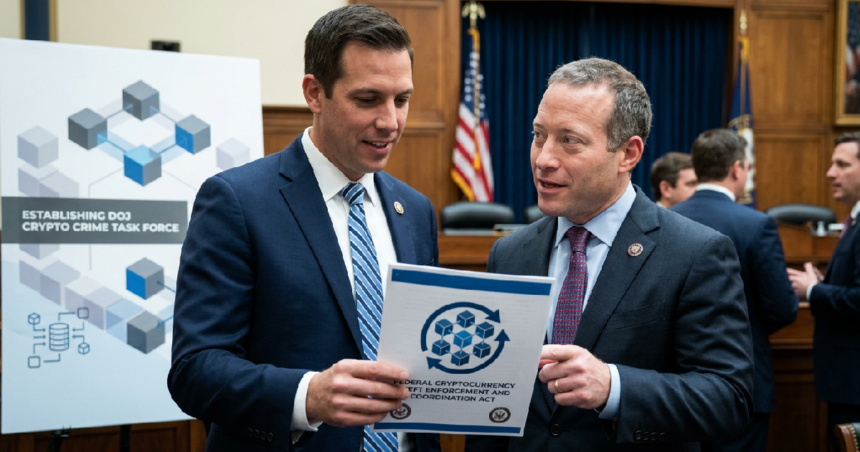
U.S. House Representatives Lance Gooden and Josh Gottheimer introduced the Federal Cryptocurrency Theft Enforcement and Coordination Act on Thursday, June 11, 2026, to establish a specialized task force within the Justice Department.
The bipartisan bill seeks to create a unified federal response to digital asset crime following the 2025 disbanding of the National Cryptocurrency Enforcement Team (NCET). The new body would coordinate investigations across participating agencies and develop standardized guidance for local law enforcement on evidence collection and blockchain forensics.
The legislative push comes after a shift in Department of Justice (DOJ) policy led to the dissolution of its dedicated crypto investigations unit. On April 7, 2025, Todd Blanche issued a memo titled “Ending Regulation By Prosecution” to all DOJ employees, which immediately disbanded the NCET.
This decision followed an executive order signed by President Donald Trump on January 23, 2025, aimed at strengthening American leadership in digital financial technology. While the order focused on fostering innovation, lawmakers now argue that the lack of a coordinated strategy has left Americans vulnerable to thieves.
Rep. Lance Gooden, a Republican member of the House Judiciary Committee, noted that Washington currently lacks a strategy to stop criminals from stealing billions from U.S. citizens. “As digital assets shape the future of finance, this bill protects consumers, cracks down on thieves, and strengthens trust in the crypto ecosystem,” Gooden stated.
Representative Josh Gottheimer, a Democrat on the House Financial Services Committee, joined as a co-sponsor to ensure the initiative remains a bipartisan priority in the current session.
Structure of the Federal Cryptocurrency Theft Task Force
The proposed Federal Cryptocurrency Theft Task Force would be established within the Justice Department and chaired by the Attorney General. Its membership would include senior representatives from the Department of Homeland Security (DHS), the Treasury Department, and various federal law enforcement agencies.
Unlike broad regulatory bodies, the House bill specifies that the task force’s scope focuses only on criminal enforcement and coordination to protect innovation. This distinction aims to separate essential policing from the debates over market oversight.
A primary function of the task force will be to bridge the gap between federal resources and local police departments. The bill mandates the development of standardized guidance for local law enforcement on blockchain forensics and victim support. This is a critical move as
com/crypto-market-forecast-2026-narrowing-window-analysis/\”>crypto market window shifts
Support for a unified federal response
Industry advocates have generally welcomed the proposal as a necessary step for market maturity. Dennis Porter, the CEO and Co-Founder of Satoshi Action Fund, stated that the task force provides the unified federal response that investigators and local law enforcement have been missing.
Porter emphasized that the framework respects local control and operates on a voluntary basis. The Digital Chamber added that the bill would provide the resources needed to trace illegal activity and pursue criminals effectively.
This legislative movement occurs as many digital assets face significant price fluctuations. For instance, the Cardano price outlook frequently hinges on the perceived security and utility of its ecosystem. By formalizing enforcement, proponents believe investors will have greater confidence in the safety of their holdings.
This is particularly relevant given that the task force is designed to help local agencies support victims who might otherwise have no recourse after a theft.
The SAFE Crypto Act and Senate collaboration
While the House bill focuses on theft enforcement, the U.S. Senate is pursuing a broader inter-governmental framework through the SAFE Crypto Act. Led by Senators Jerry Moran and Elissa Slotkin, this legislation was originally introduced on December 12, 2025.
Senator Mike Crapo, a senior member of the Senate Committee on Banking, Housing and Urban Affairs, signed onto the bill on May 20, 2026. This act proposes a task force chaired by the Treasury Department rather than the Attorney General.
Senator Mike Crapo highlighted the severity of the issue, stating that cryptocurrency scams accounted for nearly half of all U.S. cybercrime losses last year. The SAFE Crypto Act aims to identify and combat fraud through a mix of federal agencies, law enforcement, and private sector stakeholders.
This approach suggests a growing consensus in Congress that current protections are insufficient to safeguard Americans from a “growing threat” that increasingly bypasses traditional financial safeguards.
Public-private partnerships in blockchain intelligence
The Senate’s legislation places a heavy emphasis on real-time disruption through collaboration with the private sector. Ari Redbord, the Global Head of Policy at TRM Labs, noted that the legislation enables public-private collaboration using blockchain intelligence to track illicit networks as activity occurs.
Redbord argued that bringing industry and law enforcement together is the only way to meaningfully reduce the ability of criminals to exploit transformative technologies for harm. The act requires an update to relevant committees within a year of its launch.
The interplay between these two bills reflects a broader effort to provide clarity in a market often plagued by jurisdictional uncertainty. Some critics previously suggested that the CFTC was ready to take a leading role in market oversight.
However, both the House and Senate bills redirect the focus toward task forces that prioritize criminal investigation and scam protection. This shift suggests that lawmakers are less interested in “regulation by prosecution” and more concerned with establishing a permanent infrastructure for consumer safety.