

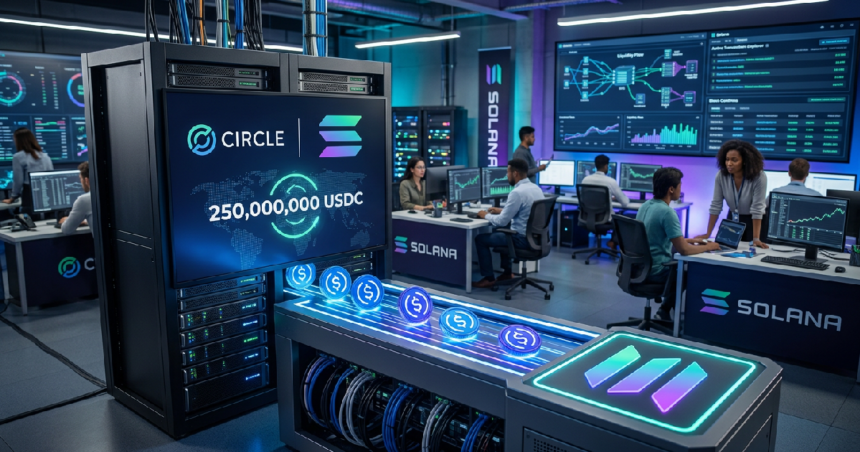
Circle has expanded the liquidity of its dollar-pegged stablecoin, USDC, by issuing an additional 250 million tokens on the Solana blockchain. This significant minting event, observed on-chain over the last six hours, underscores the network’s continuing role as a primary corridor for digital dollar transactions and decentralized finance (DeFi) activity.
The move comes at a time when Solana’s ecosystem is seeing a sustained period of high transactional volume. While other networks have struggled with escalating gas fees and congestion, Solana has maintained its position as a preferred venue for high-velocity trading and retail-facing applications. By injecting a quarter-billion dollars in fresh liquidity, Circle is responding to a clear demand for stable, dollar-denominated assets within this specific environment.
Meeting the Demand for On-Chain Liquidity
The mechanics of this issuance are straightforward but tell a larger story about market confidence. When Circle mints new tokens, it typically does so in response to institutional demand or to ensure that specific liquidity pools on decentralized exchanges remain deep enough to handle large-scale swaps without excessive slippage.
And it’s not just about trading. Stablecoins like USDC are increasingly used for cross-border settlements and as collateral for lending protocols. On Solana, where sub-second finality is the standard, 250 million USDC can move through dozens of hands in a matter of minutes, facilitating a level of capital efficiency that legacy banking systems simply cannot match.
The timing is also worth watching. As the broader market matures, the digital asset industry faces a final test for global utility. The concentration of stablecoin liquidity on high-speed networks suggests that the industry is moving away from purely speculative assets toward those that provide actual functional value.
The Competition for Stablecoin Dominance
Circle’s decision to bolster the Solana supply highlights the competitive landscape between major blockchain networks. While Ethereum remains the traditional home for much of the world’s locked value, its high transaction costs have pushed a significant portion of the stablecoin economy toward secondary layers and alternative blockchains.
Solana has capitalized on this shift. By offering a faster and cheaper alternative, it has attracted a diverse array of developers and users. However, this growth brings its own set of challenges. Critics often point to the network’s history of intermittent outages as a risk factor for managing large amounts of stablecoin capital. Despite these concerns, Circle’s latest minting suggests that institutional players are comfortable with the network’s current stability and performance levels.
This issuance also contrasts with the regulatory environment facing yield-bearing assets. While the New Clarity Act blocks interest payments on stablecoins in certain jurisdictions, the demand for non-yield-bearing “pure” stablecoins like USDC remains robust because they serve as the essential plumbing for the rest of the ecosystem.
Looking Toward Institutional Integration
As we move through 2026, the integration of stablecoins into traditional finance is no longer a theoretical exercise. We are seeing major banks and payment processors incorporate these assets into their backend systems. The 250 million USDC issued today isn’t just a number on a ledger; it represents the fuel for a new type of financial infrastructure.
Expect to see more of these “liquidity injections” as Solana continues to scale. If the network can avoid the technical pitfalls that have plagued it in the past, it may well become the primary settle-layer for the next generation of global fintech applications. For now, the successful minting and distribution of such a large sum without a hitch is a vote of confidence in Solana’s technical maturity.
Frequently Asked Questions
How does this issuance affect the price of Solana?
While minting USDC doesn’t directly change the price of SOL, it is generally seen as a “bullish” indicator. More USDC on the network usually leads to higher trading volumes and more activity in DeFi protocols, which increases the demand for SOL to pay for transaction fees.
Is this 250 million USDC backed by real dollars?
Yes, Circle maintains that every USDC token in circulation is backed 1:1 by cash and short-dated U.S. Treasuries held in segregated accounts at regulated U.S. financial institutions. These reserves are regularly audited to ensure transparency.
Why did Circle choose Solana for this specific mint?
Circle issues USDC on multiple blockchains, but they frequently add supply to Solana because of its high throughput and low fees. Users on Solana tend to move stablecoins more frequently than those on Ethereum, necessitating a constant supply of fresh liquidity to keep markets running smoothly.


