

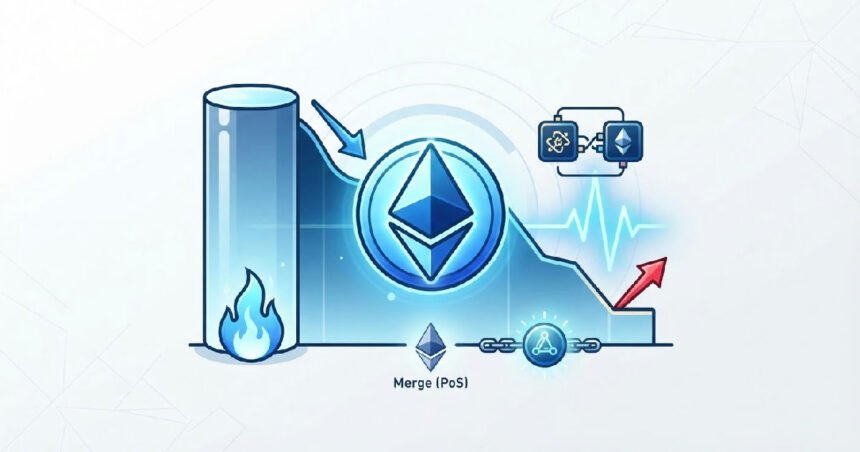
Ethereum, the world’s second-largest cryptocurrency by market capitalization, has undergone profound economic shifts through a series of key network upgrades. These changes, notably EIP-1559 and “The Merge,” aimed to curb the supply of its native token, Ether (ETH), initially leading to periods of significant deflationary pressure.
Understanding Ethereum’s deflationary impact is crucial for grasping its monetary policy, which remains a dynamic system, with recent upgrades causing a return to mild inflation.
Understanding these mechanisms is crucial for anyone tracking the digital asset space. The network’s inherent design now fundamentally alters how ETH enters and exits circulation. This evolution directly impacts its perceived value and long-term scarcity.
Understanding Ethereum’s Deflationary Impact
Ethereum’s journey towards a potentially deflationary model is anchored in two major technical overhauls. These upgrades reshaped how transactions are processed and how new ETH is created. They established a new paradigm for the network’s economic future.
The fundamental shift brought about by these overhauls signifies a deliberate move away from previous inflationary tendencies, where an ever-increasing supply of ETH was minted. By introducing mechanisms that either destroy tokens or drastically reduce their issuance, the network aimed to imbue ETH with characteristics more akin to a store of value.
This strategic re-engineering was vital for long-term sustainability and to enhance its appeal as a global settlement layer.
This evolving economic policy is a direct response to the community’s desire for a more predictable and potentially scarcer asset. It reflects a sophisticated understanding of tokenomics, moving beyond simple supply caps to active supply management. The impact of these changes extends beyond mere price action, influencing how developers build, how users interact, and how investors perceive Ethereum’s future trajectory.
EIP-1559: The Burn Mechanism
The Ethereum Improvement Proposal (EIP-1559), activated during the London Hard Fork in August 2021, fundamentally changed transaction fee dynamics. It replaced the previous auction system with a protocol-set “base fee” that adjusts with network congestion. Crucially, this base fee is permanently removed from circulation, or “burned,” rather than being paid to validators.
Only an optional “priority fee” or tip goes to the validator securing the transaction. This burning mechanism has directly reduced the total supply of ETH, making it scarcer over time. Since its implementation, approximately 4.6 million ETH has been burned.
The Merge: Reducing Issuance
September 2022 saw the monumental “Merge” upgrade, transitioning Ethereum from a Proof-of-Work (PoW) to a Proof-of-Stake (PoS) consensus mechanism. Under PoW, miners received newly issued ETH for their computational work. The shift to PoS means validators now stake their ETH as collateral to secure the network, earning rewards in newly minted ETH.
This transition drastically cut the rate of new ETH issuance. Before The Merge, about 13,000 ETH was issued daily to PoW miners, in addition to roughly 1,600-1,700 ETH for Beacon Chain stakers. Post-Merge, daily issuance plummeted to only about 1,700 ETH for PoS validators, representing an 88-90% reduction.
Some have likened this dramatic decrease to three Bitcoin halvings happening simultaneously, underscoring its significant impact on ETH supply.
Summary of ETH Daily Issuance Pre- and Post-Merge
The “Ultrasound Money” Vision and Subsequent Shifts
Following The Merge, Ethereum initially experienced net deflationary periods. Its supply decreased by roughly 300,000 ETH in the year immediately after the transition. This led Ethereum researcher Justin Drake to coin the term “ultrasound money,” suggesting ETH’s decreasing supply could make it a superior store of value compared to Bitcoin’s fixed supply.
This strong initial deflationary trend fostered significant optimism within the Ethereum community, reinforcing the narrative that the network’s upgrades were successfully transforming ETH’s monetary properties. The “ultrasound money” moniker became a popular expression for this new economic paradigm, highlighting a key differentiator from other cryptocurrencies. It posited a future where ETH’s value proposition would be bolstered by its continuously shrinking supply, assuming consistent network activity.
However, the network’s supply dynamics are not static. They are significantly influenced by ongoing network activity and further protocol upgrades. This highlights the complex, evolving nature of Ethereum’s monetary policy, where periods of deflation can be followed by mild inflation depending on transaction volumes, gas prices, and the pace of new ETH issuance to validators.
This constant flux underscores the adaptive design of Ethereum’s economic model.
What is EIP-1559?
EIP-1559 is an Ethereum Improvement Proposal implemented in August 2021 that changed the transaction fee mechanism. It introduced a base fee for transactions, which is “burned” or permanently removed from circulation, making ETH scarcer over time.
How did The Merge impact ETH supply?
The Merge transitioned Ethereum to Proof-of-Stake, drastically reducing the issuance of new ETH. Daily issuance plummeted by 88-90%, from approximately 14,600-14,700 ETH per day (PoW) to about 1,700 ETH per day (PoS).
What does “ultrasound money” mean in the context of Ethereum?
“Ultrasound money” is a term coined by Ethereum researcher Justin Drake to describe ETH’s potential to become a superior store of value due to its decreasing supply. This vision suggests that with burning mechanisms and reduced issuance, ETH’s supply could actively shrink, in contrast to Bitcoin’s fixed but not decreasing supply.
Is Ethereum’s supply always deflationary?
No, Ethereum’s supply dynamics are not static. While EIP-1559 and The Merge introduced deflationary pressures, the actual supply change depends on network activity (affecting the amount of ETH burned) and the amount of ETH staked (affecting new issuance). Periods of mild inflation can occur if the amount of ETH issued to validators outweighs the amount burned from transaction fees.