

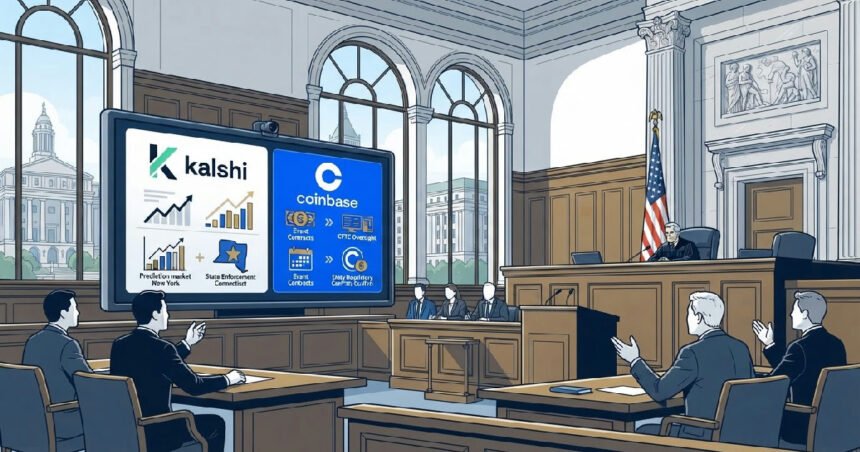
The Second Circuit denied Kalshi and Coinbase’s requests to halt enforcement actions by New York and Connecticut regulators on October 29, 2024. S. Court of Appeals for the Second Circuit delivered a significant setback to Kalshi Inc. and Coinbase Global Inc.
on October 29, 2024, denying their requests to temporarily halt enforcement actions by New York and Connecticut regulators. This decision by the Second Circuit regarding Kalshi and Coinbase has significant implications.
This ruling means both states can proceed with their lawsuits against the prediction market operators while the companies’ broader appeals are still pending. The court found that Kalshi and Coinbase failed to demonstrate a clear likelihood of success on their federal preemption arguments or that they would suffer irreparable harm without the pause.
Second Circuit Kalshi Coinbase Decision Upholds State Regulatory Authority
This decision, outlined in a concise two-page order, leaves unresolved the fundamental legal question of whether federal commodities law supersedes state gambling regulations for event contracts. It stems from earlier district court losses for both companies, which had sought to block state-level interventions into their operations.
The ongoing legal battle highlights the growing tension between federal and state oversight in the rapidly evolving prediction market space.
The Second Circuit’s panel, comprising Circuit Judges Michael H. Park, William J. Nardini, and Beth Robinson, explicitly stated that Kalshi Inc. and Coinbase Global Inc. did not make the necessary showing for an injunction pending appeal.
Their decision centered on the companies’ inability to prove a clear likelihood of success on the merits of their preemption argument. The court also found they had not adequately demonstrated they would suffer irreparable harm if the state actions continued.
This ruling allows the New York State Department of Financial Services (NYDFS) and the Connecticut Department of Banking to move forward with their respective cease-and-desist orders. These orders allege that the event contracts offered by Kalshi and Coinbase constitute illegal gambling under state law. The states are effectively cleared to pursue their cases without federal court intervention for now.
The core preemption argument at stake
At the heart of the legal dispute is the argument by Kalshi and Coinbase that their event contracts fall under the exclusive jurisdiction of the Commodity Futures Trading Commission (CFTC). They contend that the federal Commodity Exchange Act (CEA) preempts state gambling laws.
Kalshi, as the first prediction market platform to achieve Designated Contract Market (DCM) status from the CFTC, has long maintained that this federal approval shields its operations from state-level interference.
The CFTC itself has supported this stance, filing its own lawsuits against various states. The federal derivatives regulator argues that state actions against federally registered derivatives exchanges undermine its exclusive authority. This includes the commission's efforts to regulate these nascent markets and protect against practices like insider trading.
A spokesperson for Kalshi expressed disappointment, reiterating the belief that the CFTC holds exclusive jurisdiction over these regulated contracts. Similarly, Coinbase affirmed its commitment to offering innovative products within a clear regulatory framework. They indicated they would continue engaging with regulators as the appeals process unfolds. The outcome of the larger preemption argument could significantly reshape the regulatory landscape for digital assets and prediction markets.
State actions and financial implications
The denial of the injunction carries significant financial implications for both Kalshi and Coinbase. New York has already sued Kalshi in state court, seeking damages that could reach at least $36 billion. This substantial claim underscores the severity with which state regulators view the alleged violations of their gambling laws.
Connecticut’s Attorney General, William Tong, also initiated a state-court suit against Kalshi in August, mirroring New York’s concerns. For Coinbase, the stakes have rapidly increased, as prediction markets now generate over $200 million in annualized revenue for the exchange, according to its third-quarter results. This substantial revenue stream is now directly exposed to state enforcement actions.
The ongoing legal actions mean both companies face considerable legal costs and potential liabilities. They must continue to defend their business models in state courts. State officials contend their actions are vital for consumer protection, citing concerns about minors, problem gambling, and the safety of consumer funds. These issues remain central to the states' arguments against the companies' operations.
A divided legal landscape
The Second Circuit's decision further highlights a growing division among federal appellate courts regarding the preemptive scope of the CEA. While the Third Circuit previously sided with Kalshi in a New Jersey dispute, both the Ninth Circuit (Nevada) and the Sixth Circuit (Ohio, Tennessee) have rejected Kalshi's preemption arguments.
This creates a patchwork of legal interpretations across the country, complicating the regulatory environment for prediction markets.
Judicial skepticism has also emerged regarding the classification of event contracts. During the Second Circuit hearing, Judge John M. Walker Jr. questioned how sports betting could legitimately be considered a swap, which typically involves underlying financial, economic, or commercial consequences. Judge Joseph F.
Bianco remarked that applying the swap definition to sports outcomes felt like “forcing a square peg into a round hole.” This judicial perspective underscores the challenges in fitting novel financial instruments into existing regulatory frameworks.
CFTC's evolving regulatory approach
The Commodity Futures Trading Commission (CFTC) has been actively grappling with how to regulate prediction markets. The agency's stance has evolved, particularly after withdrawing a proposal for broad categorical bans on event contracts in early 2026.
Subsequently, the CFTC initiated an Advance Notice of Proposed Rulemaking, followed by a proposal titled “Prediction Markets; Public Interest Determination.” These actions signal a concerted effort by the federal regulator to establish a comprehensive framework for event contracts.
On October 9, 2026, the CFTC publicly released proposed rules that would amend its regulatory definition of “swap” to explicitly include event contracts based on sports, politics, cultural, and weather-related events. This move aims to provide clearer guidelines.
Yet, a broad coalition of states, including 41 attorneys general, continues to argue that prediction market contracts are indistinguishable from sports betting. They’ve submitted comments to the CFTC to that effect. This ongoing pushback suggests that regulatory clarity remains elusive.
Implications for the future of prediction markets
The Second Circuit's refusal to pause state actions places prediction market companies in an uncertain position. Without interim federal protection, Kalshi and Coinbase must navigate ongoing state lawsuits and potential enforcement actions. This legal pressure could significantly impact their operations and growth trajectories in New York and Connecticut.
The rulings highlight the continued battle over jurisdiction between state and federal authorities. They also bring attention to the definition of what constitutes a “swap” versus illegal gambling.
The current legal environment underscores the need for greater regulatory harmonization. The conflicting judicial opinions and evolving CFTC rules create a complex operational landscape for businesses. As the appeals proceed, the industry will closely watch for any definitive rulings on federal preemption.
The outcomes will likely set precedents for how event contracts are treated across the United States. This will affect not only established players but also emerging platforms in the decentralized finance space. The ultimate resolution could fundamentally alter how prediction markets operate and expand.