

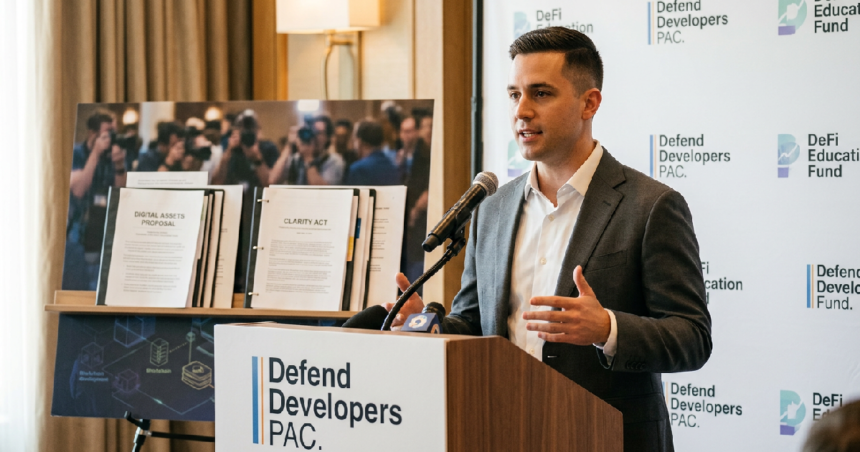
Gavin Zavatone, policy lead at the DeFi Education Fund, announced the launch of the Defend Developers PAC on Wednesday, June 3, 2026. This new hybrid political action committee (PAC) is the first of its kind exclusively dedicated to supporting members of Congress who champion legal protections for crypto developers and decentralized finance (DeFi) builders. The organization focuses on influencing the U.S. Senate as it evaluates the Digital Asset Market Clarity Act, commonly known as the CLARITY Act.
The committee enters the political arena with a broad base of institutional support. Its board and backers include executives and policy leads from the DeFi Education Fund, Solana Policy Institute, Uniswap Labs, American Innovation Project, and Orca Creative. This collective aims to provide a unified voice for software engineers who build permissionless blockchain infrastructure, ensuring they are not unfairly targeted by broad financial regulations.
The PAC’s primary goal is to advocate for provisions that shield developers from liability for how third parties use their decentralized software. This specific legal battle is critical as the crypto market window closes and industrial utility becomes the primary driver of value. Without clear protections, proponents argue that American innovation in decentralized technology could be stifled by legal risks.
Shielding DeFi builders from money transmitter liability
At the center of the legislative effort is Section 109 of the CLARITY Act, which incorporates the Blockchain Regulatory Certainty Act (BRCA). This provision seeks to ensure that developers and infrastructure providers are not classified as money transmitters if they do not take custody of user funds. By establishing this distinction, the bill would protect engineers from being held responsible for illicit activities conducted by users on decentralized platforms.
Gavin Zavatone highlighted the ongoing friction between the developer community and federal regulators. “For too long, developers building decentralized technologies have faced regulatory uncertainty and enforcement actions instead of clear rules and guidelines,” Gavin Zavatone stated. He noted that many policymakers still do not fully grasp how decentralized software development differs from traditional financial services.
The PAC plans to raise and deploy more than a six-figure sum across dozens of congressional races during the current midterm elections. Funding will primarily come from crypto founders, builders, and executives who have a direct stake in the outcome of the BRCA provisions. This financial push is intended to reward incumbents who have actively supported the developer community.
Bipartisan momentum and law enforcement concerns
The CLARITY Act (H.R. 3633) already passed the House in July 2025 and secured a 15-9 bipartisan victory in the Senate Banking Committee last month. It has now been placed on the Senate Legislative Calendar for floor consideration. However, the path forward requires reconciling different versions of the text between the Senate Banking and Senate Agriculture committees.
Despite the momentum, the bill faces opposition from several law enforcement organizations. These groups argue that the BRCA provision could make it more difficult to investigate illicit financial activity by creating regulatory blind spots. To counter this, 160 former national security and intelligence officials signed a letter organized by the Blockchain Association, arguing that the bill actually preserves the ability of investigators to pursue bad actors.
This legislative movement occurs as other agencies signal their readiness for digital asset oversight. Some analysts note that Michael Gillick says the CFTC is ready to manage crypto markets, which could complement the commodity-based framework the CLARITY Act aims to establish. The PAC’s role is to ensure developer protections aren’t traded away during these multi-agency negotiations.
Navigating compromises in the United States Senate
Senate Majority Leader John Thune has not yet scheduled the legislation for a full floor vote. Negotiations remain sensitive, particularly after a recent compromise aimed at securing Democratic support removed language that would have extended protections to certain Bank Secrecy Act-related sanctions requirements. This shows the tightrope developers must walk to achieve even basic legal clarity.
For the broader ecosystem, these legal protections are seen as a prerequisite for long-term growth. Projects remain vulnerable when governance and participation are high, a factor that often influences metrics like the Cardano price outlook during recovery phases. The Defend Developers PAC argues that the very existence of decentralized finance in the U.S. depends on codifying the “toolmaker” distinction.
By focusing on the midterm elections, the PAC hopes to install a cohort of lawmakers who view software development as a protected activity. If successful, the passage of the CLARITY Act with BRCA intact would mark the most significant legal victory for crypto developers since the industry’s inception. For now, Gavin Zavatone and his backers are focused on the immediate task of funding campaigns and educating the Senate.