

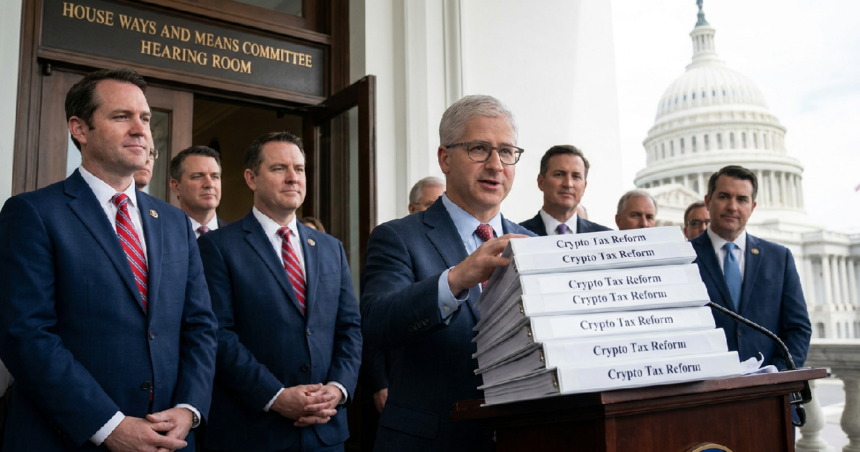
The House Ways and Means Committee is convening today, June 9, 2026, for a full committee hearing to discuss seven new legislative drafts aimed at reformulating the U.S. crypto tax code.
House Republicans officially unveiled these proposals on June 5, 2026, opting to break down the previously broad Digital Asset PARITY Act into targeted, standalone bills. This tactical shift seeks to provide immediate clarity on specific industry pain points, including the taxation of staking rewards and network transaction fees.
The legislative activity in the House coincides with intensifying negotiations in the Senate over the Digital Asset Market Clarity Act of 2025, commonly known as the CLARITY Act. Lawmakers from the Senate Banking and Agriculture committees are working to combine separate versions of the bill into a unified framework.
Supporters are eyeing a potential floor vote before the August 2026 recess, or more conservatively, following the return from recess after July 13, 2026.
These developments create a significant administrative pivot for the industry. While XRP momentum restarts on the back of recent liquidity trends, the regulatory environment in Washington is shifting toward concrete definitions. The seven House bills are derived from the original PARITY Act, which was introduced in December 2025 by Representative Max Miller (R-OH) and Representative Steven Horsford (D-NV).
Tax Clarity for Mining and Staking Activities
A central pillar of the new House package is the \”Tax Clarity for Mining and Staking Act.\” This proposal tackles the controversial practice of taxing digital assets at the moment they are generated.
Under this draft, tokens created through mining or staking would be exempt from a holder’s taxable income until the assets are actually sold or disposed of. This would move tax obligations to the point of realized gain.
Industry advocacy groups, including the Digital Chamber, the Blockchain Association, and the Crypto Council for Innovation, have welcomed the decision to move forward with these standalone drafts. They argue that breaking the PARITY Act into smaller components offers a clearer path toward legislative success. The goal is to simplify a reporting process that many currently find opaque or prohibitively complex.
Streamlining Network Gas Fee Reporting
The \”Less Tax Paperwork for Digital Asset Owners Act\” seeks to reduce the accounting burden for everyday users. It proposes a $10 de minimis tax exemption for crypto network transaction fees, often called gas fees. This would allow an individual taxpayer to exempt up to 5,000 such transactions per year from tax reporting requirements.
This change is specifically designed to eliminate the need for micro-calculation of fees on high-frequency networks.
Such reforms are particularly relevant as digital assets move toward broader utility. Investors looking at various XRP price projections often consider how regulatory friction impacts adoption. By removing the tax-reporting headache for small network fees, the bill could facilitate more seamless interaction with decentralized protocols and cross-border payment rails.
Senate Negotiations and Law Enforcement Concerns
While the House focuses on the internal revenue code, the Senate is attempting to establish a comprehensive market structure through the CLARITY Act. This legislation aims to define the jurisdictional boundaries between the Securities and Exchange Commission (SEC) and the Commodity Futures Trading Commission (CFTC). The bill is a top priority for those seeking a permanent end to the \”regulation by enforcement\” era.
However, the bill faces scrutiny from the executive branch. White House officials are scheduled to host law enforcement groups on Wednesday, June 10, 2026, to address specific concerns regarding the CLARITY Act. These discussions will likely center on how the proposed market rules might impact the ability of agencies to monitor illicit financial activities and maintain existing anti-money laundering standards.
Wash Sales and Stablecoin Classifications
The House tax reform drafts also address several technical areas of the tax code that have previously been applied inconsistently to digital assets. One proposal would apply the wash sale rule under IRC § 1091 to digital assets.
This would prevent taxpayers from claiming a loss if a substantially identical asset is reacquired within 30 days of a sale, aligning crypto with traditional securities and constructive sale rules under IRC § 1259.
Stablecoin transactions would also see a major shift under a \”deemed-basis rule.\” This provision would treat regulated, dollar-pegged payment stablecoins similarly to cash for tax purposes. No gain or loss would be recognized on a sale or exchange unless the taxpayer’s basis is less than 99% of the asset’s redemption value. This effectively removes the capital gains requirement for most stablecoin-to-fiat transactions.
Expert Testimony and the Road Ahead
Today’s full committee hearing at the House Ways and Means Committee includes a diverse panel of experts. Witnesses from Fidelity, Coinbase, Coin Center, and New York University are expected to offer testimony on how these seven bills would impact the broader ecosystem.
One particular point of interest is a proposal for a voluntary disclosure program to help users address past tax reporting issues given the evolving IRS guidance.
The legislative momentum marks a departure from the gridlock of previous years. In April 2025, Public Law 119-5 was signed into law, which nullified an IRS rule requiring DeFi platforms to report as \”brokers.\” That resolution, which passed the House 292–132 and the Senate 70–28, showed a rare bipartisan appetite for narrow crypto reforms.
Lawmakers are now testing whether that same consensus can be reached for tax and market structure.
Final negotiations for the CLARITY Act remain fluid as committees reconcile their different versions. Whether a vote occurs before or after the July 13 return date, the dual focus on tax and structure suggests Congress is moving toward a more settled regulatory state. For market participants, these shifts could finally provide the long-sought roadmap for domestic digital asset operations.