

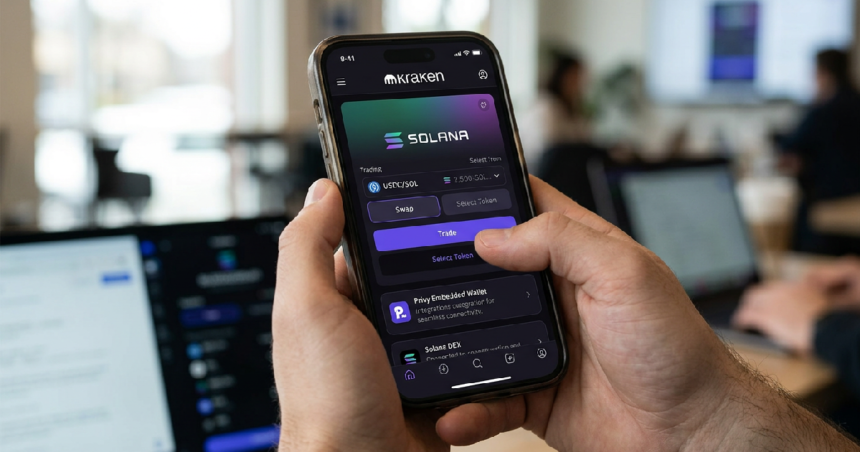
Kraken officially launched an integrated Solana decentralized exchange (DEX) trading feature within its core mobile application on June 18, 2026, marking a major shift in how the exchange handles on-chain liquidity.
Chief Data Officer Kamo Asatryan confirmed the move, which utilizes embedded wallet technology from Privy to allow users to swap nearly 2,500 verified Solana tokens using their existing USD or USDC balances.
This development effectively bridges the gap between the platform’s traditional centralized interface and the rapidly expanding ecosystem of long-tail assets on the Solana blockchain.
The new functionality allows eligible customers in the United States and more than 100 other countries to access early-stage tokens that are not typically listed on major centralized exchanges.
By removing the need for external software wallets, seed phrase management, or complex bridging processes, Kraken aims to lower the barrier to entry for decentralized finance (DeFi). The exchange characterizes this strategy as the “DeFi mullet”—maintaining a clean, professional user interface in the front while leveraging decentralized protocols behind the scenes for execution.
Transactions within the app are designed for speed and cost-efficiency, with trade settlement times typically clocking in under 60 seconds and network fees often staying below one cent. However, convenience comes with a cost; Kraken is implementing a flat 1% technology fee on every swap.
To protect users from the volatility inherent in low-liquidity pools, the system also applies an automatic 3% slippage cap on all market orders, ensuring that trades do not execute at prices significantly worse than the quoted rate.
Expanding the Solana ecosystem via embedded wallet technology
The backbone of this integration is the embedded wallet infrastructure provided by Privy, which enables a self-custodial experience without the typical technical friction. Unlike traditional exchange balances, these on-chain assets are held in wallets where Kraken does not control the private keys.
This distinction is vital for users who prioritize ownership, yet the interface keeps everything streamlined by displaying these DEX-based holdings alongside standard exchange assets in the main portfolio view.
As the crypto market window closes and focuses more on specific utility, Kraken’s move to index 2,500 verified tokens suggests a push toward capturing volume from the “memecoin” and early-utility sectors.
These tokens are identified within the app by a specific DEX label or icon, distinguishing them from assets that have undergone Kraken’s full corporate listing process. This enables the exchange to offer a vast catalog without the regulatory or liquidity burdens of a formal spot listing.
Market order execution and liquidity protocol support
Kraken’s DEX feature does not operate its own liquidity pools but instead routes orders through leading Solana DEX protocols, such as Jupiter. This ensures that users receive competitive rates by tapping into the deepest liquidity available on-chain.
Because these are third-party protocols, Kraken clarified that it does not control order fills, timing, or final execution prices, which can fluctuate rapidly in the seconds before a trade is finalized.
For many traders, this direct access simplifies a formerly fragmented process. Users no longer need to transfer funds to a browser extension or worry about maintaining a separate balance of SOL for gas fees, as the interface handles these technical hurdles automatically. This move mirrors broader trends where com/morgan-stanley-bitcoin-wealth-management-expansion-2026/”>institutional platforms expand access to more sophisticated crypto tools for a wider range of clients, though Kraken remains focused on the retail mobile experience.
Future expansions and the competitive landscape for on-chain trading
While the current rollout is limited to the Solana network, Kraken has explicitly stated that support for additional blockchains is in the pipeline. Industry analysts expect Ethereum and its prominent Layer 2 networks, such as Base, to be the next logical additions.
This expansion would put Kraken on a direct collision course with Coinbase, which has already integrated similar DEX aggregation tools into its primary platform to capture on-chain volume.
Kamo Asatryan emphasized the philosophy of simplicity in a statement on Thursday, noting that no one should feel “intimidated by bridges, gas fees, or other technical barriers” when trying to participate in on-chain markets.
This push for accessibility comes at a time when decentralized exchange volume remains a significant portion of total crypto activity, holding at roughly 13.25% of the total spot trading market share for June 2026.
Managing risk in decentralized token markets
Despite the streamlined interface, Kraken issued several warnings regarding the risks of DEX trading. These assets are often highly volatile and have not undergone the same level of legal or security auditing as assets officially listed for spot trading on the exchange. The inclusion of a token via the DEX interface does not constitute an endorsement or an investment recommendation from the firm.
Furthermore, since the feature is self-custodial, users must understand that Kraken cannot “roll back” transactions or recover funds if a third-party protocol experiences a failure. As market signals cool in other sectors, the high-octane environment of on-chain trading continues to attract those looking for the next breakout asset, making these simplified gateways a primary focus for exchange growth throughout the remainder of 2026.
Key details of the Kraken Solana DEX integration
- Asset Access: Nearly 2,500 verified tokens from the Solana ecosystem available at launch.
- Funding Options: Swaps are executed using existing USD or USDC balances within the mobile app.
- Fee Structure: A 1% Kraken technology fee plus standard Solana network fees (usually <$0.01).
- Custody Model: Self-custodial via Privy; Kraken does not hold the private keys for DEX-traded assets.
- Trade Controls: Automated 3% slippage cap to protect against extreme price swings during execution.
The integration represents another step in Kraken’s broader push into specialized services, following the rollout of its DeFi Earn vaults and its ongoing work on the Ink Layer 2 project.
As the company prepares for an eventual public offering, building a comprehensive “super app” that covers both centralized and decentralized markets appears to be a core pillar of its growth strategy for the digital asset landscape.