

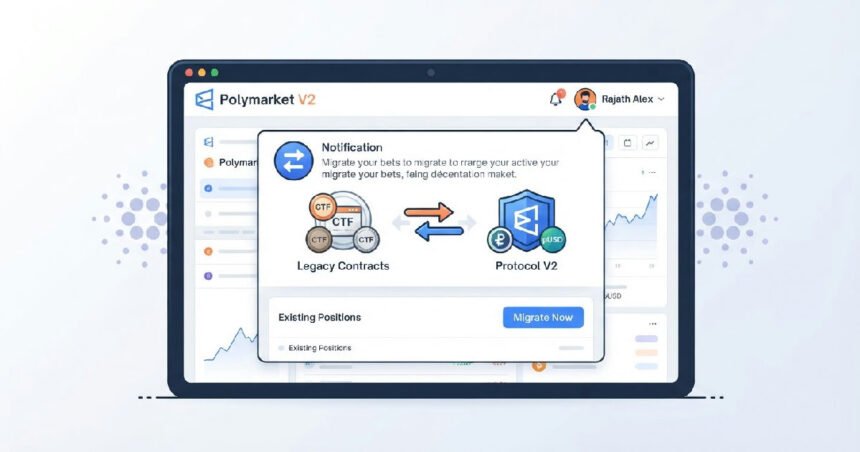
Polymarket, a prominent decentralized prediction market platform, initiated its Protocol V2 upgrade on October 5, 2026. Head of Protocol Rajath Alex confirmed that this significant overhaul will not automatically transfer existing user bets from the legacy Conditional Tokens Framework (CTF) to the new system, requiring users to actively manage their positions.
The rollout began with live test markets, known as canary markets, which are set to run until October 30, 2026.
Polymarket protocol v2 non-automatic migration
This major architectural shift aims to replace an aging patchwork of smart contracts with a more unified and modular system. While the move promises greater efficiency and scalability for future markets, it places the onus on developers and some users to adapt to the new framework, with newly created markets tentatively switching to Protocol V2 on November 2, 2026.
The core of Polymarket’s Protocol V2 rollout is its non-automatic migration of existing bets. Users holding positions under the older Conditional Tokens Framework (CTF) will find their holdings remaining in place on the legacy ledger. This means no spontaneous transfer of assets to the new V2 contracts.
For individuals accessing Polymarket via its app or website, no complex technical migration is necessary. They’ll mainly encounter approval prompts within the application itself. But for developers and integration partners, the transition is more involved.
Integrating entities must maintain support for these older CTF positions while concurrently building out a separate infrastructure for the new V2 positions. This includes implementing distinct identifiers and signing rules for V2 transactions, separating them from the legacy system. Existing CTF permissions won’t automatically grant approval for V2 operations.
Essentially, the change mandates that trading software selects the correct share identifier based on each market’s version. V2 orders will use position IDs and signing-domain version 3, whereas CTF orders will retain their exchange and signing-domain version 2. This distinction is crucial for routing trading paths correctly.
Developers will also need to update how they handle balance requests and payout reads, ensuring they can differentiate between V2 shares and older CTF shares. This dual support ensures that the existing markets continue to function seamlessly while new markets leverage the advanced capabilities of Protocol V2.
From Patchwork to Precision: The Architectural Overhaul
Polymarket’s decision to transition to Protocol V2 stems from the inherent limitations of its previous system. The original framework, built on Gnosis’s 2019 Conditional Tokens Framework, relied on layering new contracts for each market type. This approach, while functional, ultimately led to significant “architectural bloat” and reduced overall efficiency.
Protocol V2 represents a fundamental re-engineering, consolidating the system into a more streamlined and robust architecture. It introduces a single ERC-1155 position-token contract, which simplifies how market positions are represented and managed. This unified approach replaces the fragmented nature of the old system.
Moreover, the upgrade mandates pUSD, Polymarket’s native stablecoin, as the sole collateral token across all market types. pUSD is an ERC-20 token designed to wrap USDC and USDC.e at a 1:1 ratio, streamlining collateral management. The protocol also features a new OracleAggregator system, connecting to various external oracles like UMA and Chainlink for more reliable and diversified market resolution.
Initial modules within V2 support four distinct market types: binary, atomic neg-risk, incremental neg-risk, and combinatorial. This modular design not only enhances current functionality but also paves the way for future upgrades, which can be implemented through a dedicated governance process. The architecture even includes provisions for moving positions and collateral across different blockchains, a capability to be activated as Polymarket expands its network presence.
Developer Obligations and Security Assurance
The transition to Polymarket Protocol V2 places specific and critical responsibilities on developers and third-party integrations. These entities are tasked with a four-week canary period, from October 5 to October 30, to thoroughly integrate the new system. This timeframe is essential for adapting their trading software to handle the intricacies of V2 positions alongside existing CTF holdings.
A key requirement involves managing separate permissions. For V2 transactions, the account holding a buyer’s assets must specifically authorize ExchangeV3, the new trading contract, to spend sufficient pUSD for purchases and associated fees. Similarly, selling V2 shares demands explicit permission for ExchangeV3 to operate on the seller’s PositionManager shares. Legacy CTF permissions do not extend to these new V2 operations.
The Data API V1 is slated for retirement on October 24, 2026, compelling developers to migrate to V2 routes. This migration is crucial for maintaining functionality and accessing the updated market data. Polymarket is supporting this transition by offering weekly office hours, providing direct assistance for integration challenges.
Security has been a paramount concern throughout the Protocol V2 development. Polymarket engaged six independent security firms — Cantina, Certora, Quantstamp, Sigma Prime, Zellic, and Pashov Audit Group — to conduct comprehensive audits. The protocol also underwent formal verification by Certora, a rigorous process that mathematically proves the correctness of the smart contracts.
To further bolster its defenses, Polymarket has established a bug bounty program, offering substantial rewards of up to $5 million for critical vulnerability findings.
Polymarket’s Broader Ambitions and Market Trajectory
The launch of Polymarket Protocol V2 is not an isolated event but rather a continuation of the platform’s strategic evolution. It follows closely on the heels of other significant upgrades earlier in 2026, such as the CLOB V2, which went live on April 28, 2026.
That earlier upgrade revamped exchange contracts, the matching engine, and introduced pUSD as the primary collateral for trading, setting the stage for the deeper structural changes of Protocol V2.
These architectural enhancements underpin Polymarket’s ambitious growth trajectory within the prediction market space. By April 2026, Polymarket and its rival Kalshi had collectively surpassed $150 billion in lifetime trading volume, a substantial leap from Polymarket’s approximately $9 billion in volume for all of 2024 alone. This rapid expansion highlights the increasing mainstream interest in decentralized prediction platforms.
The company has also been actively strengthening its leadership and operational capabilities. Rajath Alex, now Head of Protocol, joined Polymarket in May 2026, bringing fresh expertise to the technical leadership. Additionally, Travis VanderZanden, known for founding Bird and his executive roles at Uber and Lyft, was appointed as chief growth officer, signaling a clear intent for aggressive market penetration.
Further cementing its position, Polymarket is reportedly engaged in discussions to secure a substantial funding round, aiming to raise $1 billion at a staggering $21 billion post-money valuation. Reports suggest that 1789 Capital is prepared to contribute approximately $300 million to this round.
Such investments reflect strong investor confidence in Polymarket’s long-term vision and its potential to redefine how information and events are traded on the blockchain.