

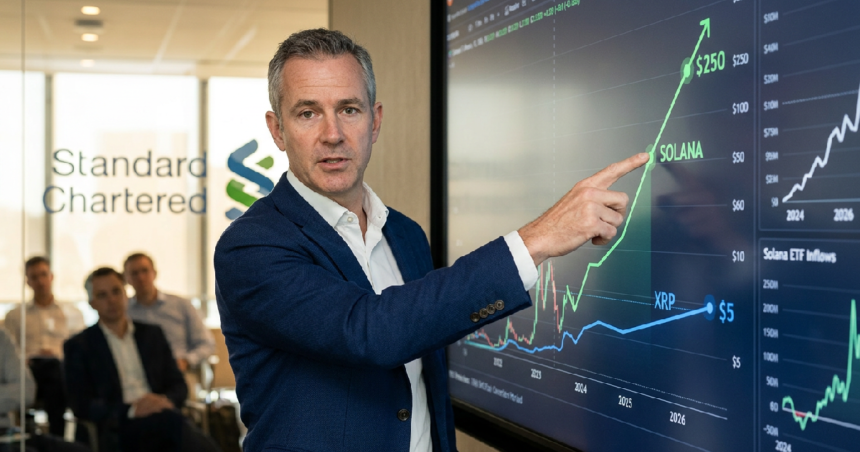
Geoffrey Kendrick, Global Head of Digital Assets Research at Standard Chartered, has shared updated price targets for the crypto market, projecting that Solana (SOL) will reach $250 by year-end 2026. While the bank remains bullish on the network’s technical pillars, it has adjusted its outlook for other major assets.
Kendrick revised his 2026 target for XRP down to $2.80, a significant drop from an initial projection of $8, citing slower ETF inflows and deteriorating macroeconomic conditions observed earlier this year.
The revised $250 target for Solana represents a 19% reduction from Kendrick’s previous $310 year-end 2026 forecast. Despite the haircut, the underlying fundamentals of the network remain a focal point for institutional interest.
Standard Chartered views the SEC’s digital-commodity ruling as a primary structural catalyst, as it allows institutions to hold the asset without the baggage of securities risk. Currently, the Bitcoin resilience seen in recent months has not yet fully translated to a broad altcoin breakout.
Adding to the 2026 forecast, analysts have identified Little Pepe as a potential surprise for the coming year. While lacking the institutional rails of its larger peers, the asset is being watched as a possible outlier in a market increasingly dominated by utility and regulatory clarity.
This comes as traders and automated platforms like Perplexity AI attempt to map out the next phase of the cycle for both established and emerging digital assets.
Solana maintains institutional momentum through ETF inflows
The path to $250 is being paved by a steady stream of institutional capital. Spot Solana ETFs, which launched on October 28, 2025, have officially crossed $1 billion in cumulative net inflows. Seven different issuers, including Bitwise (BSOL), VanEck (VSOL), Fidelity, and Grayscale, now manage roughly $987 million in assets.
In May 2026, these products pulled in $113 million, marking their strongest month of the year.
This institutional appetite contrasts sharply with the broader market. During the same period that Solana products peaked, spot Bitcoin and Ether ETFs saw combined outflows of nearly $2.7 billion.
Network activity in the first quarter of 2026 further supports the bullish case, with Solana processing over 10 billion transactions—roughly 30 times the volume of Ethereum. Use of these networks is becoming the final proof for digital assets in a shifting economy.
Major global financial entities are also building directly on the blockchain. Mastercard, Worldpay, and Western Union are currently developing payment infrastructure on Solana’s rails. These partnerships, combined with technical upgrades like the Firedancer client—intended to push throughput beyond 100,000 transactions per second—and the Alpenglow upgrade, serve as the backbone for Standard Chartered’s long-term optimism.
Technical resistance and the risk of a market flush
Solana is currently trading between $64 and $65, carrying a market capitalization of $37 billion. Technical indicators show the asset is testing a major resistance cluster near $70 to $72. Analysts suggest that a decisive breakout above this zone would strengthen the run toward Kendrick’s year-end 2026 target. However, there are downside risks to consider if the current support levels fail to hold.
Market analysts have flagged a possible flush toward $75 if the price drops below psychological support zones. This risk is driven by liquidation clusters building near $84 and geopolitical tensions between the US and Iran, which have encouraged broad de-risking across crypto markets.
If the run continues, Perplexity AI projects a base case of $250 in six months, with more aggressive scenarios placing the price between $450 and $500.
XRP targets $5 as analysts debate 2026 outcomes
While Standard Chartered’s Kendrick lowered his expectations for XRP in 2026 to $2.80, other major players remain significantly more aggressive. Bitwise Asset Management has issued a bullish case for a $4.94 valuation by year-end 2026. In their most optimistic projection, they see XRP potentially reaching $6.53 at some point during 2026.
This range reflects the ongoing debate regarding XRP momentum and liquidity surges expected this year.
Pseudonymous Korean analyst Ninedex also maintains a primary target of $5, provided that XRP climbs toward the upper boundary of its current trading channel. Ninedex even suggests a “long shot” target of $20 if the asset breaks above its long-running price channel in a move reminiscent of the 2018 breakout. As of June 16, 2026, XRP is trading in a range between $1.00 and $1.13.
Broader institutional projections for the token vary by a wide margin. While Kendrick sees a path to $7 before 2030, his revised near-term targets reflect the reality of slower-than-expected ETF adoption. This divergence in analyst opinion underscores the sensitivity of the asset to regulatory developments and global liquidity conditions, even as the network seeks to prove its utility in cross-border settlements.
Key roadmap milestones for Solana and XRP
- Firedancer Implementation: Critical for Solana to achieve 100,000+ TPS and sustain institutional scaling.
- ETF Maturity: Growth of BSOL and VSOL inflows will determine if SOL can reach a $140 billion market cap.
- XRP Channel Breakout: Analysts are watching if XRP can climb toward the upper boundary of its trading channel to validate $5 targets.
- Macroeconomic Stabilization: A shift away from the deteriorating conditions of Q1 2026 is necessary for both assets to hit their aggressive forecasts.
Market participation hits record highs despite volatility
One of the most telling metrics for the 2026 cycle is the growth in the user base. Solana hit 167 million monthly token holders in April 2026, setting a new all-time record. This is a dramatic increase from the roughly 70 million holders recorded in mid-2023.
While price action remains volatile, the technical adoption of the blockchain appears to be moving into a more mature phase of its lifecycle.
The emergence of speculative assets like Little Pepe also highlights that retail interest hasn’t disappeared. These smaller projects often provide “high-beta” opportunities that diverge from the institutional-grade movements of Solana or XRP. Nevertheless, the heavy lifting of the market remains tied to the success of infrastructure upgrades and the continued integration of traditional financial players like Mastercard and Western Union.
Looking further ahead, some analysts remain incredibly bold. While the $250 target for Solana is the focus for the end of 2026, Kendrick has suggested a longer-term roadmap of $400 in 2027 and potentially $2,000 by 2030.
For now, the market’s immediate focus is on clearing current resistance levels and proving that the utility described in whitepapers can translate into sustained transaction volume on the chain.