

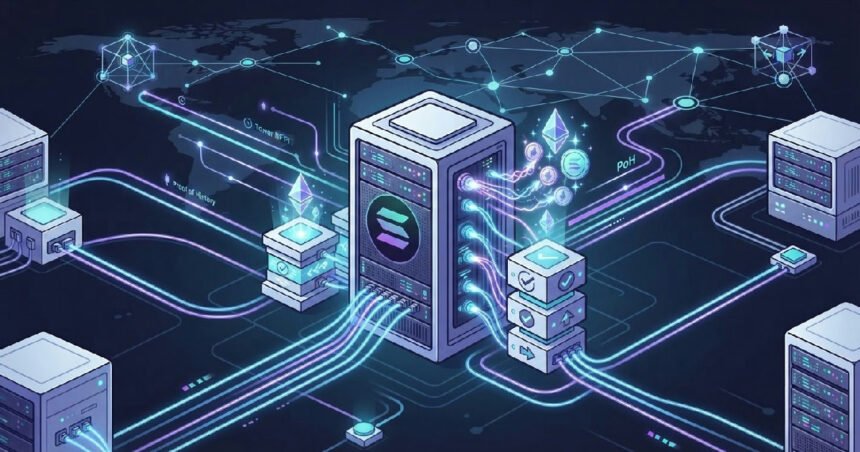
Solana’s decentralized validator set is fundamental to its network uptime and stability, ensuring consistent operation by processing transactions, maintaining the ledger, and participating in consensus.
This operational resilience stems from a sophisticated blend of Proof of History (PoH) for verifiable timekeeping, Proof of Stake (PoS) for economic security, and the Tower BFT consensus mechanism, all combined with strategic architectural choices. The Solana validator role is crucial for the network’s integrity and performance.
These core components work in concert to secure the network, handle every transaction, and provide the infrastructure layer that makes Solana functional and decentralized.
Understanding the Solana validator role in the ecosystem
Validators are the backbone of any blockchain, and on Solana, they are crucial components responsible for verifying transactions, generating new blocks, and actively participating in the consensus process. Their primary role is to maintain blockchain security, functionality, and decentralization.
A decentralized validator set is a collection of independent validators distributed across the globe. This prevents any single entity from controlling the network, significantly enhancing its resilience against attacks or failures.
The Solana Foundation actively supports this ecosystem, running programs such as the Solana Foundation Delegation Program (SFDP) to assist new validators in attracting stake and contributing to the network, a crucial element in understanding crypto networks.
Network uptime refers to the period during which the Solana blockchain remains operational and accessible for processing transactions and maintaining its state. Coupled with this, network stability describes the ability of the Solana network to consistently operate without significant disruptions. It ensures high transaction throughput and maintains the integrity of its ledger, even under considerable load.
Mechanics of Solana’s Uptime and Stability
Solana’s architecture integrates several key innovations to achieve its high throughput and maintain robust stability. These mechanisms allow the network to operate efficiently and reliably.
Proof of History and Verifiable Time
At the heart of Solana’s unique approach is Proof of History. This cryptographic timekeeping mechanism creates a verifiable record of the order and timing of events without requiring validators to constantly communicate to establish when something happened. A validator runs a continuous chain of SHA-256 hashes, where each hash proves that time has passed since the previous one, creating a verifiable delay function.
PoH is not a consensus algorithm itself, but a “pre-consensus” component. It aids in achieving agreement by providing a globally consistent timestamp. This allows validators to agree on the order and timing of transactions without extensive messaging, streamlining the overall process.
Economic Security via Proof of Stake
Solana employs a Proof of Stake consensus mechanism where validators stake SOL tokens as collateral. This stake allows them to participate in network operations, such as proposing and validating blocks. The amount of staked SOL directly influences a validator’s voting power and the likelihood of being selected as a leader.
This economic incentive encourages honest behavior within the network. Malicious actions can lead to slashing, resulting in the loss of staked tokens. This mechanism ensures that validators have a vested interest in the network’s security and integrity.
Tower BFT for Consensus
Solana’s custom implementation of Practical Byzantine Fault Tolerance, known as Tower BFT, is optimized for high performance. It leverages PoH as a global clock, which significantly reduces communication overhead between validators. This minimizes latency and enables faster transaction confirmations.
Validators cast stake-weighted votes on blocks, and a two-thirds-plus supermajority of staked SOL must confirm a block for it to achieve finality. Tower BFT’s lockout mechanism establishes exponentially increasing timeouts before validators can switch votes, making chain reorganization economically costly and impractical. This prioritization of liveness ensures network progression.
Rapid Leader Rotation and Fault Tolerance
A leader rotation mechanism sees validators take turns being the leader, or block producer, for specific time intervals known as slots. A leader schedule is computed in advance for each epoch, assigning specific slots to validators for block production. Leaders rotate rapidly, typically every four blocks or 1.6 seconds, to minimize the influence of any single validator and prevent censorship.
The PoH mechanism aids this rotation by providing a reliable and trustless source of time, ensuring a verifiable and ordered record of events. This distributed set of validators operates across numerous countries, cities, and data centers, enhancing resilience against regional outages or regulatory challenges. The protocol is designed to tolerate up to one-third of validators being malicious or offline while still maintaining safety.
Optimized Transaction Flow and Hardware Demands
Solana optimizes transaction flow through its Gulf Stream protocol, which pushes transaction caching and forwarding to the edge of the network. Validators and RPC nodes know the leader schedule in advance and proactively forward transactions to the designated future leaders, which significantly reduces confirmation times and memory pressure.
The network also utilizes pipelining within its Transaction Processing Unit (TPU), processing transactions in parallel through a four-stage pipeline: Data Fetching, Signature Verification, Banking, and Writing. This allows it to make progress on thousands of transactions simultaneously. Due to the continuous high-throughput SHA-256 computation demanded by PoH and the need to replay the full ledger in real-time, Solana validators require high-performance hardware.
Recommended specifications include a single-socket AMD EPYC 9354+ CPU with 24 or more cores at 3.5GHz+, 256GB to 512GB of ECC DDR4 or DDR5 RAM, and multiple enterprise NVMe drives (1TB+ for ledger, 500GB+ for accounts, 500GB+ for OS on separate disks), along with 10Gbps symmetric networking.
The Nakamoto Coefficient and Decentralization Efforts
The Nakamoto Coefficient serves as a critical measure of decentralization, representing the minimum number of validators that would need to collude or be compromised to prevent a network from functioning correctly. Solana’s Nakamoto Coefficient is frequently cited as 19, having been reported as 18 recently, representing 34.1% of the total stake. This figure indicates the distribution of power within the network.
The Solana network features a dynamic number of active validators. As of November 2024, there were 1,414 validators and 3,100 RPC nodes, with the network growing to comprise over 2,000 to 3,000+ active validators by May 2025. While there is no protocol-enforced minimum SOL stake to run a validator, practical economics create a threshold.
A validator typically needs to attract 5,000-8,000 SOL in total stake to cover vote transaction fees and server costs, or 50,000-100,000+ SOL in delegated stake to reach profitability. Client diversity is another vital aspect of decentralization, mirroring challenges seen in broader financial network interoperability.
Jump Crypto is actively collaborating with the Solana Foundation on projects like Firedancer, a new and independent validator client. This initiative aims to improve client diversity and network resilience, ensuring Solana’s continued operational robustness.
Maintaining a Robust Network
The intricate integration of Proof of History, Proof of Stake, and Tower BFT, alongside advanced features like Gulf Stream and parallel transaction processing, underpins Solana’s ability to deliver high throughput and reliability.
The network aims for a theoretical capacity of up to 65,000 transactions per second (TPS), with measured non-vote throughput in mid-2026 ranging between 1,600 and 3,800 TPS. Transactions can achieve finality in under one second, thanks to Tower BFT’s rapid confirmation process.
This comprehensive approach to validator operations and consensus ensures that Solana can maintain consistent uptime and stability, crucial for a global blockchain platform. The ongoing focus on decentralization, through initiatives like the Solana Foundation’s delegation programs and the development of new validator clients, remains central to its long-term health, especially in an environment where other platforms face security incident challenges.