

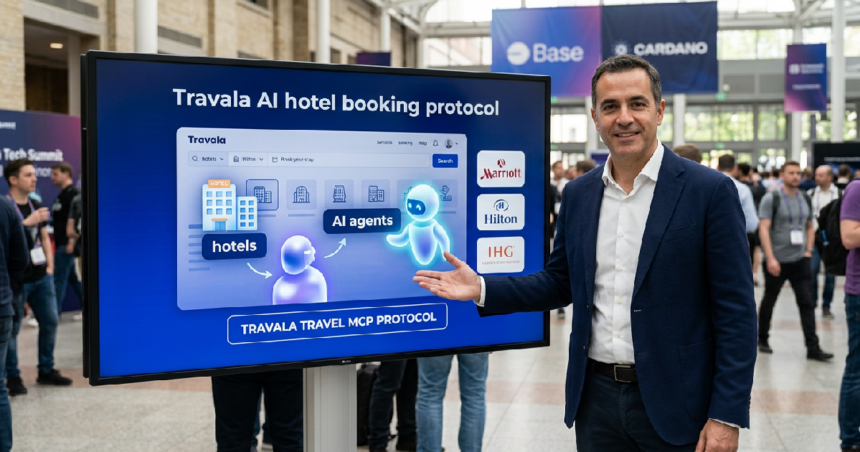
Travala CEO Juan Otero officially launched the company’s Travel MCP (Model Context Protocol) on June 4, 2026, a development that introduces autonomous AI agents capable of searching, booking, and paying for hotel stays without traditional checkout pages.
The Singapore-based travel platform built the protocol on Coinbase’s Base network, utilizing the x402 protocol to enable gasless stablecoin transactions. This release allows AI assistants to access a global inventory of over 2.2 million properties, including major hotel chains like Marriott, Hilton, and IHG.
The new system represents a departure from the manual data entry that has dominated online commerce for decades. By integrating session keys and machine-verifiable standards, the protocol permits AI agents to handle the heavy lifting of travel logistics.
While the AI manages the workflow, the traveler retains final control through manual authorization of the transaction via their digital wallet. It is a specific attempt to bridge the gap between browsing and settlement in the emerging machine-to-machine economy.
Industry observers note that this development arrives as the crypto market utility shifts toward practical, consumer-facing applications. By removing the “checkout button” from the equation, Travala is positioning itself at the center of an automation trend.
Developers can now integrate this hotel inventory directly into their own AI applications, meaning the next holiday you book through a chatbot might never require you to visit a third-party website.
How the Travel MCP protocol eliminates hotel checkout friction
The technical backbone of this launch is the Model Context Protocol (MCP), an open standard that creates a seamless link between AI models and external data sources. In this case, that data source is Travala’s vast aggregator network covering 230 countries.
Because the AI agent can maintain context across a single chat session, it can handle complex requests involving multiple searches, bookings, and even cancellations without losing track of user preferences.
Efficiency gains are the primary driver here. Travala estimates that the transaction cost for these automated bookings is approximately $0.01. By utilizing Coinbase’s x402 protocol on the Base layer-2 blockchain, the system settles payments in USDC almost instantly. This setup bypasses the traditional multi-day settlement windows and high fee structures associated with conventional credit card processing in the travel industry.
Integrating session keys for secure automation
Safety remains a significant concern for users delegating financial tasks to AI. To address this, Travala utilizes ERC-7715 session keys. These keys allow a traveler to grant an AI agent permission to request payments for a specific period or amount. However, the agent cannot move funds unilaterally.
The traveler must still provide a final digital signature, ensuring that the human remains the ultimate gatekeeper of the wallet.
Additionally, the system incorporates the ERC-8004 standard. This ensures that every transaction is machine-verifiable, creating a transparent audit trail on the Base network. With the Cardano price outlook and broader market sentiment fluctuating, such high-utility integrations provide a concrete example of how blockchain infrastructure can serve as more than just a vehicle for speculation.
Economic incentives and developer integration for AI agents
Travala isn’t just building this for its own interface; the protocol is designed for wide-scale adoption by third-party developers. To bootstrap this ecosystem, the company is offering a 10% rebate in Coinbase Wrapped Bitcoin (cbBTC) to developers for every completed stay booked through their integrated AI agents. This incentive structure could lead to a proliferation of specialized travel assistants catering to niche markets.
The protocol is already live through Claude Desktop, providing a functional template for how these interactions work. Developers can essentially “plug in” to Travala’s database of 2.2 million properties. This inventory is refreshed in real-time, ensuring that the AI agents have access to the latest pricing and availability from global aggregators and individual hotel brands alike.
This move follows a string of successful partnerships for Travala. After integrating with platforms like Skyscanner and Trivago in previous years, the company has consolidated its position as a major player in crypto-native travel. Having reported over $100 million in annual revenue in late 2024, the firm is now leveraging its financial stability to bet on the next phase of the internet: the agentic web.
As regulatory oversight of crypto matures, the focus has shifted toward building “truly autonomous travel economies.” Juan Otero, Travala CEO, described the launch as the “death of the checkout button,” signaling a move toward a world where transactions are handled as background processes rather than manual hurdles.
The success of this protocol will likely depend on whether consumers are ready to trust AI agents with their holiday planning.
The future of machine-to-machine payments in travel
The launch of Travel MCP suggests that the travel sector is becoming a primary testing ground for machine-to-machine (M2M) payments. Since x402-linked wallets on the Base network recently surpassed 100 million transactions, there is clearly an appetite for high-speed, low-cost settlement. Travala’s entry into this space suggests that stablecoins are finding their “killer app” in the removal of middle-man friction.
Looking forward, the extension of these protocols could eventually cover flights, car rentals, and local tours. For now, the focus remains on perfecting the hotel booking experience. If AI agents can reliably navigate the complexities of global hotel inventory while maintaining security, the traditional e-commerce checkout page could soon become a relic of a slower digital era.