

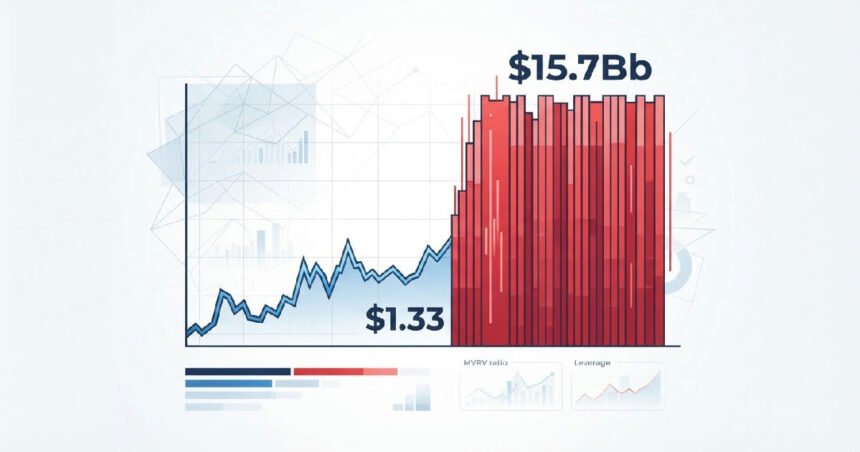
XRP’s market is sending deeply conflicting signals, creating a tense standoff between bullish and bearish forces. While key on-chain metrics suggest the digital asset may have found a temporary price floor, a staggering $15.7 billion worth of XRP exchange supply threatens to smother any significant upward momentum.
As of October 20, the asset’s price hovered around $1.33, caught between indicators of undervaluation and an immense wall of potential sell-side pressure. The outcome of this battle hinges on whether genuine spot demand can materialize to absorb the available supply.
XRP exchange supply and MVRV ratio signals a potential bottom for holders
One of the primary bullish arguments stems from XRP’s 365-day Market Value to Realized Value (MVRV) ratio. According to data from analytics firm Santiment, this ratio has dropped to approximately 0.92. This figure indicates that the average price paid for XRP by all holders who bought within the last year is about 8% higher than the current market price.
A sub-1.0 MVRV ratio is often viewed as a positive sign by analysts. It implies that the average long-term holder is currently sitting on an unrealized loss, which reduces the incentive to sell and take profits. With fewer sellers in the market, the path of least resistance can often be upwards, provided new buyers step in.
XRP’s valuation stress appears more pronounced than other major cryptocurrencies like Bitcoin and Ethereum, whose MVRV ratios are hovering between 0.97 and 1.04. However, this metric is purely a valuation observation; it does not in itself guarantee a rebound. A market needs fresh capital and buying interest to fuel a recovery.
The $15.7 billion wall of exchange supply
The most significant counterargument to the bullish case is the enormous volume of XRP held on exchanges. On-chain data provider CryptoQuant reported on October 17 that aggregate exchange reserves had reached 11.81 billion XRP. At current prices, this stockpile is worth roughly $15.7 billion.
This level of exchange inventory places it in the 99th percentile for the past year, signaling an unusually high amount of liquid, tradable supply. These tokens are held in exchange wallets for various purposes, including custody, market making, hedging, or as collateral for derivatives trading. Regardless of intent, their presence means they can be sold into the market with little friction.
To put the figure in perspective, a sale of just 1% of these reserves would introduce about 118.1 million XRP into the market. This equates to approximately $157 million in sell pressure, representing a substantial 34% of the recent 24-hour spot trading volume of $464 million logged by CoinGlass.
The existence of such a large overhang could easily absorb waves of new buying, capping any potential price rally. The futures market momentum has also shown signs of weakness recently.
Uneven distribution of reserves
Interestingly, this supply is not evenly distributed. While Binance is the largest exchange by volume, its reserves of 2.67 billion XRP are only in the 30th percentile of its historical range. This implies that the bulk of the record-high supply is held on other trading venues, creating a market-wide risk that isn’t isolated to a single platform.
A complicated derivatives and leverage picture
The derivatives market adds another layer of complexity to XRP’s outlook. Recent data shows a partial deleveraging on Binance, which initially appears to be a healthy sign. According to a CryptoQuant analysis, XRP futures open interest on Binance fell 15.8% from $538.1 million on October 4 to $453 million by October 17.
During this period, the exchange’s estimated leverage ratio also declined from 0.205 to 0.170.
This unwind of leveraged long positions, which included $25.7 million in liquidations around October 7 and 8, suggests some of the speculative froth has been removed from the market. However, this is only part of the story. While this reset occurred, other platforms are offering ways to use holdings, with some noting that XRP yield farming opportunities come with their own set of risks.
The problem is that Binance only accounts for about 27% of the total XRP futures market. Glassnode data from October 19 shows that total open interest exceeds $1.4 billion. Major platforms like Bybit ($243.3 million), Gate ($217.0 million), and Bitget ($200.3 million) collectively hold a significant portion of the remaining 73% of leveraged bets.
It remains unclear if a similar deleveraging has occurred on these other venues.
Funding rates begin to climb again
Furthermore, funding rates, which represent the cost of holding leveraged positions, have begun to turn positive again across major exchanges. Readings from October 19 showed rates from +0.006% on Binance to +0.010% on Bybit and OKX. This indicates that traders are once again willing to pay a premium for bullish long positions, suggesting that leverage may be quietly rebuilding in the system.
Key price levels and forward-looking scenarios
For traders and investors, the path forward for XRP is defined by several key price levels. The immediate support to watch is $1.25. A sustained rally would require the price to hold above this level and decisively clear the resistance zones at $1.35 and then $1.40.
Crucially, a healthy recovery would need to be driven by strong spot buying, with trading volumes increasing while open interest in the futures market remains flat or even declines. This would signal that the rally is founded on genuine demand rather than fragile, speculation-fueled leverage.
If these conditions are met, a move toward the $1.55 target becomes more plausible. The dynamic of large reserve movements seen with other assets highlights how supply shifts can precede major price action.
Conversely, the bearish scenario would see XRP close decisively below the $1.25 support level, particularly if the broader market led by Bitcoin loses its footing around the $80,000 mark.
Such a breakdown could trigger a wave of selling, as the 73% of futures exposure outside Binance and the massive exchange supply overhang could amplify the downward pressure. In this event, technical analysts see the next major support area in the $1.10 to $1.15 range.
Ultimately, XRP’s fate rests on a delicate balance. The undervaluation signaled by the MVRV ratio provides a glimmer of hope for bulls. But until the market can demonstrate enough buying power to chew through the formidable $15.7 billion supply waiting on exchanges, any recovery will remain tentative and vulnerable to reversal.