

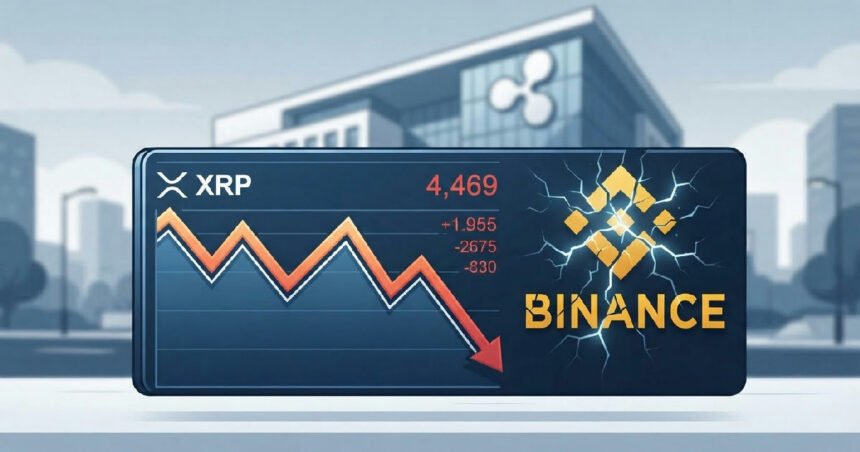
The XRP price is sharply down today, pushed lower by the reverberations of a record-breaking $6.3 billion hack that hit Binance’s hot wallets on Thursday night, October 29, 2026. A substantial $300 million in XRP was among the first cryptocurrencies stolen in the breach, sending shockwaves through the broader digital asset market.
Compounding investor concerns, while Ripple, the company behind XRP, was able to freeze a significant portion of its stablecoin, RLUSD, it proved unable to halt the movement of the stolen XRP.
Massive Binance Breach Shakes Crypto Markets
This major security incident comes at a challenging time for XRP, which has faced sustained market pressure throughout October 2026. Profit-taking and a general cooling of risk appetite have already impacted its valuation. The perceived disparity in security and control between Ripple’s own stablecoin and XRP itself now appears to be significantly influencing investor confidence, despite recent positive developments from the firm.
The cryptocurrency world woke up on Friday, October 30, 2026, to news of the largest crypto theft in history. Attackers successfully drained $6.3 billion from Binance’s hot wallets on October 29. The sheer scale of the breach immediately impacted market sentiment across the entire industry, triggering a broad sell-off.
The total crypto market value fell by 6.47% over 24 hours, shrinking to $2.6 trillion. Traditional financial markets also felt the ripple effect, with the S&P 500 down 1.8% and the Nasdaq Composite dropping 3.1% on the same day. This widespread fear pushed the crypto market’s Fear and Greed Index down to 41, firmly indicating a state of “fear” among investors.
For XRP holders, the news was particularly jarring. The first $300 million stolen in the hack was reportedly XRP, directly linking the cryptocurrency to the catastrophic event. This immediate exposure amplified selling pressure on the token.
XRP’s Distinctive Vulnerability Highlighted
A crucial aspect of the Binance hack that has garnered significant attention is the contrasting response regarding different digital assets. Ripple, through its co-CEO Yi He, confirmed the firm was able to freeze approximately $200 million in its stablecoin, RLUSD, that was linked to the attack.
On-chain data independently verified by TRM Labs showed this freeze amounted to 40.5 million RLUSD, equivalent to about $40.5 million.
This ability to freeze RLUSD sharply contrasts with the situation surrounding the stolen XRP. Ripple could not intervene to freeze the $300 million in XRP once it was taken from Binance. This stark difference underscores a perceived divide in the control and security mechanisms between Ripple’s centralized stablecoin offering and the decentralized nature of XRP itself.
Ripple CEO Brad Garlinghouse has often described XRP as the firm’s “North Star,” reiterating, “We will never give up on XRP.” However, he also noted that RLUSD or fiat currencies might be more appropriate for certain financial transactions.
The incident has intensified market scrutiny over these distinctions, potentially swaying investor preference towards assets with greater perceived recovery potential in the event of a breach. Other stablecoin issuers like Tether, Circle, and World Liberty Financial also froze substantial amounts, contributing to an approximate $2.67 billion total frozen across stablecoins.
Broader Headwinds Hit XRP Amid Price Slump
The Binance hack exacerbated an already challenging month for XRP. The cryptocurrency had been experiencing broader market pressures throughout October 2026, characterized by persistent profit-taking and a general shift away from riskier assets. As of Friday afternoon, October 30, XRP was trading near $1.30.
The token saw a 4.2% decline in the last 24 hours alone, as of 1:23 p.m. ET. This daily dip contributes to a larger trend, with XRP slipping by 6% weekly and losing almost 13% over the past month. Over the past year, its value has decreased by approximately 50% from its levels 12 months prior.
XRP’s daily low on October 30 reached $1.1968, marking its lowest trading point since August 20. The cryptocurrency had previously faced rejection at the $1.40 mark on October 21, correcting to $1.25 before the hack further depressed its value to a multi-month low of $1.19.
Currently, XRP is trading below its 200-day moving average of $1.28, with the 50-day average of $1.40 now acting as a significant overhead resistance level. Its market capitalization has tanked to under $80 billion.
Ripple’s Strategic Moves and Market Realities
Despite the recent price performance, Ripple has been busy announcing significant strategic developments. The company’s recent Swell 2026 conference unveiled impressive figures, including annualized product revenue of $900 million and $16 trillion in processed transactions. Brad Garlinghouse also launched a new advertising campaign at Nasdaq during the event, aiming to bolster Ripple’s brand presence.
Regulatory advancements have also been positive. The Office of the Comptroller of the Currency (OCC) granted final approval to Ripple National Trust Bank on October 26, 2026. This new entity is set to manage segregated reserves for RLUSD, act as a collateral trustee, and provide fiduciary services, solidifying Ripple’s institutional footprint.
Furthermore, the RLUSD stablecoin has seen expanded access across Coinbase platforms — Prime, Exchange, and its retail app — and a broader partnership with Robinhood. BNY Mellon has also extended custody support to both XRP and RLUSD.
Moody’s assigned RLUSD an A2 long-term and P-1 short-term investment-grade rating, signaling strong confidence in the stablecoin’s financial standing. Such positive news typically injects optimism, but the broad market weakness and the specific implications of the Binance hack have overshadowed these developments for XRP itself.
XRP Ledger developers recently proposed tighter controls for permissioned assets, indicating ongoing efforts to enhance the network’s capabilities.
Investor Sentiment and Ecosystem Evolution
The broader cryptocurrency market remains highly sensitive to investor sentiment, which often dictates price trends. The current atmosphere of “fear” following the Binance hack has proven to be a potent force against individual asset performance.
Even positive news, such as US spot funds on XRP taking in a net $8.43 million on October 29—the strongest daily figure for October—struggled to counteract the dominant bearish pressure. One fund alone accounted for $5.57 million of these inflows, showing pockets of sustained interest.
As the XRP Ledger ecosystem continues to evolve, Ripple and C2FO are actively collaborating to integrate C2FO’s Instant Pay settlement platform onto XRPL using RLUSD. This highlights the company’s focus on utility and real-world applications for its stablecoin.
The market is watching closely how these strategic initiatives ultimately impact investor perception and the long-term trajectory of XRP, especially in light of security concerns amplified by recent events. For a deeper dive into the factors influencing market movements, understanding investor sentiment can be crucial.