

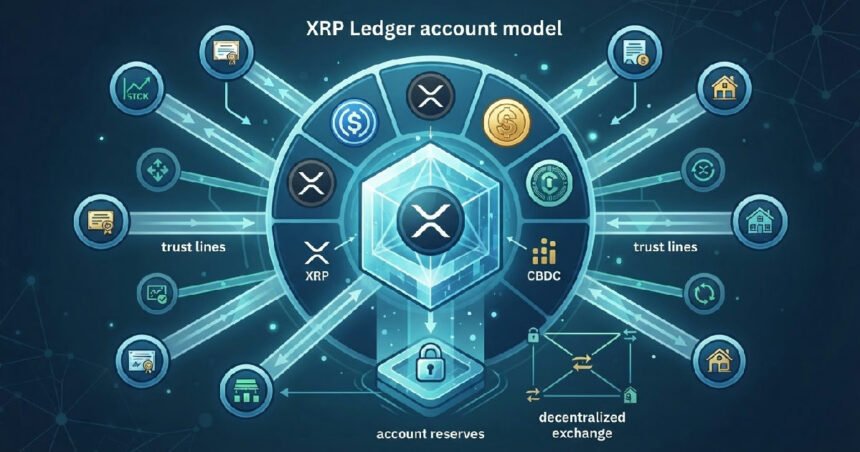
Understanding the XRP Ledger account model
The XRP Ledger (XRPL) operates with a distinct account and trust line framework designed to manage both its native cryptocurrency, XRP, and various other issued digital assets. This foundational model ensures secure handling of diverse tokens, actively combats network spam, and powers the network’s integrated decentralized exchange (DEX). Its architecture is critical to how users interact with the blockchain security measures on the XRPL.
An XRPL account represents a participant on the ledger, holding their XRP balance, settings, and other relevant data. Unlike simple public addresses found in some other blockchain systems, an XRPL account is a tangible object requiring activation and ongoing maintenance. This design choice contributes to the network’s resilience and structural integrity.
Account creation isn’t a direct transaction; rather, an account comes into existence when a valid address receives sufficient XRP to cover the base reserve. This initial deposit activates the account, establishing an AccountRoot entry within the ledger. The AccountRoot object then details the account’s unique identifier and its current XRP holdings.
The AccountRoot object comprehensively describes a single account, encompassing its settings and XRP balance in “drops,” the smallest unit of XRP. Key fields include the identifying address, the sequence number for the next valid transaction, and flags that dictate specific account behaviors. These flags can control functionalities like disabling the master key or enforcing deposit authorization.
XRPL Accounts: Activation, Reserves, and Transaction Costs
Maintaining the ledger’s integrity and preventing excessive growth from spam or malicious activity is paramount. To achieve this, every XRPL account must maintain a minimum XRP amount known as the base reserve. This specific XRP quantity is locked and cannot be spent as long as the account remains active on the ledger.
The current base reserve requirement on the Mainnet stands at 1 XRP. This figure reflects a reduction from previous levels of 10 XRP and, earlier, 20 XRP, following a validator vote in December 2024. This adjustment demonstrates the network’s adaptability to evolving usage patterns and efficiency goals.
Beyond the base reserve, an account must hold an owner reserve for each object it owns on the ledger. These objects include trust lines, decentralized exchange offers, escrows, and payment channels. The current owner reserve is 0.2 XRP per item, also locked, but released if the associated object is removed.
A notable exception exists for newly funded accounts regarding owner reserves. Such accounts can establish their first two trust lines without incurring the owner reserve, provided their total balance does not exceed the 1 XRP base reserve. If an account holds more than 1 XRP, the owner reserve applies universally to all trust lines created.
Every transaction processed on the XRPL incurs a small transaction cost, paid in XRP, which is then irrevocably destroyed (burned). This burning mechanism serves as a crucial anti-spam measure, making it economically unfeasible to flood the network with low-value transactions. This contrasts with other networks where fees are typically paid to miners or validators.
The minimum transaction cost for a standard operation is 10 drops, equivalent to 0.00001 XRP. These costs are not static; they can dynamically increase under periods of higher network load to maintain network stability. This mechanism ensures network resilience during times of congestion by discouraging excessive activity.
Trust Lines: Enabling Issued Assets on the XRPL
The XRPL functions as a multi-currency network, supporting not only XRP but also a variety of other fungible tokens. These tokens are commonly referred to as “issued assets” or “IOUs,” representing different forms of value like fiat currencies or commodities. Unlike XRP, which is native and decentralized, issued assets are fundamentally controlled by their respective issuers.
Trust lines are a foundational mechanism on the XRPL, enabling accounts to hold and transfer these issued assets. A trust line acts as a ledger entry linking an account with an issuer for a specific currency. This explicit connection ensures that users only receive tokens from entities they consent to, enhancing security and user control.
This system functions as a proactive spam filter. An account cannot receive an issued asset unless it explicitly “trusts” the issuer for that specific currency by establishing a trust line. This design effectively prevents unsolicited or unwanted tokens from being pushed into a user’s account without their explicit consent.
Any account can unilaterally create a trust line to an issuer through a TrustSet transaction. This action establishes a line with a zero balance and default settings. Trust lines can also arise implicitly from certain transactions, such as buying a token on the decentralized exchange. This flexibility streamlines user experience and market participation.
Each trust line includes a LimitAmount parameter, which caps the maximum amount of the asset an account is willing to hold from that issuer. While users can configure specific limits, many wallet implementations set trust lines with the protocol-maximum limit. This effectively makes them unlimited for practical purposes, simplifying management of broader altcoin market dynamics.
Trust lines can be deleted under specific conditions: if both sides’ settings are in their default state and the balance of the issued asset is zero. To delete a trust line, an account holder must first adjust their settings to defaults and offload any positive balance. This process ensures a clean removal from the ledger when an asset is no longer needed.
Issuers possess the option to enable a “Require Auth” flag on their issuing account. When activated, this means other accounts can only hold tokens they issue if the issuer specifically authorizes their trust lines. This feature provides issuers with greater control over token distribution, enabling selective access and compliance measures.
Furthermore, issuers retain the capability to freeze trust line tokens, which imposes restrictions on how those specific tokens can be used or transferred. It’s crucial to note, however, that this freezing capability applies solely to issued assets and never to XRP itself. The native XRP remains impervious to such controls, ensuring its immutability.
Multi-signing for enhanced security
The XRPL supports multi-signing, a security feature allowing multiple secret keys to authorize transactions for an account. This significantly enhances security by requiring a combination of signatures, which can be customized with different weights and a minimum quorum. Multi-signed transactions often incur higher fees due to their increased complexity and processing requirements.
Advanced Features and Network Stability
The XRPL’s built-in decentralized exchange (DEX) allows users to trade XRP and various issued assets directly on the ledger. Trust lines are indispensable for participating in the DEX, as they enable accounts to hold the diverse issued assets being traded. This integration creates a seamless trading environment for digital assets.
Pathfinding is another powerful feature of the XRPL. It identifies the most efficient routes for cross-currency payments and asset exchanges, leveraging liquidity from trust lines, order books, and Automated Market Makers (AMMs) within the DEX. This capability allows for smooth conversions between different issued assets and XRP, optimizing transaction flows for users.
Issued assets can “ripple” through accounts, a process that facilitates exchanges of equivalent tokens using the same currency code. This often involves reducing tokens issued to one party and increasing them for another via an issuer. Rippling is fundamental to how liquidity providers manage and move issued assets efficiently across the network, optimizing overall liquidity.
Market Impact and Future Perspectives
The meticulous design of the XRP Ledger’s account and trust line model underpins its utility and security for a global audience. By implementing robust reserve requirements and transaction costs, the XRPL effectively discourages spam, maintaining a lean and efficient ledger. This pragmatic approach benefits all network participants by ensuring stability and predictable operations.
The flexibility offered by issued assets and trust lines positions the XRPL as a versatile platform for diverse financial instruments. From stablecoins to tokenized commodities, the framework allows for a wide array of digital representations to coexist with native XRP. This multi-currency capability is a significant draw for developers and enterprises seeking robust blockchain solutions.
The network’s integrated DEX and advanced pathfinding algorithms provide sophisticated trading and payment functionalities directly on-chain. This minimizes reliance on external intermediaries, offering users greater control and transparency over their digital assets. Such features are critical for expanding the utility of XRP in the broader financial landscape, fostering direct peer-to-peer interactions.
As the digital asset space continues to evolve, the XRPL’s foundational account and trust line model remains a crucial component of its appeal. Its balance of decentralization with issuer control for issued assets offers a nuanced approach to digital finance. This ongoing development reflects its commitment to long-term viability and broader adoption within the financial sector.