

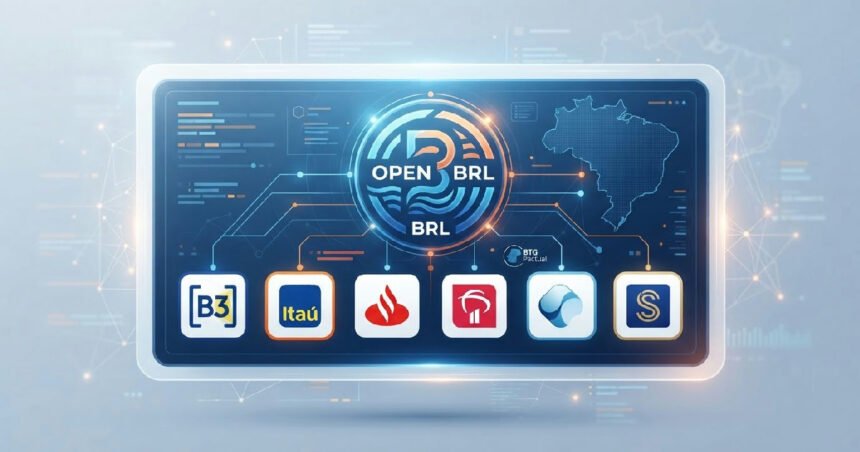
B3 Itaú Santander partners with six major Brazilian financial institutions to develop Open BRL, a stablecoin pegged to the Brazilian real, set to launch in Q1 2027. A.
– Brasil, Bolsa, Balcão, the operator of Brazil’s primary stock exchange, has announced a significant collaboration with six of the nation’s largest financial institutions, including B3 Itaú Santander partners, to develop Open BRL. This new stablecoin will be pegged directly to the Brazilian real, aiming to launch its operations in the first quarter of 2027.
The ambitious project seeks to establish a universal medium of exchange across Brazil’s burgeoning digital financial market.
B3 Itaú Santander partners drive Brazil’s digital currency
The consortium includes heavyweight banks and brokerages: Bradesco, BTG Pactual, Itaú Unibanco, Safra, Santander, and XP. This collective effort signals a unified move by major players to modernize Brazil’s financial infrastructure through blockchain technology. The partners intend for Open BRL to extend its reach far beyond the founding members, embracing the entire Brazilian financial ecosystem.
The core objective behind Open BRL is to foster interoperability within Brazil’s increasingly fragmented digital asset landscape. Luiz Masagão, Vice President of Products and Clients at B3, emphasized this expansive goal. He stated in an interview with Valor Econômico that the initiative aims to be open to the entire Brazilian financial market.
This approach moves beyond proprietary solutions, creating a shared infrastructure for value transfer and digital asset settlement. B3 will initially manage the underlying technology. Meanwhile, Banco B3, a subsidiary within the exchange group, will serve as the issuer of Open BRL, ensuring a clear and regulated path for its deployment.
The six participating firms are tasked with developing crucial integrations and exploring various use cases for the new infrastructure. They are also contributing capital to the venture. This collaborative funding model underlines the commitment from some of Brazil’s most influential financial entities to the success and widespread adoption of the stablecoin.
Operational mechanics and robust regulatory alignment
Open BRL is designed to operate with clear financial backing and strict adherence to regulatory standards. The stablecoin will maintain a one-to-one peg with the Brazilian real, ensuring its stability and reliability in transactions. Luiz Masagão underscored the trust factor, stating that for every stablecoin issued, there will be one Brazilian real deposited.
Users will be able to deposit reais to receive an equivalent amount of Open BRL tokens and redeem them back for reais at any time. This direct convertibility is a cornerstone of the project’s design. It ensures liquidity and confidence for institutional participants within the digital economy.
The project is being developed in close coordination with Brazilian regulators, including the Central Bank of Brazil and the Brazilian Securities and Exchange Commission (CVM). B3 has affirmed that Open BRL will comply with all national regulatory frameworks, covering anti-money laundering, compliance, and cybersecurity.
Eric Altafim, Director of Products and Corporate Sales at Itaú Unibanco, hailed Open BRL as a significant step in modernizing Brazil’s capital and financial markets, highlighting its potential for broader impact.
A dedicated management committee, comprising representatives from all founding partners, will oversee the stablecoin’s operational rules, technological roadmap, and pricing strategies. This shared governance model is intended to ensure equitable development and decision-making as the platform evolves. The commitment to regulatory oversight and a transparent operational structure aims to build strong confidence in this new digital asset.
Shifting from solo ambition to a broad partnership
The launch of Open BRL marks a notable evolution in B3’s strategy regarding stablecoins. The exchange operator had previously pursued its own stablecoin project, B3RL, which was reportedly under development as recently as July. B3RL was envisioned as a real-pegged token backed by Brazilian Treasury bonds. It was intended to underpin blockchain trading of stocks and fixed-income securities starting in 2027.
However, the current announcement for Open BRL makes no mention of B3RL, suggesting a pivot towards a more collaborative model. This shift from an internal, B3-led initiative to a consortium-driven project brings together a wider array of institutional capital and expertise. Such a move redistributes influence and responsibility across multiple key financial players, potentially leading to broader market acceptance and utility.
The move also positions the project within an already competitive stablecoin market in Brazil. By July, the country reportedly had more than a dozen real-pegged stablecoins already in circulation. This collaborative approach distinguishes Open BRL, aiming to consolidate efforts rather than adding another isolated token to the existing ecosystem. The scale of the partners involved could offer a significant advantage in this crowded field.
Broader implications for Brazil’s digital asset landscape
Brazil has been at the forefront of developing a comprehensive regulatory framework for crypto assets, with the Central Bank of Brazil issuing resolutions that took effect in February 2026. These regulations mandate licensing for virtual asset service providers and classify certain stablecoin transactions as foreign-exchange operations. This regulatory environment creates a structured playing field for initiatives like Open BRL.
The introduction of Open BRL aims to address a critical challenge in the digital asset space: interoperability. As Luiz Masagão noted, “When you tokenize, you tokenize the assets, but you need to have some medium of exchange for that settlement to happen.” Open BRL is positioned to be that universal medium, bridging various blockchain projects and proprietary stablecoins that currently lack seamless interaction.
This initiative could significantly streamline institutional transfers and digital asset settlement across Brazil. By providing a common rail for value transfer, Open BRL has the potential to enhance efficiency and reduce friction in digital financial transactions. This unified approach could accelerate the adoption of tokenized securities and other digital assets within B3’s ecosystem and beyond.
What comes next for Brazil’s tokenized future
With an anticipated launch in the first quarter of 2027, Open BRL is poised to become a foundational element of Brazil