

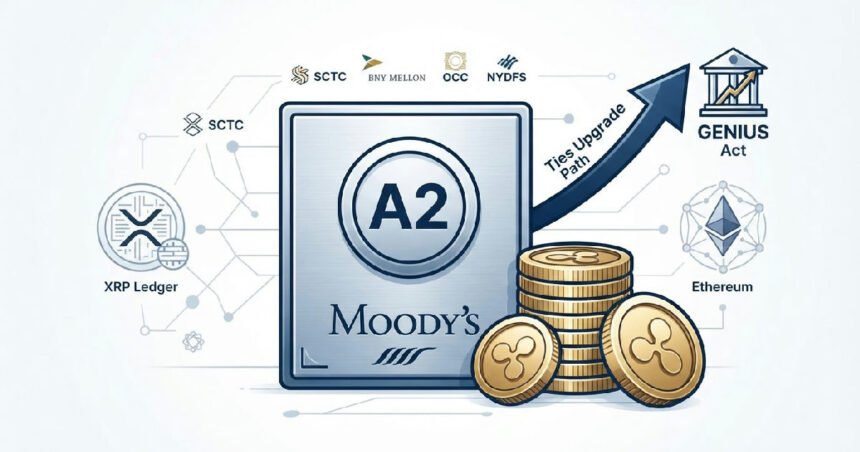
Moody’s Ratings has assigned an A2 long-term deposit rating and a P-1 short-term deposit rating to Ripple USD (RLUSD), marking a significant milestone for the stablecoin sector. The announcement, made on October 28, 2026, positions RLUSD as the first stablecoin to ever receive an investment-grade rating from Moody’s.
This rating applies specifically to RLUSD tokens issued by Standard Custody & Trust Company (SCTC), a wholly-owned subsidiary of Ripple Labs, on both the XRP Ledger and Ethereum blockchains.
A2 rating ties upgrade path
Moody’s highlighted that future upgrades to this rating could be tied to firmer legal claims for stablecoin holders and the impending enforcement of the GENIUS Act in 2027.
Jack McDonald, Ripple’s senior vice president of stablecoins, quickly pointed out the achievement in an X post, emphasizing RLUSD’s pioneering status with a Moody’s investment-grade rating. The ratings were assigned under Moody’s “Stablecoin” methodology, which the agency published in March 2026. This comprehensive framework assesses a stablecoin’s credit quality based on various factors, including the backing assets, liquidity, and redemption mechanisms.
The A2 long-term deposit rating signifies an upper-medium grade within Moody’s scale, indicating a low credit risk for RLUSD holders. This means the stablecoin issuer, SCTC, has a strong capacity to meet its financial obligations, though it might be more vulnerable to adverse economic shifts than those with higher, Aaa ratings.
Simultaneously, the P-1 short-term rating is Moody’s highest possible short-term grade, reflecting a superior ability to repay obligations in the near term.
This investment-grade designation is a critical endorsement for RLUSD, distinguishing it in a crowded and often scrutinized stablecoin market. It provides a level of institutional validation that could attract more conservative investors and enterprises. Moody’s assessment, however, is not a company-wide credit rating for Ripple Labs or its other ventures, but rather focuses solely on the RLUSD stablecoin issued by SCTC.
The methodology used by Moody’s evaluates several key aspects. It scrutinizes the credit quality and market value of the reserve assets, the sufficiency of reserve coverage, the liquidity of those reserves, and the efficiency of redemption arrangements. Further considerations include how reserves are segregated and custody arrangements with third parties, alongside broader operational, technological, legal, and regulatory factors.
The GENIUS Act and RLUSD’s Upgrade Path
Moody’s identified specific areas that currently limit RLUSD’s rating and offer pathways for potential upgrades. A primary concern is that Standard Custody & Trust Company is not structured as a bankruptcy-remote vehicle, and current RLUSD holders lack a direct ownership stake in the reserve assets.
However, these weaknesses are partially offset by the fact that reserves are held in segregated accounts titled for holders and are under the stringent supervision of the New York Department of Financial Services (NYDFS).
A significant catalyst for a higher rating is the forthcoming Guiding and Establishing National Innovation for U.S. Stablecoins (GENIUS) Act. This federal legislation, set to take effect in January 2027, promises to introduce additional statutory protections.
Critically, the GENIUS Act will mandate the exclusion of required stablecoin reserves from an issuer’s bankruptcy estate, thereby providing robust legal safeguards for holders that are currently absent. Arrangements offering holders a priority interest in the reserve could also support an upgrade.
Conversely, the rating could face a downgrade if there’s a weakening of reserve quality, a shift to a lower-rated custodian, or failures in control mechanisms. The clear roadmap laid out by Moody’s indicates a strong emphasis on regulatory clarity and enhanced legal protections for stablecoin holders as key drivers for future rating improvements.
Pillars of Trust: RLUSD’s Backing and Custody
The foundation of RLUSD’s A2 rating rests largely on the quality and structure of its backing assets. Ripple’s stablecoin reserves are predominantly invested in highly liquid, short-duration U.S. government assets, such as Treasury bills, and cash. This conservative asset allocation provides a strong basis for maintaining the stablecoin’s 1:1 peg with the U.S. dollar, a core tenet of stablecoin reliability.
Standard Custody & Trust Company aims to maintain a robust 103% reserve coverage against its outstanding RLUSD tokens. This target exceeds the minimum coverage level Moody’s associates with the A2 rating, adding an extra layer of security for holders.
The majority of these Treasury bills and cash reserves are held with The Bank of New York Mellon (BNY), an institution itself rated Aa1(cr) by Moody’s. This choice of a highly-rated, established financial custodian further bolsters confidence in RLUSD’s stability.
Ripple has been busy solidifying its institutional infrastructure. On October 26, 2026, the Office of the Comptroller of the Currency (OCC) granted final approval for Ripple National Trust Bank, a new federally supervised national trust bank.
This approval marks a key step in Ripple’s strategy, as the bank is slated to manage segregated RLUSD reserves and act as their collateral trustee, reinforcing the legal and operational framework supporting the stablecoin. The OCC’s approval followed conditional acceptance in December 2025, highlighting a deliberate and lengthy regulatory process.
This development ensures that while Standard Custody & Trust Company, regulated by NYDFS, continues to issue RLUSD, the reserve management benefits from federal oversight, a detail explored further in reporting on Ripple’s trust bank approval.
Redemption processes for RLUSD are structured for qualifying institutions that SCTC has onboarded, allowing redemptions at par and on a T+2 basis. While efficient, Moody’s noted that a bankruptcy scenario for SCTC, and the automatic stay that would follow, could potentially extend this timeline. However, the anticipated protections from the GENIUS Act aim to mitigate this risk substantially.
Ripple’s Expanding Stablecoin Strategy and Market Position
The Moody’s rating announcement arrives amid a dynamic period for Ripple and its stablecoin initiatives, coinciding with Ripple’s Swell conference in New York.
The company launched RLUSD in December 2024, and it has since grown to become the ninth-largest stablecoin by market capitalization, currently hovering around $2.5 billion to $2.6 billion as of October 28, 2026. RLUSD boasts approximately 12,920 on-chain holders, indicating a growing adoption among users.
Beyond the ratings, Ripple has also focused on expanding its partnerships and infrastructure. BNY Mellon, already a key custodian, expanded its institutional custody partnership with Ripple on October 27, extending support to XRP and RLUSD. The two entities are also exploring tokenized trade finance, signaling deeper collaboration.
This reflects a broader trend of traditional financial institutions engaging with digital assets. Following the news, XRP, Ripple’s native token, saw its price rise 1.99% to $1.32 in early trading on October 28, amid broader discussions surrounding XRP token dynamics.
Other strategic alliances include Standard Chartered, which launched institutional RLUSD custody through its Dubai International Financial Centre branch on October 12. A proposed collateral arrangement with LMAX Group is also in the pipeline, pending further approvals and testing.
Additionally, Ripple’s agreement with Cross River Bank aims to integrate RLUSD into the bank’s payment infrastructure, facilitating dollar transfers and round-the-clock settlement. These partnerships collectively enhance RLUSD’s utility and reach within the global financial ecosystem.
Regulatory Momentum and Future Outlook for Stablecoins
The Guiding and Establishing National Innovation for U.S. Stablecoins (GENIUS) Act, signed into law in July 2025, represents a landmark piece of legislation designed to bring federal oversight to the payment stablecoin sector. Effective January 18, 2027, the act establishes a comprehensive regulatory framework intended to balance innovation with financial stability and consumer protection.
Key provisions include mandating 100% reserve backing with liquid assets, requiring monthly public disclosures of reserve composition, and prohibiting payment stablecoin issuers from offering interest or yield to holders.
This regulatory clarity is crucial for the stablecoin industry’s maturation. It stipulates that issuing a payment stablecoin in the U.S. without an appropriate federal or state license will become unlawful once the act takes effect.
Furthermore, the Office of the Comptroller of the Currency (OCC) has issued a final rule to implement the GENIUS Act’s provisions, aligning federal oversight with the new legal landscape. State regulators are also adapting; the New York Department of Financial Services (NYDFS) announced a proposed regulation in June 2026 to update its U.S.
dollar-backed stablecoin framework in anticipation of the federal law.
While Moody’s A2 rating provides a significant boost, it is distinct from other stablecoin assessments. For example, S&P Global Ratings uses a numerical scale to evaluate a token’s ability to maintain its reference value.
S&P assessed Circle’s USDC with a strong stability score of 2 in December 2025, but rated Tether’s USDT a 5 (weak) in November 2025, citing concerns over its reserve composition and transparency.
These differing approaches highlight the complexity of evaluating digital assets, but Moody’s entry into the space with a traditional credit rating methodology adds a new dimension of institutional scrutiny. Continued regulatory developments, like those addressing cross-chain hurdles, will be vital for the long-term health and growth of the stablecoin market.
The confluence of a prestigious investment-grade rating and robust incoming regulation paints a promising picture for RLUSD and the broader stablecoin ecosystem.
As the industry navigates evolving legal frameworks and increasing institutional adoption, such ratings will likely become a benchmark for trust and stability, potentially paving the way for wider acceptance of digital currencies in mainstream finance.
Ripple’s proactive engagement with regulators and its strategic partnerships underscore a commitment to securing a leadership position in this evolving financial frontier.