

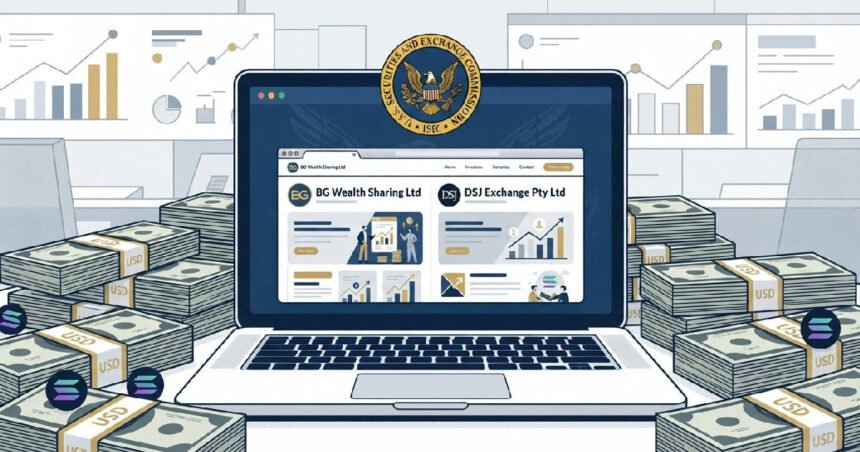
A sophisticated crypto investment fraud that pulled in over $130 million from tens of thousands of investors has been shut down by the U.S. Securities and Exchange Commission (SEC). The scheme, allegedly run by BG Wealth Sharing Ltd and DSJ Exchange Pty Ltd, brazenly used the SEC’s own public website to project a false air of legitimacy and lure victims into its grasp.
Between October 2025 and June 2026, the two entities allegedly defrauded investors across more than 40 U.S. states and several countries, leaving a trail of over $100 million in losses. The operators are now facing a civil lawsuit filed by the regulator in the Northern District of California seeking penalties and the repayment of illicit gains.
Unpacking the crypto investment fraud’s facade of legitimacy
The core of the deception hinged on exploiting the very systems designed to protect investors. The operators of the crypto investment fraud submitted official-looking documents to the SEC, knowing they would become part of the public record. Specifically, BG Wealth Sharing filed a Form ADV to claim status as an “exempt reporting adviser.”
Simultaneously, DSJ Exchange filed a Form D to announce a supposed $100 million securities offering. Once these filings were live on the SEC’s EDGAR database and Investment Adviser Public Disclosure system, the scammers pointed potential victims to the government-hosted records as proof of their legitimacy. This tactic preyed on the common misconception that an SEC filing number equals SEC approval or oversight.
To bolster the illusion, the companies allegedly created and distributed fabricated registration certificates featuring the SEC’s official seal. This gave their claims a veneer of authenticity that was hard for novice investors to question.
The entire operation was a stark contrast to the transparent and secure environment envisioned for a legitimate crypto custody system, instead using public infrastructure as a weapon against the public itself.
The SEC has since removed the fraudulent filings from its websites. The agency’s Office of Investor Education and Assistance has repeatedly issued alerts warning the public that scammers often use these types of filings to appear legitimate, urging investors to use the agency’s own tools to research the background of anyone offering an investment.
The anatomy of a high-tech Ponzi scheme
Behind the fake regulatory credentials was a classic scheme promising impossible returns. Investors were told they could earn at least 60% monthly and double their money within 40 days, all without risk. These claims were attributed to a proprietary artificial intelligence trading technology with a supposed 99.6% accuracy rate.
The operation was fronted by a fictional founder, “Professor” Stephen Beard, who was credited with developing the nearly flawless trading signals. BG Wealth styled itself as the “world’s largest hedge fund” and claimed to partner with DSJ Exchange, which it presented as a secure and licensed crypto trading platform. In reality, the SEC alleges the trading activity was fictitious.
Blockchain analysis revealed the scheme’s true nature. Investigators tracked deposits from over 223,000 blockchain addresses totaling more than $130 million between March and early June 2026. Of that massive sum, no more than $25 million was sent back out to addresses likely belonging to early investors, a hallmark of a Ponzi-like structure where new money pays off old investors.
The scheme was amplified by a multi-level marketing (MLM) engine. Participants were incentivized to recruit new victims through a 12-level system, promising them bonuses, commissions, and “transaction volume dividends.” This created a viral loop that rapidly expanded the scheme’s reach across the globe.
Unraveling the operation’s global reach
The operators used a wide array of modern communication tools to attract and retain their victims. The campaign spanned social media, encrypted messaging channels like Telegram, weekly live videoconferences to maintain engagement, and even a dedicated mobile app that displayed fake account balances and trading profits.
Laura D’Allaird, Chief of the SEC Enforcement Division’s Cyber and Emerging Technologies Unit, highlighted the calculated nature of the operation. “This alleged scheme was well-planned, as evidenced by how many different communications channels the defendants chose to broadcast to their target audiences,” she stated. The consistent engagement was designed to build a sense of community and trust.
D’Allaird further explained how the scammers sustained the illusion of success. “They further sustained the ruse by displaying fake certificates with the SEC’s seal and making periodic payments to certain investors – a Ponzi-like tactic – while misappropriating the remaining funds,” she said.
The widespread nature of such schemes can have ripple effects, sometimes contributing to market volatility similar to the fallout from a major Binance breach crypto selloff, as trust erodes across the sector.
When investors eventually attempted to cash out their supposed profits, they were met with resistance. The companies imposed withdrawal fees as high as 20% and instituted long delays. Ultimately, access was blocked entirely, and the operators demanded additional payments for “taxes” before disappearing and directing users to another defunct platform.
Ignoring a trail of red flags
One of the most audacious aspects of the crypto investment fraud was its persistence in the face of mounting regulatory pressure. Before the SEC filed its charges, the scheme was already on the radar of authorities around the world. At least seven foreign securities regulators had issued public warnings about BG Wealth and DSJ Exchange.
Within the United States, multiple states had also taken action. Authorities in Alaska, Hawaii, Oklahoma, Texas, Utah, Washington, and Wisconsin issued cease-and-desist orders against the companies for violating state securities laws. Yet, the operators continued their fraudulent activities, seemingly undeterred by the increasing scrutiny.
In a particularly bold move, after the Federal Bureau of Investigation (FBI) seized one of BG Wealth’s website domains in April 2026, the purported founder “Professor” Beard blamed the takedown on a “Chinese hacker” and urged investors in a video message to remain calm. This demonstrates a level of impunity and a belief that they could outrun law enforcement.
This trail of ignored warnings underscores the challenges regulators face in policing borderless crypto schemes. Even with public alerts and legal actions in multiple jurisdictions, the operators were able to continue raising funds by simply shifting domains and communication channels.
The SEC’s response and the future of enforcement
With its recent civil lawsuit, the SEC is seeking to permanently bar the entities from operating and to force them to return their unlawfully obtained funds with interest. The regulator has also asked the court to prohibit BG Wealth from ever again trying to submit a Form ADV filing, closing a loophole it exploited.
The case serves as a critical lesson for the industry and investors alike. It highlights a significant vulnerability in how public databases can be misused to create a false sense of security. While the SEC encourages investors to use its resources, it also stresses that a filing is not an endorsement. It is merely a record, and its contents can be false.
For the tens of thousands of victims, the road to recovering their losses will be long and uncertain. The operators are believed to be based abroad, which complicates the process of seizing assets and enforcing U.S. court judgments.
This situation is a stark reminder of the risks inherent in the digital asset space, where promises of high returns often mask fraudulent intentions. The case contrasts sharply with the intended vision for the industry, where legitimate crypto collaborations are meant to foster innovation and growth, not to orchestrate deception on a massive scale.